This article was automatically translated from the original Turkish version.
Kingdom(s) | Animalia (Animals) | ||||||||
|---|---|---|---|---|---|---|---|---|---|
Division | Chordata (Chordates) | ||||||||
Class | Mammalia (Mammals) | ||||||||
Team(s) | Carnivora (Carnivores) | ||||||||
Family | Ursidae (Bears) | ||||||||
Genus | Helarctos (Sun Bear) | ||||||||
Specie(s) | H. malayanus | ||||||||
IUCN Red List | Vulnerable | ||||||||
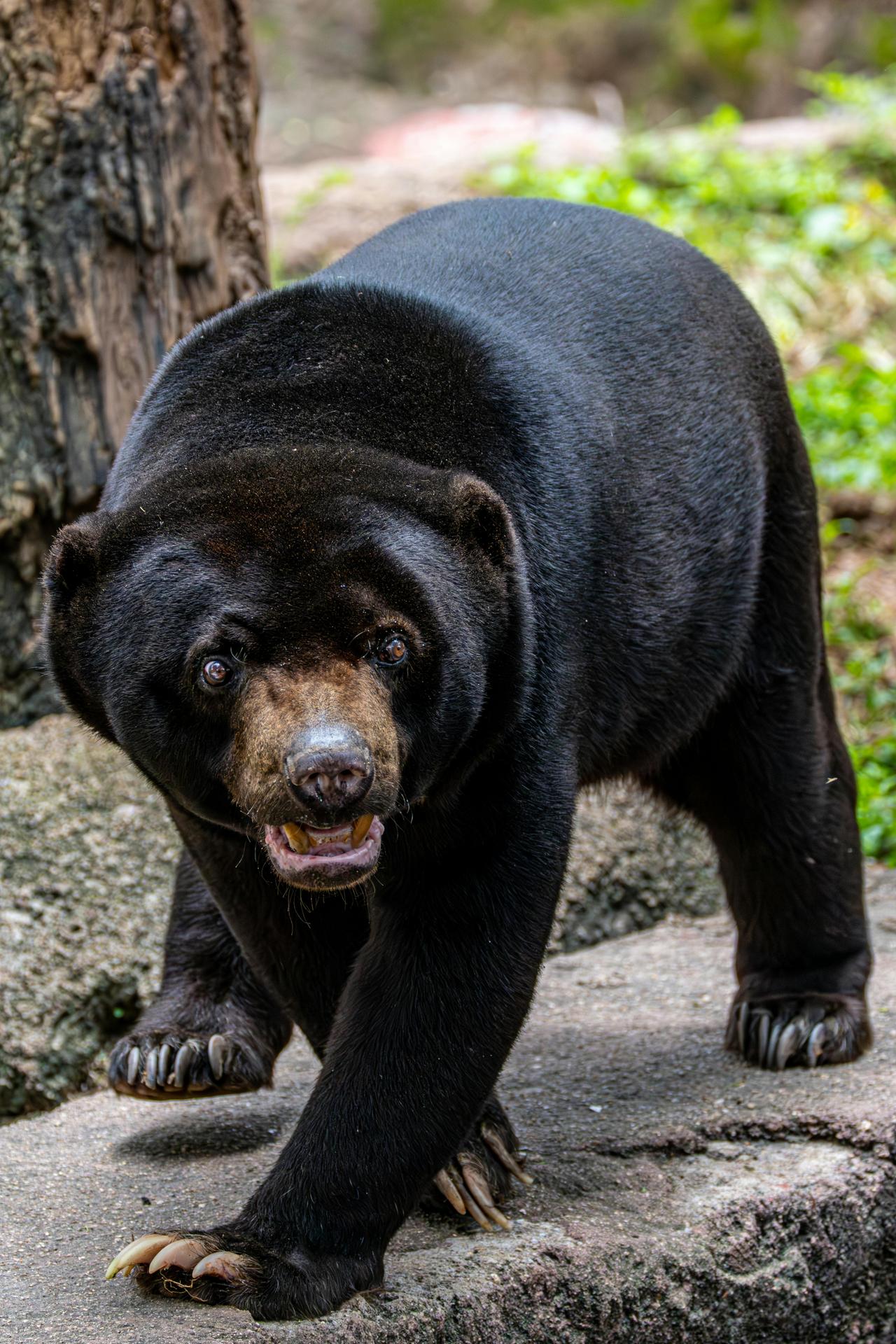
Sun bear, scientifically known as Helarctos malayanus, is a bear species native to the tropical forests of Southeast Asia and the smallest member of the family Ursidae. It is characterized by its small size, long tongue, powerful jaws, and distinctive chest marking. In classification, it belongs to the Kingdom Animalia, Phylum Chordata, Subphylum Vertebrata, Class Mammalia, Order Carnivora, and Family Ursidae. Two subspecies have been identified: the Bornean sun bear (H. m. euryspilus) and the Malayan sun bear (H. m. malayanus).
The sun bear has a wide geographic range extending from the eastern Himalayas through China’s Sichuan province southward to Burma, parts of Indochina, and the Malay Peninsula. These bears inhabit dense lowland tropical forests and spend a large portion of their lives in trees. They prefer to build nests 2 to 7 meters above ground for resting or basking during the day; due to this arboreal lifestyle, they are known in Malay as basindo nan tenggil, meaning “one who likes to sit high up.”
Sun bears are about half the size of an American black bear and are the smallest members of the bear family. Their shoulder height is approximately 70 cm, and their body length from head to tail ranges from 1.2 to 1.5 meters. Males are only 10 to 20 percent larger than females.
Their fur is short, stiff, and glossy, typically dark brown or black. This thick and dense coat provides protection against the challenges of the tropical climate and dense vegetation. Their distinguishing feature is a crescent-shaped, pale yellow or white patch on the chest, unique to each individual like a fingerprint.
Sun bears are well adapted to an arboreal lifestyle. Their large, curved claws and hairless soles make them excellent climbers. Their strong jaws and teeth enable them to break open trees and crack hard-shelled foods. They possess the longest tongue of any bear species, a critical adaptation for reaching honey and insects inside tree hollows. Loose skin on their bodies serves as a defensive mechanism, allowing them to turn and bite when grabbed by predators. Their gait is distinctive, with all four feet turned inward.
Sun bears are nocturnal and active at night, resting during the day. Due to their tropical habitat and the year-round availability of food, they do not hibernate.
Sun bears have no specific breeding season; females are the only known bear species capable of mating multiple times per year. Gestation lasts between 95 and 240 days due to delayed implantation. Typically, one or two cubs are born. Newborns are blind, hairless, and helpless. Cubs remain with their mother until they reach sexual maturity at around three years of age. In captivity, they have been recorded to live over 24 years.
Ecosystem Roles: Sun bears play a vital role as seed dispersers by excreting the seeds of fruits they consume. They also contribute to ecosystem balance by regulating insect populations, particularly termites and bee colonies.
Sun bears are one of the rarest bear species and are listed as Vulnerable on the International Union for Conservation of Nature (IUCN) Red List. Their population is estimated to have declined by more than 30 percent over the past 30 years. Their inclusion on CITES (Convention on International Trade in Endangered Species of Wild Fauna and Flora) Appendix I prohibits international trade.
Primary Threats include habitat loss due to intensive deforestation for coffee, rubber, and especially oil palm plantations. Other significant threats are illegal hunting for their meat, bile used in traditional medicine, and the pet trade, as well as human-wildlife conflict arising from crop damage. Limited knowledge about this species hinders the development of effective conservation strategies.
Myers, Phil. "Helarctos malayanus (sun bear)." *Animal Diversity Web. University of Michigan Museum of Zoology.* Accessed October 21, 2025. https://animaldiversity.org/accounts/Helarctos_malayanus/
Pexels. "34234765 Numaralı Stok Fotoğraf." Accessed October 21, 2025. https://www.pexels.com/tr-tr/fotograf/34234765/.
San Diego Zoo Wildlife Alliance. "Sun Bear." *San Diego Zoo Animals & Plants*. Accessed October 21, 2025. https://animals.sandiegozoo.org/animals/sun-bear.

Kingdom(s) | Animalia (Animals) | ||||||||
|---|---|---|---|---|---|---|---|---|---|
Division | Chordata (Chordates) | ||||||||
Class | Mammalia (Mammals) | ||||||||
Team(s) | Carnivora (Carnivores) | ||||||||
Family | Ursidae (Bears) | ||||||||
Genus | Helarctos (Sun Bear) | ||||||||
Specie(s) | H. malayanus | ||||||||
IUCN Red List | Vulnerable | ||||||||
No Discussion Added Yet
Start discussion for "Sun Bear (Helarctos malayanus)" article
Geographic Range and Habitat
Physical Characteristics
Behavior, Communication, and Diet
Reproduction and Ecology
Conservation Status and Threats