


This article was automatically translated from the original Turkish version.
+1 More
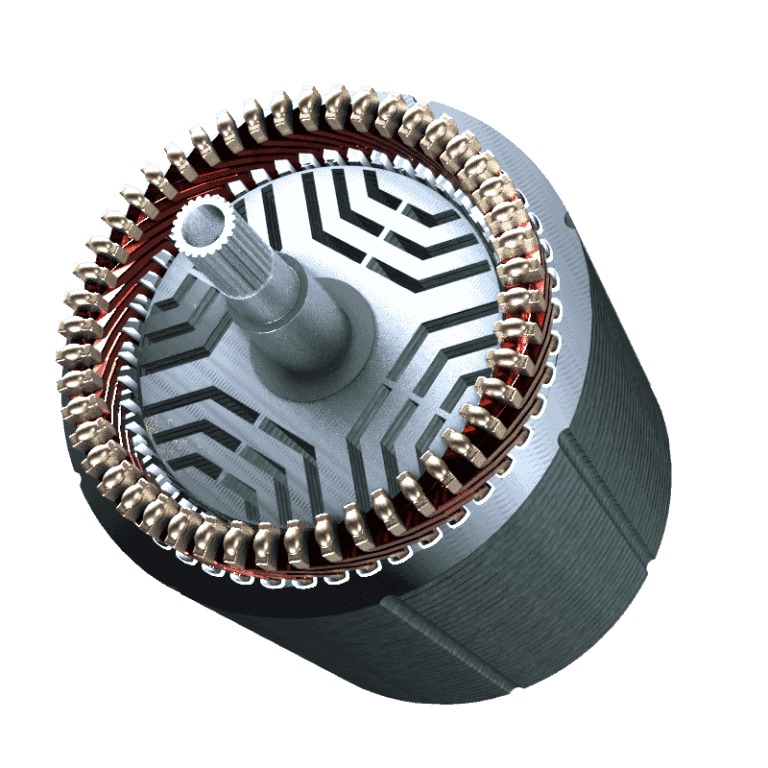
Synchronous reluctance motors (SynRM) are electric machines that generate torque through reluctance torque and operate on AC power. Unlike other electric machines, they do not have windings on their rotors (rotating part); instead, torque is produced based on the design of flux barriers within the rotor. Motor performance can be enhanced by adding permanent magnets to the rotor.

Synchronous Reluctance Motor Structure - Oswos
SynRMs are polyphase alternating current machines. Their stator (stationary part) structure is similar to that of other AC motors, but their rotor designs are more distinct and complex.
To maximize the torque produced by SynRMs, various rotor designs have been developed, including axial (ALA) and transverse (TLA) laminations.

Synchronous Reluctance Motor Components -
The stator, like in other polyphase AC machines, consists of multiple phase windings placed in slots cut along the stator axis.
The rotor of SynRMs features a unique design known as flux barriers, which generate torque and distinguish SynRMs from other AC motors. According to this design, the saliency ratio is defined as the ratio of magnetic flux density along the d-axis to that along the q-axis in the rotor coordinate system. To maximize the torque produced by the motor, the saliency ratio must be increased; therefore, rotor flux barrier designs are implemented in SynRMs.
The primary source of torque in SynRMs is reluctance torque. Reluctance is a magnetic resistance that opposes the flow of magnetic flux in a magnetic circuit. It is obtained by dividing the magnetomotive force by the flux. Reluctance torque arises due to differences in reluctance values along different axes of a ferromagnetic material. In a motor within a magnetic field, the rotor rotates so that its d-axis, where reluctance is low and inductance is high and magnetic flux flows easily, aligns with the magnetic field to minimize the magnetic flux path. This alignment generates reluctance torque.

Synchronous Reluctance Motor Flux Barriers - DergiPark
SynRMs are powered by balanced polyphase (typically three-phase) AC voltage, creating a rotating magnetic field in the air gap between the stator and rotor at synchronous speed. The resulting magnetic flux follows the path of least reluctance along the d-axis of the rotor, where inductance is high and reluctance is low, causing the rotor to rotate at synchronous speed.

Synchronous Reluctance Motor Operation Demonstration - ELIN Motors
As the magnetic flux completes its path along the d-axis, the magnetic field in the windings continuously changes, causing the d-axis to continuously attempt to align with the rotating magnetic field, thereby initiating synchronous rotation of the motor. The reluctance torque produced by the SynRM depends on the inductance values along the d-axis and q-axis, and thus on the saliency ratio. To maximize torque, the saliency ratio must be increased, as this parameter is central to machine design and optimization. To achieve maximum torque, the d-axis inductance (Ld) should be as high as possible, while the q-axis inductance (Lq) should be reduced to the lowest possible value.
SynRMs are generally driven by variable frequency inverters. Early designs included short-circuited cage structures on the rotor to assist with motor starting. However, these structures negatively affected the saliency ratio responsible for torque production and are therefore rarely used today. Currently, inverter systems control both the motor’s starting phase and its nominal operation, maintaining constant power and constant torque regions.

Sample Control Scheme for Synchronous Reluctance Motor - Veichi
Generally, maximum torque per ampere (MTPA) control strategy is employed. Under this strategy, the electrical angle between the current vector and the d-axis is held constant at 45° to produce maximum torque under varying speed and load conditions. Implementation of this control structure requires knowledge of rotor position and speed. The current, speed, and position data obtained from the motor are processed through mathematical calculations to determine the required reference d-axis and q-axis currents. Based on these calculations, the polyphase AC power supplied to the motor stator is controlled using various semiconductor devices.
Due to their structural simplicity, robust construction, and ability to operate at constant speed, SynRMs are used in various applications including electric vehicles, HVAC systems, industrial automation, compressors, pumps, renewable energy generation, and household appliances.

Sample Representation of Synchronous Reluctance Motor - ABB

No Discussion Added Yet
Start discussion for "Synchronous Reluctance Motor" article
General Construction
Operating Principle
Motor Control
Advantages
Disadvantages
Applications