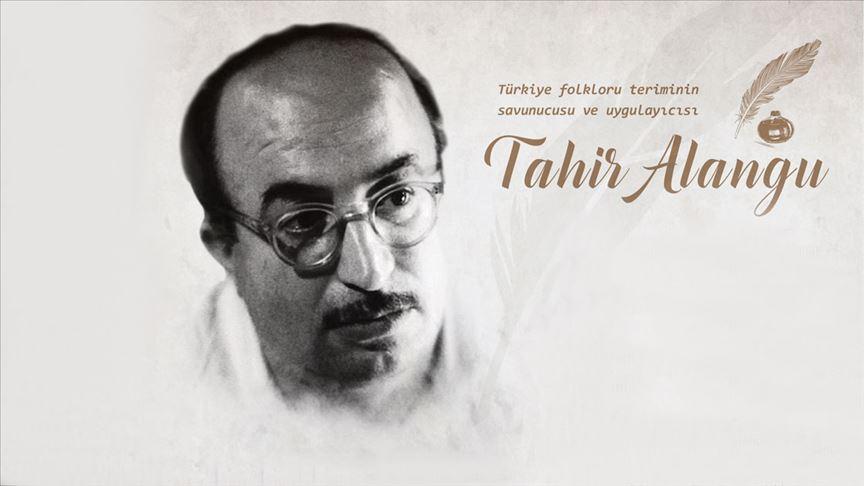

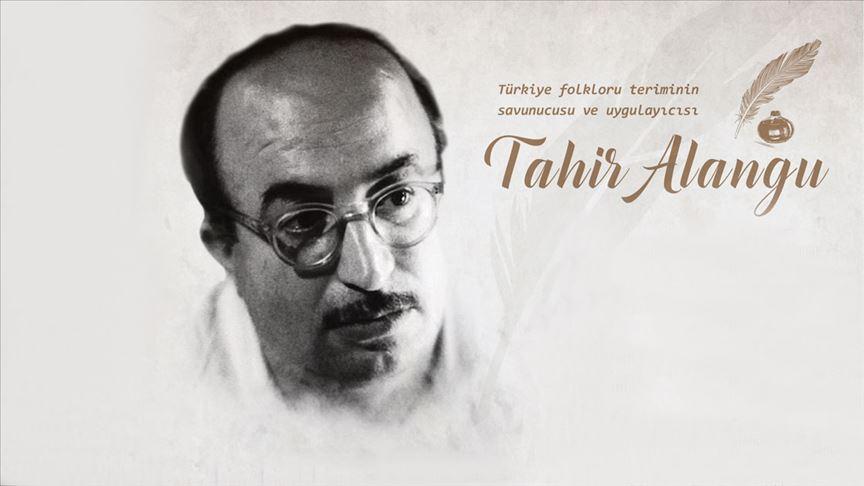

Tahir Alangu was born in Istanbul in 1915. When the Surname Law was enacted, he chose the surname Alangu/Alango, derived from an old Turkish legend meaning "spotted deer." His father, Muhtar Nâzım Bey, was a naval officer, and his mother, Kâmile Hanım, was a homemaker who had graduated from a secondary school; he had a brother named Kerim. In 1947 he married Mesude Arcıl, and from this marriage two daughters were born: Başak in 1948 and Şadan in 1955.
He completed the last two years of primary school in Anamur district of Mersin, where his father was stationed. The folktales he heard during childhood in Anamur shaped his interest in folklore. He graduated from Kabataş High School in Istanbul as a boarding student. In 1943 he graduated from the Department of Turkish Language and Literature at Istanbul University’s Faculty of Letters. His graduation thesis, supervised by Professor Dr. Ahmet Caferoğlu, was titled “The Internal Structure and Heroes of Turkish Folktales.”
He fulfilled his military service as a literature teacher at military high schools in Denizli, Çanakkale, Bursa and Maltepe. After military service, he taught literature at Yozgat High School, Kepirtepe and Ortaklar Village Institutes, Van (1950–1952), Erzincan (1952–1955), and Çarşamba Imam Hatip School in Istanbul (1955–1959), as well as at Pertevniyal High School (1959–1964), Galatasaray High School (1964–1973), and the English High School for Boys. Additionally, he taught theater history at the Journalism Higher School, and folklore courses at Robert College and Boğaziçi University (1969–1973).
Tahir Alangu (1915–1973) was a distinguished literary scholar, teacher and folklorist known for his high-quality contributions to Turkish literature and folklore. His innovative approaches in folklore, particularly his dynamic and sociological perspective on folk literature, made him one of the leading figures of his time. He produced work across a broad spectrum—from folktales to epics, from modern storytelling to translations—and left a lasting mark through both scholarly and artistic endeavors.
Alangu is particularly known for his studies on folklore, folktales and the short story genre. His approach, which integrated modern literature with folk culture, elevated him beyond the role of an ordinary folklorist to that of an interpreter and cultural analyst.
Distinction Between Static and Dynamic Folklore: Alangu divided Turkish folklore into “static” and “dynamic” categories. He criticized the static understanding of folklore and argued that folk culture is in constant flux, emphasizing that folklore evolves alongside the lives of the people.
The Educational Role of Folklore: He asserted that folklore plays a vital role in national education and that the foundation of national literature must be rooted in folk culture. According to him, a literature that does not draw from folk culture cannot be universal. Alangu preferred the term “Turkish folklore” to “Turkey folklore,” advocating for the existence of an original folklore shaped by the contributions of the diverse cultures living on these lands.
AA. Alangu, Tahir. “Türkiye Folkloru Teriminin Savunucusu ve Uygulayıcısı Tahir Alangu.” Accessed July 11, https://www.aa.com.tr/tr/kultur-sanat/turkiye-folkloru-teriminin-savunucusu-ve-uygulayicisi-tahir-alangu/1881287.
Dursun, Aysun. “Alangu, Tahir.” Türk Edebiyatı İsimler Sözlüğü (TEİS). Accessed July 11, 2025. https://teis.yesevi.edu.tr/madde-detay/alangu-tahir.
Görkem, İsmail. “Tahir Alangu’nun Folklor Anlayışı.” Türkoloji Araştırmaları Dergisi. Accessed July 11, 2025. https://turkoloji.cu.edu.tr/HALKBILIM/gorkem_09.pdf
Ministry of Culture and Tourism. "Alangu, Tahir." Republic of Turkey Ministry of Culture and Tourism, Accessed July 11, 2025. https://www.ktb.gov.tr/EN-118157/alangu-tahir.html.

Education and Career
Contributions to Folklore and Literature
Works
Studies and Research
Compilation and Anthology
Monograph and Biography
Translations