


This article was automatically translated from the original Turkish version.
+1 More
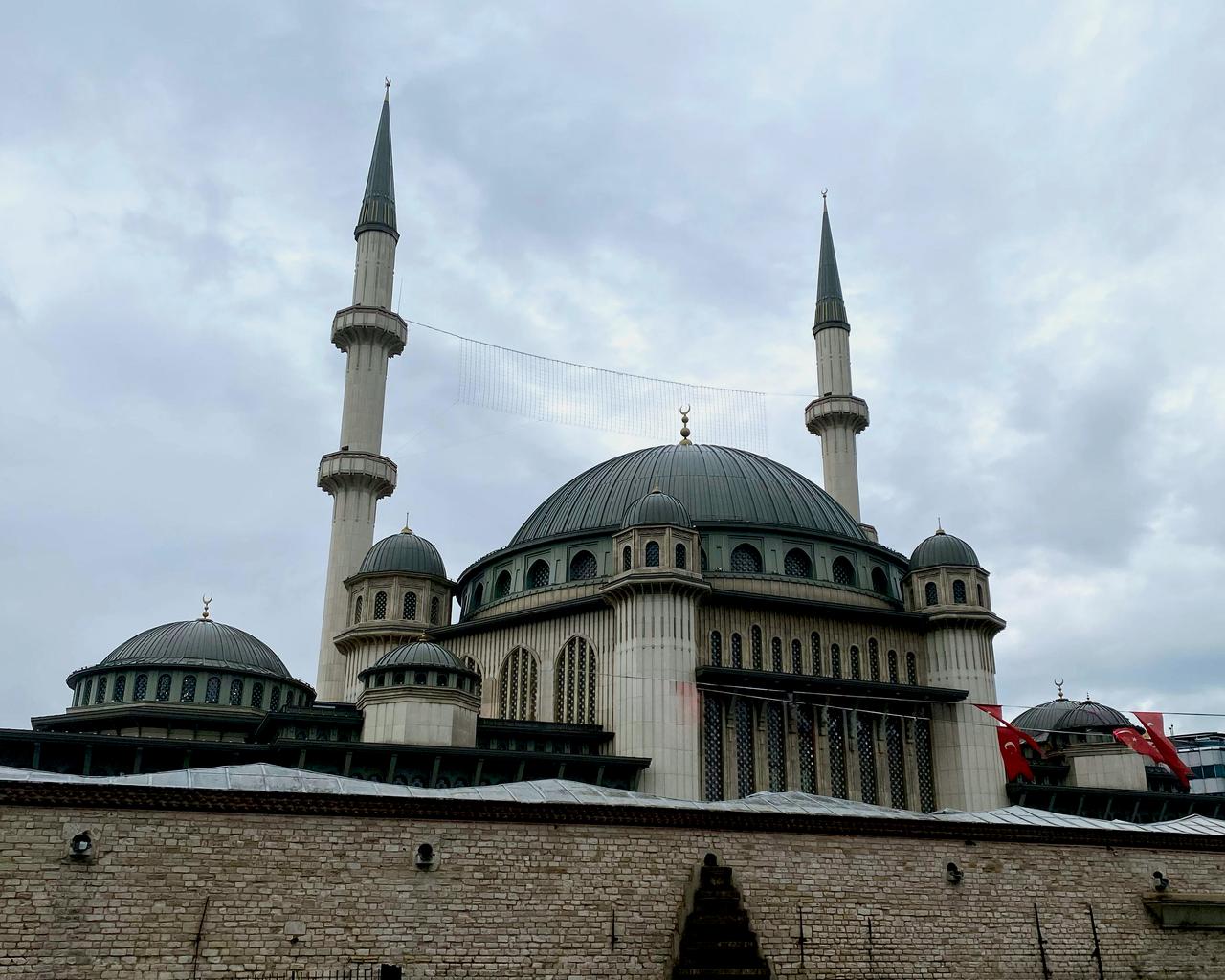
Taksim Mosque
Location | Taksim Square - Beyoğlu / Türkiye | ||||||||
|---|---|---|---|---|---|---|---|---|---|
Start Date | 17 February 2017 | ||||||||
End Date | 28 May 2021 | ||||||||
Architect(s) | Şefik Birkiye Selim Dalaman | ||||||||
Architectural Style(s) | Seljuk Anatolian Ottoman | ||||||||
Social Areas | Bookstore Café Kitchen Multipurpose Hall | ||||||||
Founder and Completion Builder | Sur Yapı | ||||||||
Calligraphers | Nakkaş Adem Turan Davut Bektaş | ||||||||
Dome Diameter | 24.5 Metre | ||||||||
Dome Height | 33 Metre | ||||||||
Number of Minarets | 2 Şerefiyeli | ||||||||
Minaret Height | 64.8 Metre | ||||||||
Taksim Mosque is situated as a symbol within Istanbul’s historical and cultural fabric important. A structure was built on the square where water from the Ormanı stream during the reign of Mahmud II Belgrade was channeled source and distributed taksim to the public maksem. The resulting maksem transformed Taksim Square into a public center. The mosque planned for Taksim Square has occupied a central place not only as a place of worship but also in decades-long social and political debates long. The history of Taksim Mosque has evolved in parallel with Istanbul’s transformation process. After the construction over four centuries ago of the Hüseyin Ağa Mosque, which stood relatively distant from the square, the gradual decay of a mosque located within the Taksim Topçu Barracks, built in the early 19th century for the Ottoman army’s artillery corps, created a need for a new place of worship in Taksim.
In the 1930s, within the framework of the urban planning work carried out by French planner Henri Prost, the area where the barracks stood was reorganized as a green area and the space now known as Gezi Park region was created. Initial concrete steps regarding the Taksim Mosque were taken from the 1950s onward but were postponed due to political conditions. The 1980 coup halted official steps toward mosque construction, while in the 1990s Prime Minister Necmettin Erbakan and Istanbul Metropolitan Municipality Mayor Recep Tayyip Erdoğan brought the issue back to the agenda. Due to political developments, construction was again delayed; the Taksim Mosque re-entered public discourse following the failure of the 15 July 2016 coup attempt, when President Recep Tayyip Erdoğan stated, “Our project is ready. God willing, we will also build the Taksim Mosque.”【1】
After the mosque was reopened for worship in 2020, its completion in 2021 was viewed as part of a similar process to the conversion of Hagia Sophia back into a mosque.【2】

Exterior of Taksim Mosque, Photo: Duhan Küçük
The Taksim Topçu Barracks is one of the structures built during the Ottoman army’s modernization process. Constructed during the reign of Selim III (1806), this military complex was designed for the artillery corps of the kapıkulu troops and marked the northern boundary of the Taksim region.
Inside the barracks stood a mosque named Selim Câmi-i Şerifi. It was common practice in the Ottoman Empire for military barracks to include a place of worship. The mosque within the Taksim Topçu Barracks was a domed structure with a single minaret, a pulpit, and a hünkâr gallery. In 1808, its religious services were secured through its endowment to Mihrişah Valide Sultan, mother of Selim III. Shortly after the barracks became operational, the mosque suffered heavy damage during the Kabakçı Mustafa Revolt in 1808.【3】
In 1812, under the direction of the chief architect Hafız Mehmed Emin Ağa, the Taksim Topçu Barracks were rebuilt. After the armistice, the complex was occupied for a period by Senegalese troops and became known as Makmohan Barracks. After the Senegalese troops departed, White Russians who had fled the Russian Revolution and arrived in Istanbul held barracks races in its courtyard. Over time, football matches were also held there.

Taksim Topçu Barracks (Encyclopedia of Istanbul)
The Taksim Topçu Barracks suffered extensive damage during the 31 March Incident, one of the largest political crises in Ottoman history. The 31 March Incident (13 April 1909) began as a revolt against the Committee of Union and Progress government during the reign of Abdulhamid II and spread to various parts of Istanbul. Soldiers stationed at the Taksim Topçu Barracks resisted the Hareket Army sent to suppress the uprising. However, on 26 April 1909, the Hareket Army bombarded the barracks, neutralizing the rebels.【4】
With the permission of Mustafa Kemal Atatürk, the Republic Monument was erected in Taksim Square in 1928 by Italian sculptor Pietro Canonica.【5】

Portraits on the monument (Arkeopolis)
In 1936, Henri Prost came to Istanbul at Atatürk’s invitation and began work to give the city a secular and laic appearance. The study published by the Chamber of City Planners states that certain buildings were deliberately demolished to highlight others, and these demolitions were carried out under laws proposed by Prost and approved by parliament.【6】
İshakoğlu, founder of İshakol Paint and the first producer of branded paint in Türkiye, established the Association for the Construction and Preservation of Taksim Mosque and Külliye in the 1970s with community support.【7】
Immediately after the 12 September military coup, construction procedures for the Taksim Mosque were suspended. Due to political tensions, the Taksim Mosque project was delayed and attempted to be canceled, but it re-emerged on the agenda on 5 November 1991 with the establishment of the Taksim Mosque Culture and Art Foundation. The foundation’s board included Recep Tayyip Erdoğan, Vehbi Ram, Rahmi Koç, Sabri Ülker, Sakıp Sabancı, Semiha Şakir, Şarık Tara, Osman Boyner, among others.【8】
Following Recep Tayyip Erdoğan’s election as Mayor of Istanbul Metropolitan Municipality in 1997, the construction of Taksim Camii, which had been approved by the municipality, gained momentum. The Chamber of Architects, the Chamber of Civil Engineers, the Istanbul Pharmacists’ Chamber, the Association for the Support of Contemporary Life, the Association of Archaeologists and Archaeology, the Association for the Protection of Historical Houses of Türkiye, the Esentepe Environment Protection Association, the Ayaspaşa Association, the ÇEKÜL Foundation, the Türkiye Environmental and Greening Organization, and the Istanbul Bar Association submitted objections to the relevant institutions. Recep Tayyip Erdoğan announced a groundbreaking date for Taksim Camii, but the project was suspended due to the events of 28 February. In 2013, during the Gezi Park protests, Taksim Camii and Topçu Kışlası reemerged on the public agenda, yet no concrete action was taken.【9】
Following the failed coup attempt of 15 July 2016, President Recep Tayyip Erdoğan, speaking from Kısıklı ring, declared, “Our project is ready. God willing, we will also build Taksim Camii.” In 2017, the foundation of Taksim Camii was laid and construction began. The construction, which lasted approximately four years, was completed and the mosque opened on the last Friday of May 2021 Ramadan.【10】

Recep Tayyip Erdoğan at the opening of Taksim Camii (Taksim Camii)
Taksim Camii is situated on a plot of 2,482 square meters in Taksim Square and has a total enclosed construction area of approximately 16,000 square meters. The façades feature stone and precast cladding, while the domes are constructed using titanium-zinc alloy. During construction, the “Top-Down” method was employed, allowing excavation and superstructure works to proceed simultaneously. This approach minimized disruption to surrounding buildings, roads, and daily life while accelerating the construction process.

Image: Duhan Küçük
The architectural design incorporates lines inspired by 19th-century Beyoğlu architecture, adapting traditional mosque forms to contemporary sensibilities. The mosque is distinguished by two minarets with balconies: one standing approximately 33 meters tall and the other 64.80 meters tall. The building materials and design integrate classical elements with a modern aesthetic. The interior prayer hall is planned to accommodate up to 4,000 worshippers simultaneously. In addition to a 465-square-meter section designated for women, an additional 2,950 square meters of space is available for prayer.【11】

Image: Duhan Küçük
Bodrum and ground-floor levels include multipurpose halls, exhibition spaces, library and a soup kitchen, serving as social and cultural spaces. Thus, the mosque is designed not merely as a place of worship but also as a digital library and community hub for artistic activities. To harmonize with its surroundings, entrances are strategically oriented toward Taksim Square, İstiklal Avenue, and Talimhane to regulate pedestrian traffic flow.
A covered parking facility with space for 163 vehicles meets the parking demand. During construction, approximately 7,500 meters of fore pile, 3,000 tons of reinforced concrete steel, and 20,500 cubic meters of concrete were used. A precast cladding covering 1,300 square meters was applied to the façades, and the structural steel assembly weighed 310 tons.【12】
The interior decoration of Taksim Camii reflects traditional Turkish-Islamic art through a contemporary lens. The interior of the main dome features extensive use of hat art inspired by the Ottoman and Seljuk periods. The center of the main dome contains the Fatiha Sura, while verses from the Al-i İmran Sura are inscribed on the drum. The middle band of the dome includes verses 285 and 286 of the Baqara Sura and verses 20 to 24 of the Haşr Sura.

Image: Duhan Küçük
The entrance dome features the Ikhlas Sura and Ayet’el Kürsi. Above the main entrance, the concluding portion of verse 103 of the Nisa Sura is inscribed, while verse 24 of the Ra’d Sura is displayed above the entrance on İstiklal Avenue. These details enhance not only the spiritual atmosphere offered to worshippers but also the aesthetic and artistic value of the mosque.

Image: Duhan Küçük
Anadolu Ajansı. “Taksim'e yapılan cami kılınan cuma namazıyla ibadete açıldı.” Accessed February 24, 2025. https://www.aa.com.tr/tr/turkiye/taksime-yapilan-cami-kilinan-cuma-namaziyla-ibadete-acildi/2257073
Arzu, Cihangir. *Bir Mabedin Varoluş Mücadelesi Taksim Camii Basından İktibaslar*. Accessed February 24, 2025. https://www.academia.edu/102168232/Taksim_Camii_Kitabı
Birge, Yıldırım, Arzu, Erdem. "Taksim Meydanı’nın Cumhuriyet'in Kamusal Alanı Olarak İnşası." Tasarım + Kuram Mimar Sinan Güzel Sanatlar Üniversitesi Mimarlık Fakültesi Dergisi, p. 19, May 2015. Accessed February 24, 2025. https://dergipark.org.tr/tr/download/article-file/208048
Cengiz, Türksoy. “Planlama.” *Planlama Dergisi* 93/1-4. TMMOB Şehir Plancıları Odası Yayını. Accessed February 24, 2025. https://www.spo.org.tr/resimler/ekler/3c3bce66e43be4f_ek.pdf
Gur, Faik. “Sculpting the nation in early republican Turkey.” *Historical Research.* vol. 86, no. 232 (May 2013). Accessed February 24, 2025. https://onlinelibrary.wiley.com/doi/full/10.1111/1468-2281.12000
Habertürk. "Cumhurbaşkanı Erdoğan Kısıklı'daki evinin önünde halka seslendi." Habertürk Resmi YouTube Kanalı. Accessed February 24, 2025. https://www.youtube.com/watch?v=RLKxLShNv10&t=1499s
Handan, Keskin. *İstanbul’un Kimliği ve Planlama.* PhD thesis, İstanbul Üniversitesi, 2014.
Kadir Has University. "Costantinopoli. Partenza di Antiglieria e Cavalleria per Varna dalla caserma Al-Takım." Coupé with engraved image [JPG]. *İstanbul Ansiklopedisi*. Accessed February 24, 2025. https://istanbulansiklopedisi.org/salt/entries.jsp
Kadir Has Üniversitesi. "CANONİCA (Pietro)." *İstanbul Ansiklopedisi*. Accessed February 24, 2025. https://istanbulansiklopedisi.org/handle/rek/7692
Kalkan, Aygün. “Anıtın Tarihçesi.” ArkeoPolis. Accessed February 24, 2025. https://arkeopolis.com/taksim-cumhuriyet-aniti-tarihcesi-ve-heykellerin-hikayesi/
Kazım, Çeçen. “Maksem.” TDV İslam Ansiklopedisi. Accessed February 24, 2025. https://islamansiklopedisi.org.tr/maksem
Necdet, Evliyagil. “Taksimde büyük bir cami yapılacak.” *İstanbul Ansiklopedisi*. Accessed February 24, 2025. https://istanbulansiklopedisi.org/salt/entries.jsp
TVNET. “160 yıllık 'gözde' proje: Taksim Cami nasıl hayata geçirildi?” TVNET Resmi YouTube Kanalı. Accessed February 24, 2025. https://www.youtube.com/watch?v=JEkxnnSyMTY&t=366s
Taksim Mosque. "Taksim Camii Tarihçesi." Accessed February 24, 2025. https://taksimcamii.com.tr/hakkimizdataksim-camii-tarihcesi-2.html
Taksim Mosque. "Taksim Camii İbadete Açıldı." Accessed February 24, 2025. https://www.taksimcamii.com.tr/haber-detay-taksim-camii-ibadete-acildi-3.html
[1]
[2]
[3]
[4]
[5]
[6]
Handan Keskin, “The Identity and Planning of Istanbul” (Ph.D. Thesis, Istanbul University, 2014), pp. 158–159.
In Prost’s statements, Istanbul was considered archaeologically valuable only for its ancient and Byzantine periods. The recurring concept of “open spaces” in his reports refers to a planning approach encompassing parks, promenades,
[7]
[8]
[9]
[10]
[11]
[12]
Taksim Mosque
Location | Taksim Square - Beyoğlu / Türkiye | ||||||||
|---|---|---|---|---|---|---|---|---|---|
Start Date | 17 February 2017 | ||||||||
End Date | 28 May 2021 | ||||||||
Architect(s) | Şefik Birkiye Selim Dalaman | ||||||||
Architectural Style(s) | Seljuk Anatolian Ottoman | ||||||||
Social Areas | Bookstore Café Kitchen Multipurpose Hall | ||||||||
Founder and Completion Builder | Sur Yapı | ||||||||
Calligraphers | Nakkaş Adem Turan Davut Bektaş | ||||||||
Dome Diameter | 24.5 Metre | ||||||||
Dome Height | 33 Metre | ||||||||
Number of Minarets | 2 Şerefiyeli | ||||||||
Minaret Height | 64.8 Metre | ||||||||
History
First Place of Worship
Period After the Proclamation of the Republic
Demolition of Historical Structures
After Urban Reorganization
Architectural Features
Artistic and Decorative Features
Religious Personnel