


This article was automatically translated from the original Turkish version.
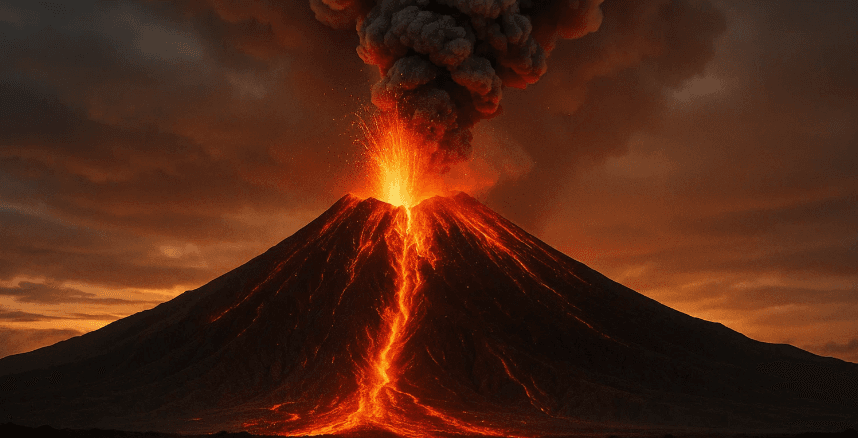
Generated with Visual Artificial Intelligence.
Big Bang Theory | April 1815 | ||||||||
|---|---|---|---|---|---|---|---|---|---|
Location | Indonesia Sumbawa Island | ||||||||
Volcano Type | Stratovolcano | ||||||||
Explosion Intensity | Volcanic Explosivity Index (VEI) 7 | ||||||||
Elevation (Before 1815) | Approximately 4,300 m | ||||||||
Elevation (After 1815) | Approximately 2,850 m | ||||||||
Tambora Volcano is a stratovolcano located on Sumbawa Island in Indonesia. The massive eruption that occurred in 1815 is regarded as one of the most destructive volcanic events in modern history. The eruption caused climatic changes not only across Indonesia but on a global scale, and the event is remembered in world history as the “year without a summer.” The eruption directly or indirectly led to the deaths of approximately 71,000 people and triggered widespread agricultural crises across a vast geographic area.
Before 1815, Tambora Volcano had been in a period of relative inactivity despite being an active volcano. However, increased seismic activity beginning in 1812 signaled the approach of a major eruption. The eruption began on 5 April 1815 and reached its peak on 10 April. The explosions during this period were so violent that their sounds were heard up to 2,000 kilometers away and generated seismic-like shaking on nearby islands. According to historical records, Tambora’s height before the eruption was approximately 4,300 meters; after the eruption, the summit collapsed to 2,850 meters, forming a large caldera.
During the main eruption in April 1815, volcanic ash clouds rose to a height of 43 kilometers. The dense ash and gases released into the atmosphere were the primary cause of widespread climatic effects. Pyroclastic flows that reached the sea generated massive tsunamis, causing additional destruction along coastal regions. The intensity of the eruption was measured at level 7 on the Volcanic Explosivity Index (VEI), one of the highest values ever recorded in history.
One of the most significant consequences of the Tambora eruption was its impact on the global climate. Sulfate aerosols and volcanic gases dispersed into the atmosphere greatly reduced the amount of sunlight reaching the Earth’s surface. As a result, the year 1816 became known as the “year without a summer.” Temperatures in Europe and North America dropped significantly below average, leading to a sharp decline in agricultural production and widespread famines. Severe food crises emerged in regions such as New England, China, and India, resulting in increased mortality from starvation and disease.
The eruption directly and indirectly caused the deaths of tens of thousands of people. Approximately 10,000 people perished on Sumbawa and its surrounding areas during and immediately after the eruption. However, the most devastating impact stemmed from the burial of farmland under ash and lava, contamination of drinking water sources, and the emergence of long-term famine conditions. This pushed the total death toll to approximately 71,000. In addition, migration movements, the breakdown of social structures, and economic losses were among the long-term effects of the eruption.
Tambora Volcano remains an active volcano today, with approximately 1.2 million people living in its vicinity. A potential future large-scale eruption would pose a significant risk not only to Indonesia but also to global climate stability. As a result, the region is continuously monitored through geological observations and is the subject of international scientific research. Tambora also serves as a critical case study for research in climate history, disaster management, and global environmental change.
Akın, Galip. 2006. “Küresel Isınma, Nedenleri ve Sonuçları.” *Ankara Üniversitesi Dil ve Tarih-Coğrafya Fakültesi Dergisi* 46, no. 2: 29–43. Accessed September 26, 2025. https://dergipark.org.tr/en/download/article-file/2153271.
Anadolu Ajansı. “Endonezya’da 1,2 Milyon Kişi Patlama Riski Olan Yanardağ Çevresinde Yaşıyor.” *AA*, December 7, 2020. Accessed September 26, 2025. https://www.aa.com.tr/tr/dunya/endonezya-da-1-2-milyon-kisi-patlama-riski-olan-yanardag-cevresinde-yasiyor/2050074.
Ekici, Taner. 2023. “Yeryüzündeki Volkanik Aktivitenin Dağılımı ve Türkiye’den Örnekler.” *Journal of Science and Technology* 2, no. 1: 5–15. Accessed September 26, 2025. https://dergipark.org.tr/en/download/article-file/2979059.
Kozan, Mert. “İS 535-537 Yılları Arasında Ortaçağ’da Gelişen İklim Değişikliğinin Kuzey Yarımküre Üzerindeki Etkisi: Güneşin On Sekiz Ay Boyunca Etkisini Azaltması ve Yaşanan Soğumanın Tarihsel Yansımaları.” *TAD* Volume 37, no. 64 (2018): 207–226. Accessed September 26, 2025. https://dergipark.org.tr/tr/download/article-file/780832.

Generated with Visual Artificial Intelligence.
Big Bang Theory | April 1815 | ||||||||
|---|---|---|---|---|---|---|---|---|---|
Location | Indonesia Sumbawa Island | ||||||||
Volcano Type | Stratovolcano | ||||||||
Explosion Intensity | Volcanic Explosivity Index (VEI) 7 | ||||||||
Elevation (Before 1815) | Approximately 4,300 m | ||||||||
Elevation (After 1815) | Approximately 2,850 m | ||||||||
No Discussion Added Yet
Start discussion for "Tambora Volcanic Eruption" article
Historical Background
Development of the Eruption
Global Climatic Effects
Social and Demographic Consequences
Current Risks and Significance