


This article was automatically translated from the original Turkish version.
+1 More
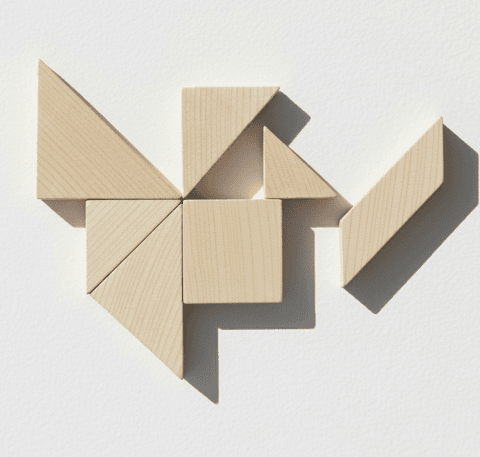
Tangram
(Generated by Artificial Intelligence.)
Varieties | T tangram (4-piece model) Heart tangram (9-piece model) Zero tangram (8-piece model) Egg tangram (9-piece model) Square tangram (7-piece classic model) | ||||||||
|---|---|---|---|---|---|---|---|---|---|
Area(s) of Use | Development of creativity and imagination Support for language and communication skills Psychopedagogical assessments and educational game activities Enhancement of logical reasoning and problem-solving skills Development of spatial intelligence and visual perception Mathematics and geometry instruction | ||||||||
Tangram is a cognitive and visual perception puzzle composed of seven geometric pieces: two large triangles, one medium triangle, two small triangles, one square, and one parallelogram. By combining these pieces, various figures can be formed, typically representing animals, humans, objects, or abstract shapes. Tangram is also used in scientific research as a stimulus for studying visual perception and cognitive processes. The history of tangram extends back to the mid-1800s, when the square-based tangram became standard. Since then, various variations have emerged.
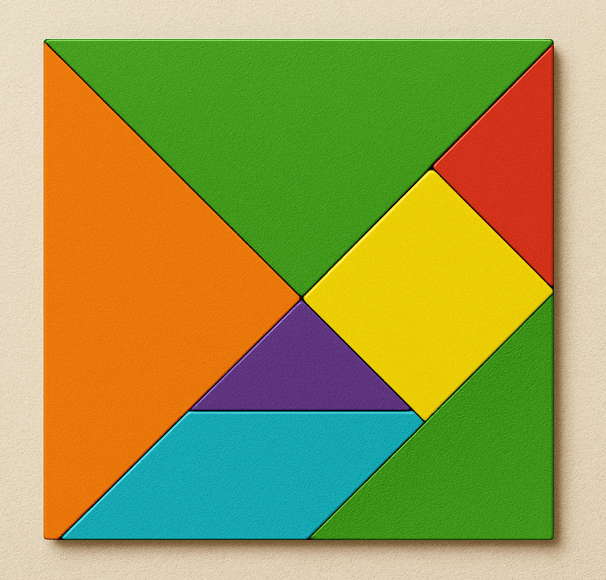
Tangram Pieces (Generated by Artificial Intelligence)
Tangram is a traditional Chinese puzzle with origins dating back to the mid-1800s. Historically known as qī qiǎo bǎn or "seven boards of skill," it was used in China for educational and recreational purposes. In the 19th century, it spread to the West, where it began to be used as an educational tool, a game, and an artistic object. Over time, it has been employed in cognitive science and psychology as an experimental stimulus to study abstract thinking, shape recognition, problem solving, and linguistic description processes.
The pieces used in the tangram game are defined by different sizes of triangles, squares, and parallelograms. Their combinations can form geometric figures, human and animal shapes, letters and numbers, everyday objects, and abstract designs. Variants of tangram include the classic seven-piece square tangram, the nine-piece heart tangram, the nine-piece egg tangram, and the four-piece T tangram. These variants differ in the number and arrangement of pieces and offer diverse educational applications.

Square Tangram (Topbaş Tat and Bulut, 2012)
【1】

Heart Tangram (Topbaş Tat and Bulut, 2012)
【2】

Zero Tangram (Topbaş, Tat and Bulut, 2012)
【3】

Egg Tangram (Topbaş Tat and Bulut, 2012)
【4】
Tangram pieces can be manufactured from materials such as paper, plastic, and wood, and today they can also be produced using 3D printers. The ability to design and produce individual pieces allows educators to adapt materials to the specific needs of students. This enables the customization of concrete learning tools to support students’ conceptual understanding.
Tangram shapes serve an important function in cognitive science as abstract and ambiguous visual stimuli. These stimuli are particularly used in experimental studies such as “reference games” to explore how shared meanings are established in human communication and how abstract forms are named. The multiple interpretive possibilities inherent in tangram figures make them suitable materials for understanding human cognitive processes such as naming (nameability), analogy, and generalization. Research has shown that some tangram shapes are easily nameable while others invite a wide range of interpretations.
In education, tangram plays a critical role, especially in teaching mathematics and geometry. It enhances students’ attention and focus, while the process of determining the correct orientation and position of pieces supports logical reasoning and strategic thinking. Tangram activities concretize fundamental geometric concepts such as translation, reflection, and rotation, facilitating learning. Additionally, describing shapes verbally and in writing strengthens students’ mathematical expression and communication skills. Physically placing and moving the pieces also develops students’ coordination abilities. These activities are guided by teachers, who provide cues to support students when they encounter difficulties. As a tool for learning through play, tangram effectively promotes the development of creative thinking, spatial perception, and problem-solving skills, while increasing interest in mathematics and enabling students to experience geometric concepts from multiple perspectives.
Gaziantep İl Milli Eğitim Müdürlüğü. "Gaziantep İl Milli Eğitim Müdürlüğü, Tangram." YouTube. Accessed October 14, 2025. https://www.youtube.com/watch?v=j2pHHpJWoq0
Ji, Anya, Noriyuki, Kojima, Noah, Rush, Alane, Suhr, Wai Keen, Vong, Robert D., Hawkins, and Yoav Artzi. "Abstract Visual Reasoning with Tangram Shapes." *arXiv preprint arXiv:2211.16492* (2022). Accessed October 14, 2025. https://arxiv.org/abs/2211.16492
Macedo, Lino de, Ana Lucia Petty, Gisele E. de Carvalho, and Maria Thereza Costa Coelho de Souza. "Intervenção Com Jogos: Estudo Sobre o Tangram." *Psicologia Escolar e Educacional* 19, no. 1 (2015): 13–22. Accessed October 14, 2025. https://www.scielo.br/j/pee/a/6CgbYtzLJfV5LPRTCcMhXJv/?format=html
Topbaş Tat, Emel, and Safure Bulut. "Yumurta Tangramın Matematik Derslerinde Kullanımına Yönelik Bir Çalışma." *İlköğretim Online* 12, no. 1 (2012): 12–19. Accessed October 14, 2025. https://core.ac.uk/download/pdf/230029843.pdf
Yılmaz, Mehtap, and Mehmet Algil. "Matematik Öğretim Materyallerinin 3D Yazıcılarla Üretimi ve Eğitimciye Sağladığı Katkılar." *Journal of Awareness* 3, no. 4 (2018): 41–52. Accessed October 14, 2025. https://dergipark.org.tr/en/pub/joa/article/531915
[1]
Emel, Topbaş Tat, ve Safure, Bulut. "Yumurta Tangramın Matematik Derslerinde Kullanımına Yönelik Bir Çalışma." İlköğretim Online 12, no. 1 (2012): 14. Erişim 14 Ekim 2025. https://core.ac.uk/download/pdf/230029843.pdf
[2]
Emel, Topbaş Tat, ve Safure, Bulut. "Yumurta Tangramın Matematik Derslerinde Kullanımına Yönelik Bir Çalışma." İlköğretim Online 12, no. 1 (2012): 14. Erişim 14 Ekim 2025. https://core.ac.uk/download/pdf/230029843.pdf
[3]
Emel, Topbaş Tat, ve Safure, Bulut. "Yumurta Tangramın Matematik Derslerinde Kullanımına Yönelik Bir Çalışma." İlköğretim Online 12, no. 1 (2012): 14. Erişim 14 Ekim 2025. https://core.ac.uk/download/pdf/230029843.pdf
[4]
Emel, Topbaş Tat, ve Safure, Bulut. "Yumurta Tangramın Matematik Derslerinde Kullanımına Yönelik Bir Çalışma." İlköğretim Online 12, no. 1 (2012): 14. Erişim 14 Ekim 2025. https://core.ac.uk/download/pdf/230029843.pdf

Tangram
(Generated by Artificial Intelligence.)
Varieties | T tangram (4-piece model) Heart tangram (9-piece model) Zero tangram (8-piece model) Egg tangram (9-piece model) Square tangram (7-piece classic model) | ||||||||
|---|---|---|---|---|---|---|---|---|---|
Area(s) of Use | Development of creativity and imagination Support for language and communication skills Psychopedagogical assessments and educational game activities Enhancement of logical reasoning and problem-solving skills Development of spatial intelligence and visual perception Mathematics and geometry instruction | ||||||||
History and Applications
Tangram Pieces and Variants
Production and Material Properties
Role in Cognitive Science and Education