This article was automatically translated from the original Turkish version.
+2 More
Building Type | Church | ||||||||
|---|---|---|---|---|---|---|---|---|---|
Architectural Period | 19th century | ||||||||
Construction Year | 1853 | ||||||||
Original Function | Greek Orthodox Church | ||||||||
Current Function | Cultural Center | ||||||||
Location | Taşbaşı Neighborhood Türkiye Ordu Altınordu | ||||||||
Taşbaşı Kilisesi is a historically and culturally significant structure located in the Taşbaşı neighborhood of Altınordu district, Ordu province, Türkiye, along the Black Sea coast. Originally constructed as a place of worship by the local Orthodox Greek community, the church remains an important cultural symbol of Ordu today, thanks to its long and layered history. Its strategic location with sea views and distinctive architectural features have enabled it to serve various functions over time.

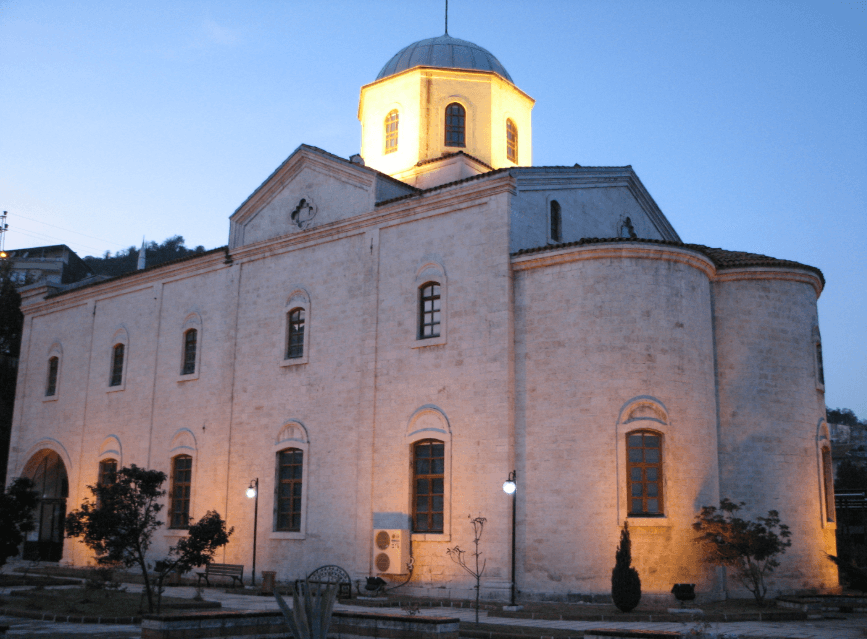
Taşbaşı Kilisesi (Ordu Provincial Directorate of Culture and Tourism)
The construction of Taşbaşı Kilisesi was completed in 1853 by the Orthodox Greek community living in Ordu during the Ottoman Empire period. Its original name was the Hypapante Church, derived from the feast of the Presentation of Jesus at the Temple. During this period, it functioned as a place of worship reflecting the region’s multicultural character.
In the Republican era, its use as a church ended in 1937, and it served as the Ordu Prison until 1977. During this time, it became commonly known among the public as “mapushane.” Several modifications were made to its original architectural fabric while it functioned as a prison.
In 1983, the structure was acquired by the Ministry of Culture and Tourism of the Republic of Türkiye and entered a comprehensive restoration process. These restoration efforts remained faithful to the original architecture, largely returning the building to its authentic state, with the exception of the bell tower. The building was officially opened to the public on 10 April 2000 under the name Taşbaşı Culture Center.
Currently, a project is underway to convert the church into an archaeology museum. Upon completion, the project plans to display artifacts excavated at Kurul Castle in Ordu alongside historical objects transferred from various other museums.
Taşbaşı Kilisesi is an example of a late-period basilica plan. The building has a rectangular orientation aligned east-west and is constructed entirely of local cut stone, except for its dome. On the eastern facade, a large central apse is flanked by two smaller apses. The interior space is divided into three naves by two rows of three columns each. These columns support the arches that carry the building’s semerdam roof.
Taşbaşı Kilisesi is an essential component of Ordu’s cultural heritage, distinguished by its historical layers and architectural elegance. Its past roles as a place of worship and later as a prison reflect the historical and social transformations witnessed by the building.
Today, the Taşbaşı Culture Center has become one of the central hubs of artistic and cultural life in Ordu. Exhibitions, concerts, theater performances, and various cultural events are regularly held within its walls. Its role as a venue for artistic activities has revitalized the structure with a new cultural purpose distinct from its original function. In this sense, the building is not merely a historical artifact but also a living space that showcases contemporary artistic production.
Bahtiyar Karadeniz, Cemile. "Ordu İli’nin Doğal Kaynaklara Dayalı Turizm Potansiyelinin Değerlendirilmesi." Uluslararası Sosyal Araştırmalar Dergisi 11, no. 61 (2018). Accessed August 20, 2025. https://www.researchgate.net/publication/330003735_ORDU_ILININ_DOGAL_KAYNAKLARA_DAYALI_TURIZM_POTANSIYELININ_DEGERLENDIRILMESI
Batuk, Cengiz, and Süleyman Turan. "Orta ve Doğu Karadeniz Bölgesi’nde Misyonerlik Faaliyetleri." In Dinler Tarihi Araştırmaları-V. Ankara: Türkiye Dinler Tarihi Derneği Yayınları, 2005. Accessed August 20, 2025. https://isamveri.org/pdfdrg/D147715/2005/2005_BATUKC_TURANS.pdf
Ordu İl Kültür ve Turizm Müdürlüğü. "Taşbaşı Kültür Merkezi (Eski Cezaevi-Kilise), Altınordu/Ordu." Accessed August 20, 2025. https://ordu.ktb.gov.tr/TR-130738/tasbasi-kultur-merkezi-eski-cezaevi-kilise-altinorduord-.html

Building Type | Church | ||||||||
|---|---|---|---|---|---|---|---|---|---|
Architectural Period | 19th century | ||||||||
Construction Year | 1853 | ||||||||
Original Function | Greek Orthodox Church | ||||||||
Current Function | Cultural Center | ||||||||
Location | Taşbaşı Neighborhood Türkiye Ordu Altınordu | ||||||||
Historical Development and Functional Changes
Architectural Features
Cultural Significance and Contemporary Use