This article was automatically translated from the original Turkish version.
Material(s) | Wool Yarn Vegetable Dye | ||||||||
|---|---|---|---|---|---|---|---|---|---|
Technique | Hand Weaving, Tight Knotting | ||||||||
Motifs | Geometric Patterns, Stylized Plant Motifs | ||||||||
Taşpınar hand-knotted rug is a handwoven carpet produced in the village of Taşpınar, located in the province of Aksaray, using traditional techniques and adorned with regional motifs and patterns. These rugs are among the most significant examples of Anatolian carpet-making culture and have historically been an essential part of local households, serving both as home decoration and a source of livelihood.
The production of Taşpınar hand-knotted rugs has been sustained for centuries as a deeply rooted tradition. In the past, these rugs were woven by local women using their manual labor and decorated with motifs reflecting Taşpınar’s geographical and cultural identity. They quickly gained recognition beyond regional boundaries. From the 20th century onward, as production expanded, the Taşpınar rug became one of Anatolia’s prominent handwoven textiles and emerged as a key cultural and tourist asset of Aksaray.
Taşpınar hand-knotted rugs are primarily made using natural materials. Wool yarn is dyed with plant-based dyes sourced locally to create distinctive tones. Production is carried out with fine craftsmanship on traditional looms. The manufacturing process includes yarn preparation, warping, knotting, and tight knotting techniques. The high density of knots ensures the rug’s durability and long lifespan.
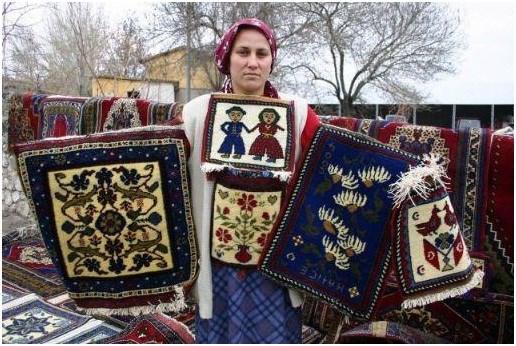
Taşpınar hand-knotted rugs feature dense geometric patterns, stylized plant motifs, and symbols unique to the region. The color palette prominently includes vibrant shades such as red, blue, navy, green, and yellow. The motifs reflect the community’s beliefs, observations of nature, and aesthetic preferences across generations. Traditional motif compositions hold an important position in Anatolian carpet art.

Example of a Taşpınar Rug (Ministry of Culture and Tourism)
The Taşpınar hand-knotted rug is more than a decorative object; it serves as a living vehicle for transmitting the culture and history of the local community. This craft plays a vital role in promoting Aksaray and contributes significantly to the local economy. Production is largely carried out by women, making it an important factor in social development. In this regard, the Taşpınar rug stands as a key example of rural development and the preservation of traditional professions.
The Taşpınar rug holds significant value within Turkish cultural heritage due to its original motifs, traditional weaving techniques, and region-specific production methods. Recognizing this, the Ministry of Culture and Tourism has registered the Taşpınar rug under the category of intangible cultural heritage and granted it geographical indication protection. This has standardized production conditions and established legal and cultural safeguards to ensure the transmission of this important cultural asset to future generations.
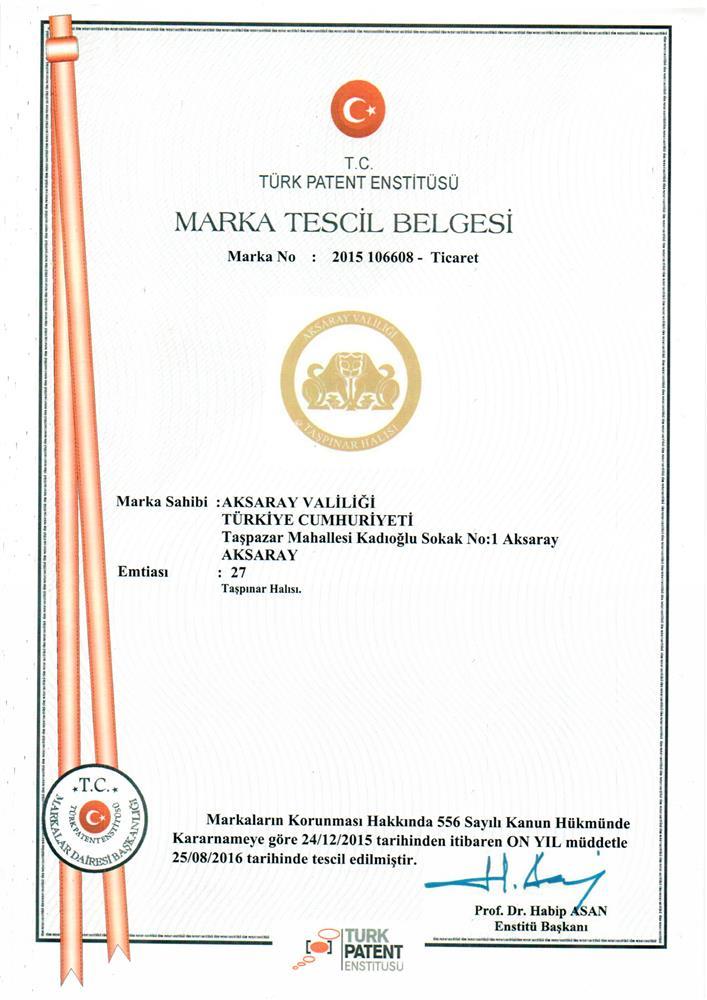
Trademark Registration Certificate (Ministry of Culture and Tourism)
Today, efforts are being made to sustain the production of Taşpınar hand-knotted rugs through courses and promotional activities supported by the Aksaray Governorship and the Ministry of Culture and Tourism. Local communities are actively passing this art to younger generations to prevent its disappearance and promoting the rug through fairs and exhibitions. The Taşpınar hand-knotted rug is recognized as a protected cultural heritage asset.
Aksaray Valiliği. “Taşpınar Halısı Yaşatılması Gereken Bir Değer.” Aksaray Valiliği Resmî Web Sitesi. Accessed June 26, 2025. http://www.aksaray.gov.tr/taspinar-halisi-yasatilmasi-gereken-bir-deger
Aksaray İl Directorate of Culture and Tourism. "Taşpınar Dokumaları." Aksaray Provincial Directorate of Culture and Tourism Official Website. Accessed June 26, 2025. https://aksaray.ktb.gov.tr/TR-232510/taspinar-dokumalari.html
Aksaray İl Directorate of Culture and Tourism. "Taşpınar Halısı." Aksaray Provincial Directorate of Culture and Tourism Official Website. Accessed June 26, 2025. https://aksaray.ktb.gov.tr/TR-233397/taspinar-halisi.html
Ministry of Culture and Tourism. "Taşpınar El Halısı." *Kültür Portalı*. Accessed June 26, 2025. https://www.kulturportali.gov.tr/portal/taspinarelhalisi

Material(s) | Wool Yarn Vegetable Dye | ||||||||
|---|---|---|---|---|---|---|---|---|---|
Technique | Hand Weaving, Tight Knotting | ||||||||
Motifs | Geometric Patterns, Stylized Plant Motifs | ||||||||
History
Materials and Production Process
Motifs and Color Characteristics
Cultural and Economic Function
Registration Status
Current Status