

This article was automatically translated from the original Turkish version.
+2 More
Status | Museum | ||||||||
|---|---|---|---|---|---|---|---|---|---|
Province(s) | Istanbul | ||||||||
Period(s) | Byzantine | ||||||||
Construction Date(s) | 10th–14th centuries | ||||||||
Architectural Feature(s) | Three-story plan arched windows brick-stone alternating masonry facade facing the courtyard | ||||||||
Museum Opening | 21 July 2019 | ||||||||
District | Fatih | ||||||||
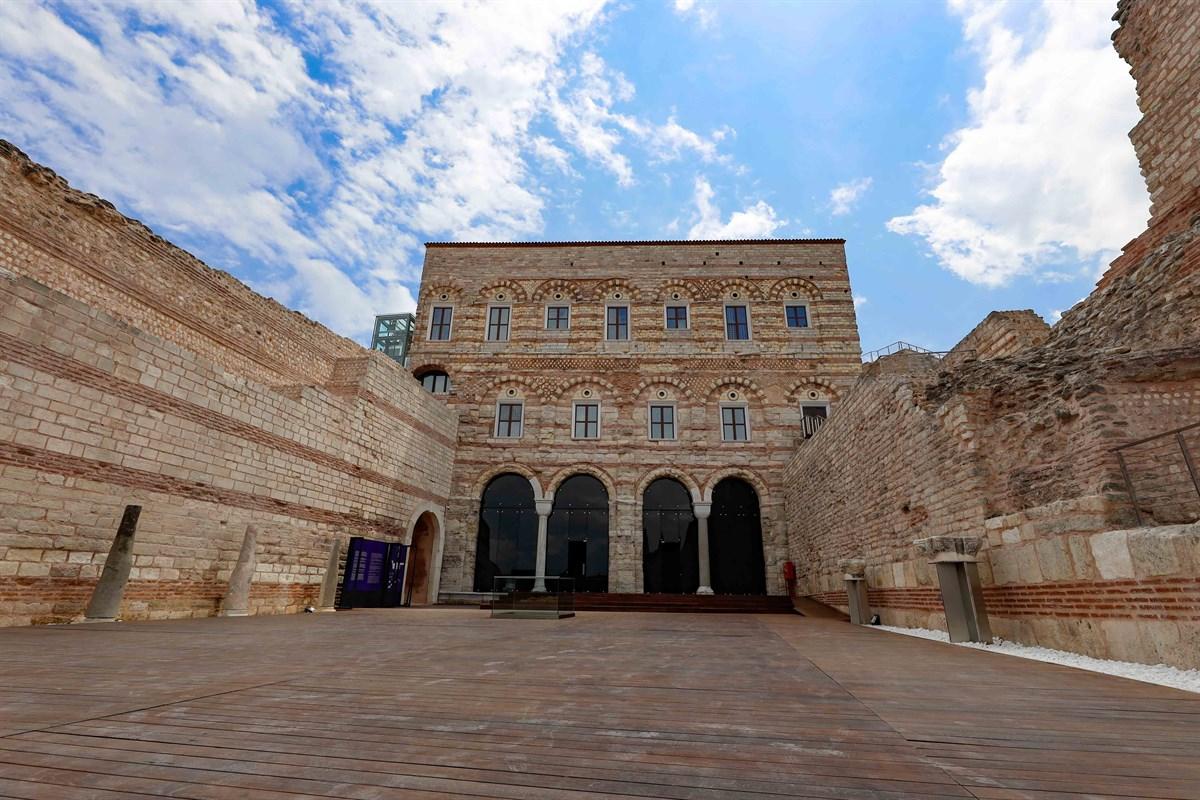
Tekfur Sarayı is a historical palace structure located adjacent to the land walls of the Edirnekapı and Ayvansaray (Eğrikapı) areas in the Fatih district of Istanbul. The building, part of the Blakhernai Palace Complex of the Byzantine Empire, is the only palace in Istanbul that has reached the present day with its architectural integrity preserved from the Byzantine period. The gate associated with the structure, known as the Tekfur Sarayı Gate (Porphyrogennetos Gate), measures 3.50 meters in width and 2.30 meters in height on the field side, and 4.15 meters in width and 4.36 meters in height on the city side.
There are differing accounts in the literature regarding the construction date of the palace. Some sources state that the structure was commissioned by Emperor Porphyrogenitus in the 10th century as an addition to an existing palace, while others indicate it was built in the late 11th or 12th centuries or during the 13th and 14th centuries as an extension of the Blakhernai Palace.

View from the Palace Garden (T.C. Istanbul Governorship)
Architecturally, Tekfur Sarayı reflects the characteristics of Middle and Late Byzantine art. It features a three-story plan facing the courtyard. The façade combines brick and stone masonry and includes arched windows, providing valuable insights into the palace architecture of its era.
After the conquest of Istanbul in 1453, the palace was used for various purposes in different centuries. In its early post-conquest period, the building and its surroundings remained in ruins until the late 17th century when it was converted into a menagerie. Busbecq, who arrived in the city as an ambassador, wished to see a giraffe housed there; upon learning of the animal’s death, he had its grave excavated to examine this creature, which he had never seen before in Europe.【1】

Tile Artifact from the Ottoman Period (T.C. Istanbul Governorship)
In the 18th century, the palace grounds were converted into a ceramic and tile workshop, and in the 19th century, into a glass and candle (mumhane) manufacturing facility known as “Şişehane.” During the reign of Sultan Ahmed III, master artisans brought from Iznik established tile kilns in the palace courtyard and produced tiles using clay extracted from the Alibeyköy Creek. The tiles manufactured in these workshops were used in architectural monuments such as the Ahmed III Fountain in Sultanahmet, the Kandilli Hekimoğlu Ali Pasha Mosque, and the Eyüp Cezeri Kasım Pasha Mosque.
Archaeological and art historical excavations at the palace and its surroundings were conducted in 1995, 1999, and 2005 under the leadership of Professor Dr. Filiz Yenişehirlioğlu. In the excavation trenches A1, A2, A3, B1, and C1 opened along the eastern edge of the structure, numerous glass artifacts, architectural remnants, tile and ceramic production waste, and tile kilns dating to the Ottoman period (17th century and later) were identified at depths ranging from 10 to 95 cm.

Area Exhibiting Tile Artifacts (T.C. Istanbul Governorship)
Archaeometric analyses were performed on 46 glass artifacts recovered from the excavations using X-ray Fluorescence Spectroscopy (Micro-XRF and PED-XRF) and Raman Spectroscopy. The results indicate:
Based on the findings from the 2005 excavations and the scientific reports prepared, restoration techniques minimizing intervention were determined, and the repair process was initiated by the Istanbul Metropolitan Municipality, completed in 2014. Following the excavation studies led by Professor Dr. Filiz Yenişehirlioğlu, the restoration was carried out in accordance with the proposed project, and with the approval of the Ministry of Culture and Tourism, Tekfur Sarayı was granted special museum status and opened to the public on 21 July 2019.

View of the Museum After Restoration (T.C. Istanbul Governorship)
The museum’s design reflects both the Byzantine palace identity and the Ottoman manufacturing function of the building. The collection includes artifacts unearthed during the palace excavations, as well as items from the Museum of Turkish and Islamic Arts, the Istanbul Archaeological Museums, and Topkapı Palace that originate from Tekfur Sarayı.
The museum’s floor plan and exhibition layout are as follows:
Akyol, Ali Akın, and Yusuf Kağan Kadıoğlu. “Tekfur Sarayı Cam Buluntuları: Arkeometrik Çalışmaları.” *TÜBA-KED*, no. 13 (2015): 27–36. Accessed March 4, 2026. https://dergipark.org.tr/en/download/article-file/1343176
Koç Üniversitesi Istanbul Walls Project. "Tekfur Sarayı Kapısı." Istanbul Walls Project. Accessed March 4, 2026. https://istanbulsurlari.ku.edu.tr/tr/gate/603/tekfur-sarayi-kapisi
Ministry of National Education. "Tekfur Sarayı."EBA Okul Learning Environments. Accessed March 4, 2026. https://okuldisiogrenme.eba.gov.tr/place-detail/tekfur-sarayi-8371
T.C. İstanbul Valiliği. “Tekfur Sarayı Kapılarını Ziyaretçilere Açtı.” İstanbul Valiliği Resmî İnternet Sitesi. Accessed March 4, 2026. https://www.istanbul.gov.tr/tekfur-sarayi-kapilarini-ziyaretcilere-acti
T.C.Fatih Kaymakamlığı Governorship. “Tekfur Sarayı.” Fatih District Governorship Official Website. Accessed March 4, 2026. https://www.fatih.gov.tr/tekfur-sarayi
İstanbul Büyükşehir Municipality Atatürk Library. “Tekfur Sarayı.” İBB Atatürk Kitaplığı. Accessed March 4, 2026. https://ataturkkitapligi.ibb.gov.tr/tr/Kitaplik/Muzelerimiz/Tekfur-Sarayi/10
[1]
T.C. Fatih District Governorship, “Tekfur Sarayı,” Fatih District Governorship Official Website, Access date: 4 March 2026, https://www.fatih.gov.tr/tekfur-sarayi
Status | Museum | ||||||||
|---|---|---|---|---|---|---|---|---|---|
Province(s) | Istanbul | ||||||||
Period(s) | Byzantine | ||||||||
Construction Date(s) | 10th–14th centuries | ||||||||
Architectural Feature(s) | Three-story plan arched windows brick-stone alternating masonry facade facing the courtyard | ||||||||
Museum Opening | 21 July 2019 | ||||||||
District | Fatih | ||||||||
History and Architectural Features
Functions During the Ottoman Period
Archaeological Excavations and Archaeometric Analyses
Restoration Process and Museum Function
Floor Plan and Exhibition Layout