This article was automatically translated from the original Turkish version.
+2 More
Other Name(s) | Four Churches Okhta Ecclesia | ||||||||
|---|---|---|---|---|---|---|---|---|---|
Location | Artvin Tekkale Village Yusufeli District | ||||||||
Elevation(s) | 1350 m | ||||||||
Construction Date(s) | 961–1001 (Bagratid period) | ||||||||
Period(s) | Bagratid Period Middle Ages | ||||||||
Architectural Plan | Basilical plan composed of three naves | ||||||||
Current Status | Ruins, roof collapsed, plaster and frescoes damaged | ||||||||
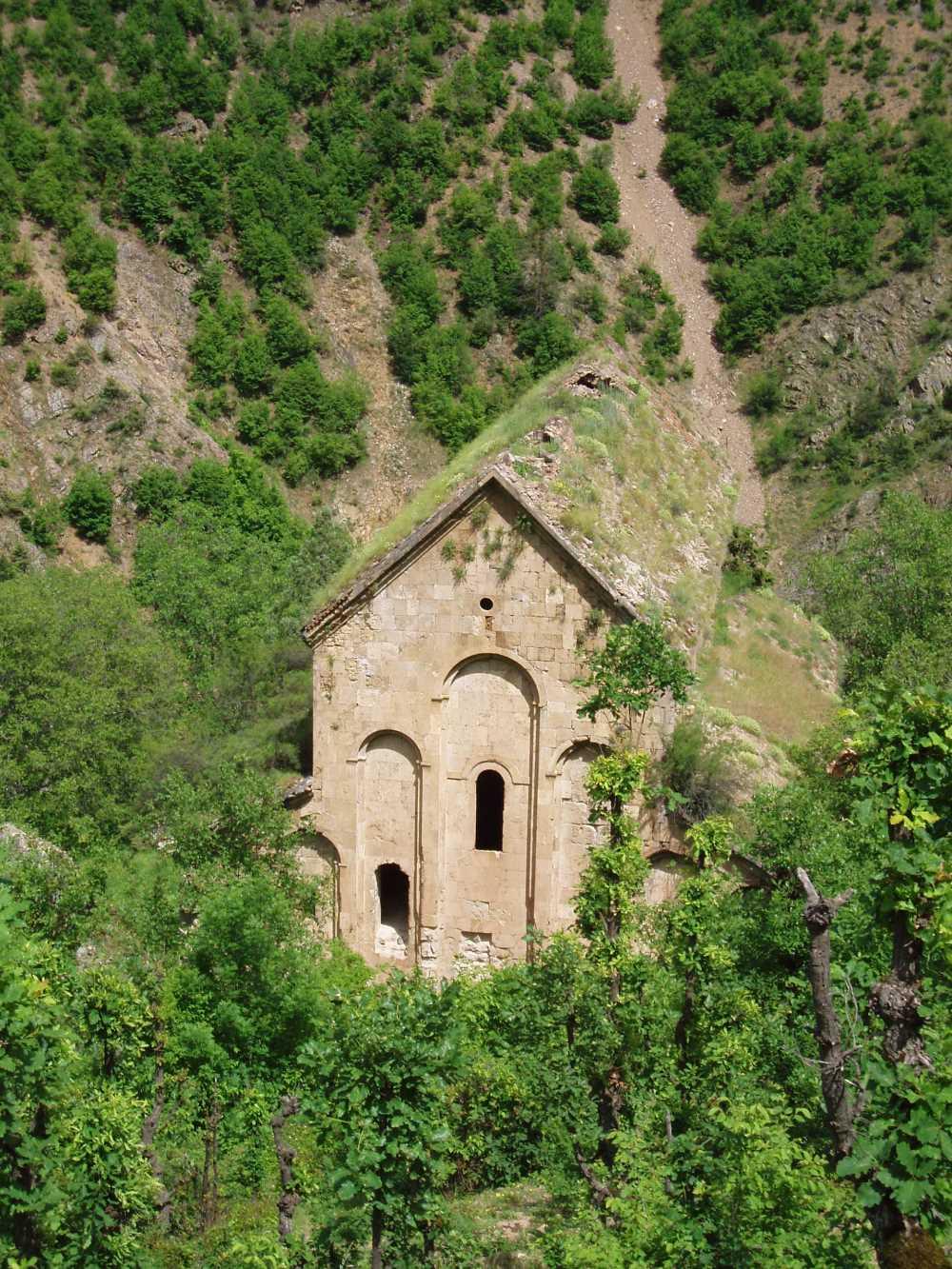
Tekkale Monastery is a medieval Georgian monastery complex located on a hill at an elevation of 1350 meters, approximately 7 kilometers from Tekkale Village, 4 kilometers southwest of Yusufeli District in Artvin Province. Also known as “Four Churches” or “Okhta Ecclesia,” the monastery consists of a complex of structures including a church, trapeza (refectory), seminar room, and chapel. The church shares similar planning features with the Barhal Church and is one of the most prominent examples of medieval Georgian monastic architecture in the region.

Tekkale Monastery (Culture Portal)
The Tkkale Monastery was constructed during the Bagratid period, under the reign of the Georgian King David, between 961 and 1001. The monastic complex functioned as a nunnery, as indicated by its architectural layout. A Georgian manuscript dated 1031 records that a cleric named Ioannes withdrew to the Okhta Ecclesia Monastery in 965, renouncing worldly pleasures “through the fire of Christ’s love.” This passage provides a historical reference to monastic life during the period and the significance of the structure.

Tekkale Monastery (Culture Portal)
The Tkkale Monastery comprises four main structures: the church, trapeza, seminar room, and chapel. The church is a three-aisled basilica with an external dimension of 28.40 by 18.65 meters. The eastern façade is arranged vertically in two tiers and horizontally in three stages. The central apse is flanked by pastophoria chambers. The façade is decorated with round-arched windows and relief carvings featuring geometric and botanical motifs. The north and south façades are two-storied and exhibit symmetrical arrangements. A rectangular narthex has been added to the western façade.
Internally, the church features a cross-shaped plan supported by eight free-standing piers, creating three naves. The central nave is covered by a barrel vault, while the side naves are roofed with lower ceilings. At the eastern end, a rectangular bema and a semi-domed apse are located. The pastophoria chambers are two-storied, with rectangular and T-shaped cells on the upper levels. The roof of the structure has been largely destroyed.
Musical plastic decorations and traces of frescoes are visible on both the interior and exterior walls. The relief ornamentation includes geometric and botanical motifs. In the apse, a fresco depicts a saint holding a model of a basilica-plan church; this figure is believed to represent Saint Nino. Despite the general deterioration of the structure, portions of the frescoes have survived. Above the church’s east gable, an inscription reads “May Christ protect David.”

Tekkale Monastery (Culture Portal)
The Tkkale Monastery is currently in ruins. Two inscriptions in Georgian remain, located on the western and southern façades, but both are illegible due to damage. The complex was abandoned following the local population’s conversion to Islam. Over time, the roof collapsed, the interior filled with sediment due to flooding, and wall plastering has peeled away. The site has also suffered damage from treasure hunters. No restoration work has been carried out to date. Although no longer in use, the monastery remains accessible to visitors, with access provided via village transport.
T.C. Kültür ve Turizm Bakanlığı. "Dört Kilise." Artvin İl Kültür ve Turizm Müdürlüğü. Accessed August 16, 2025.
T.C. Kültür ve Turizm Bakanlığı. "Tekkale Manastırı." *Kültür Portalı.* Accessed August 16, 2025.
Zorba Kıvılcım, Burcu. “Tekkale (Dört Kilise) Manastırı.” *Türkiye Turizm Ansiklopedisi, 2019.* Accessed August 16, 2025.

Other Name(s) | Four Churches Okhta Ecclesia | ||||||||
|---|---|---|---|---|---|---|---|---|---|
Location | Artvin Tekkale Village Yusufeli District | ||||||||
Elevation(s) | 1350 m | ||||||||
Construction Date(s) | 961–1001 (Bagratid period) | ||||||||
Period(s) | Bagratid Period Middle Ages | ||||||||
Architectural Plan | Basilical plan composed of three naves | ||||||||
Current Status | Ruins, roof collapsed, plaster and frescoes damaged | ||||||||
History
Architectural Features
Decorations
Restoration and Current Condition