


This article was automatically translated from the original Turkish version.
+2 More
The Tes Inscription is an Old Turkic (runic) epigraphic example in the form of a reddish rectangular granite block with inscriptions on all four sides, dated to the Uyghur Khaganate period. It is located in the Hovsgol (Hövsgöl) region of Mongolia, within the Tes (Tesiin Gol) River basin. The preserved portions of the inscription consist of a total of 22 lines and contain content relating to early Uyghur political and administrative events, tribal names, and expressions concerning boundaries and marker functions.
The Tes Inscription was first discovered in 1915 by B. Ya. Vladimirtsov (though it is reported that it was not published at the time); the modern discovery and documentation known today occurred during the Mongolian–Soviet epigraphic expeditions of 1976, when S. G. Klyaštorniy and S. Karcavbay excavated the inscription from the soil. The first textual publications of the inscription were produced by S. Kharjaubai and M. Shinekhüü, and most recently by S. G. Klyaštorniy; Klyaštorniy’s publication includes a more complete copy, photographs, and an English translation.
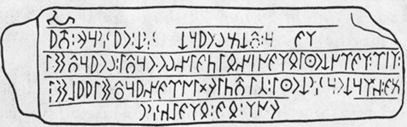
South Face of the Tes Inscription. (Drawing: Klyaštorniy)
【1】
The inscription is a single piece of reddish rectangular granite; the preserved portion measures approximately 86 cm in length, with the broad faces about 32 cm wide and the narrow faces about 22 cm wide. Based on line heights, the preserved height of the inscription is recorded as approximately 76 cm.
The inscription contains text on all four sides: six lines on the west, five on the north, six on the east, and five on the south, totaling 22 lines. Due to erosion of the upper and top portions of the stone, most line beginnings are missing, and the legible sections are generally the endings of the lines.
The height of the letters (runic signs) is estimated at approximately 3.5–4 cm; the forms of the characters resemble those found in the Taryat (Terhin) and Şine Usu inscriptions; similar markings to those of Taryat/Şine Usu are also found along the lower edges of the narrow sides—features that associate the inscription closely with the group of Uyghur inscriptions.
The Tes Inscription is written in Turkic runic (Orkhon/Old Turkic) script; its linguistic features reflect the language and dialectal characteristics of the Uyghur period (Uyghur Khaganate). The text includes both vocabulary unique to Uyghur inscriptions and expressions with boundary or marker functions, typical of the inscription type.
Unlike some other Uyghur inscriptions, the narrative voice of the Tes Inscription is predominantly in the third person singular; this usage provides clues regarding the text’s genre and function—for example, as a monumental or boundary marker text.
Since many sections of the inscription are fragmented or eroded, its content is inferred from the preserved portions. The inscription includes references to early Uyghur political events and officials; information concerning the death of a ruler and his successors in some lines; settlement and boundary matters; tribal names and markings. Passages on the west, east, south and north faces address different themes; for instance, terms of the type “berlgü/bitig” (signifying a kind of personal or institutional emblem or seal) appear in certain places.
Prominent terms identified from the inscription include çıt (boundary marker), belgü/bengü (emblem), örgin (administrative center), boz ok (a tribal name), along with several regional and tribal designations; these words provide direct data regarding the inscription’s geographical, administrative and social context. This list of terms and concepts demonstrates the special value of the Tes Inscription for research on the Turkic language.
There is no consensus among researchers regarding the date of erection of the Tes Inscription. Some scholars (e.g., A. Róna-Tas) date it to around 750, while G. Doerfer proposes 761–762; Osman F. Sertkaya also defends the 750 date. These discrepancies arise primarily from the absence of an explicit date in the inscription and its fragmentary condition.
In comprehensive assessments (e.g., Rybatzki, Doğan), it has been argued that the chronological relationship among the Tes, Tariat and Şine Usu inscriptions is complex; due to functional differences (e.g., tomb inscription versus boundary/marker inscription), these three inscriptions should not be directly equated. The Tes Inscription’s function as a “boundary marker” has led to discussions suggesting its chronology may follow that of the Şine Usu Inscription or be positioned intermittently relative to it.
The Tes text has been read and interpreted multiple times; Klyaštorniy produced the most comprehensive modern edition and analysis. Earlier readings by Kharjaubai and Shinekhüü also exist. Researchers have differed on the interpretation of missing line beginnings, the reading of personal or tribal names, and the meaning of certain expressions.
Recent publications suggest that small but significant phrases, such as the expression ilgerü konmak on the third line of the south face, may have been overlooked in earlier readings, and that alternative interpretations have rendered the context of the text more intelligible. Moreover, researchers (Berta, Mert, Ölmez, among others) have proposed different readings of specific words; this indicates that the text remains contested and open to reevaluation.【2】
The Tes Inscription is a valuable primary source for both historical and linguistic research, offering insights into the early Uyghur Khaganate through its script, emblematic markings, and vocabulary (e.g., belgü, örgin, boz ok, kasar, etc.). Unique words and structures in the Tes Inscription contribute to the understanding of Uyghur dialectology and the phonological and morphological features of Old Turkic.
The inscription’s function as a “boundary marker” provides concrete evidence for historical interpretations concerning the delineation of medieval Turkic political geography, tribal relationships, and the formation of administrative centers (örgin). Furthermore, the study of relationships between the Tes Inscription and those of Tariat and Şine Usu has contributed to the reevaluation of the chronology of Uyghur inscriptions.
Aydın, Erhan. "Tes ve Tariat Yazıtları Üzerine." *Moğolistan Kültürel Mirası İçinde Türk Yazıtlarının Bugünü ve Geleceği Çalıştayları Bildiriler Kitabı*, İzmir, 2022: İzmir Kâtip Çelebi Üniversitesi Yayınları, 1-10. Accessed October 14, 2025. Erişim Bağlantısı.
Aydın, Mihriban. "Tes Yazıtı’nın Güney Yüzünün 3. Satırında Yeni Bir Deyim? İlgerü konmak." RumeliDE Dil ve Edebiyat Araştırmaları Dergisi 38 (February 2024): 249-256. Accessed October 14, 2025. https://dergipark.org.tr/tr/download/article-file/3739616
Rybatzki, Volker. "Taryat, Tes ve Şine Usu Yazıtları Arasındaki Dil Bilimsel ve Tarihî Bağlar Üzerine Bazı Notlar." *Belleten* (2011): 61-80. Accessed October 14, 2025. Erişim Bağlantısı.
Tekin, Talât. "Tes Yazıtı Hakkında Dokuz Not." Trans. Ülkü Çelik. *Erdem* 14 (1989): 389-398. Accessed October 14, 2025. https://dergipark.org.tr/tr/pub/erdem/issue/44528/552270
[1]
Mihriban Aydın. "Tes Yazıtı’nın Güney Yüzünün 3. Satırında Yeni Bir Deyim? İlgerü konmak." RumeliDE Dil ve Edebiyat Araştırmaları Dergisi 38 (Şubat 2024): 256. Erişim Tarihi: 14 Ekim 2025. https://dergipark.org.tr/tr/download/article-file/3739616
[2]
A.e. Erişim Tarihi: 14 Ekim 2025. https://dergipark.org.tr/tr/download/article-file/3739616

Discovery and Publication
Physical Characteristics and Preservation
Language, Script and Text Type
Content of the Text
Dating and Chronological Debates
Readings, Previous Interpretations and Recent Debates
Linguistic and Historical Significance