


This article was automatically translated from the original Turkish version.
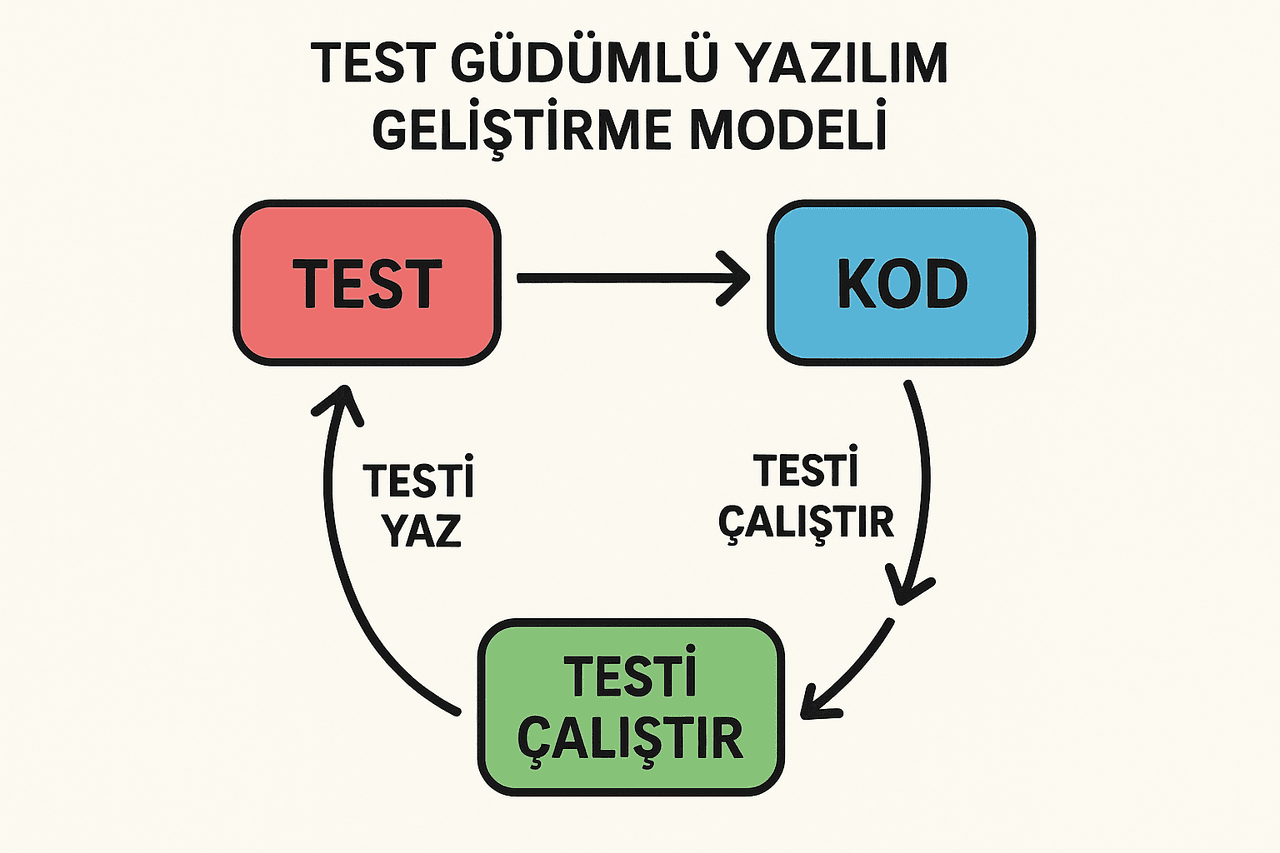
Generated with artificial intelligence.
Test-Driven Software Development
Definition(s) | Test-Driven Development (TDD) is a methodology that emphasizes writing tests before code aiming to prevent errors at early stages of the software development process. | ||||||||
|---|---|---|---|---|---|---|---|---|---|
TDD Process | Write Test (Red), Write Minimal Code (Green), Refactor, Run All Tests, Repeat the Cycle | ||||||||
TDD Test Types | Acceptance Tests Regression Tests Integration Tests Functional Tests Unit Tests | ||||||||
Test-Driven Development (TDD) is a software development model that places test writing at the center of the development process to prevent errors from the very beginning. This approach was popularized in the late 1990s by Kent Beck as part of the Extreme Programming (XP) methodology and has since transformed the quality standards of numerous software teams.
In the early days of software engineering, software testing was largely treated as a clearly separated responsibility between developers and test specialists, with testing typically conducted only at the end of the development process. This approach gained widespread acceptance through the axiom proposed by Glenford Myers in his 1976 book Software Reliability: “a developer should not test their own code.” The dominant understanding of the time relied on black-box testing techniques, encouraging tests to be performed from the outside without regard to the internal workings of the software.
In the early 1990s, a noticeable paradigm shift occurred in the discipline of software testing, spurred by the influence of the Smalltalk community, which initiated independent experiments with developer-written tests. In 1994, Kent Beck laid the foundations of modern unit testing frameworks with SUnit, a framework he developed for Smalltalk; this work became the precursor to today’s popular testing frameworks such as JUnit, PyTest, and NUnit.
Between 1998 and 2002, the Extreme Programming (XP) methodology took shape, and the integration of testing into the development cycle was systematized through the “Test First” approach. This approach was institutionalized in 2003 with Beck’s publication of Test Driven Development: By Example, which paved the way for the widespread adoption of the TDD concept in software development literature.
Test-Driven Development (TDD) proposes placing test writing at the heart of the development process. The central philosophy of this method is that code should evolve in a requirement-driven, test-defined, and behavior-oriented manner. In traditional approaches, features are designed, implemented, and then tested; TDD, by contrast, begins by defining the functionality through a test and then develops the simplest possible code that passes that test.
The underlying belief of this approach is that errors can be caught early and systematically, and that code can be stripped of unnecessary complexity to become simple, modular, and easily testable. In TDD, every new feature begins with a test scenario that clearly defines the expected behavior of the function. This expectation is made concrete through the test, which initially fails (Red). The developer then writes just enough code to make the test pass (Green), and finally refactors the code to align with design principles (Refactor).
According to the TDD philosophy, tests serve not only as a validation mechanism but also as living documentation. Each test reveals how a function is intended to work and under what conditions it should behave as expected, facilitating knowledge sharing—especially in large teams.
The Test-Driven Development process is based on the Red-Green-Refactor cycle, which contains a systematic algorithm. The process works step by step as follows:
Although the TDD approach is primarily focused on unit testing, as noted in the provided sources, various other test types also play a significant role within test-driven development. These include:
Comprehensive planning of tests ensures that the full benefits of TDD—early error detection, continuous feedback, and sustainable maintainability—are fully realized.
Two primary approaches emerge in the application of Test-Driven Development (TDD): Inside-Out (Detroit School) and Outside-In (London School). These approaches offer different paths for determining where to begin writing tests and how the design should evolve.
Inside-Out is the classical TDD understanding. The developer begins with the smallest building blocks of the software—individual classes or functions. Tests are written first for these atomic units, which then combine to form more complex structures. In this approach, the software’s architecture emerges naturally from the evolution of tests and code. Mock usage is minimal; integration tests come into play as real components are implemented. This model is generally preferred for monolithic or relatively small-scale projects.
In contrast, Outside-In is particularly prominent in applications with complex, layered, or microservice architectures. In this approach, development begins at the user interface or the outermost layers of the system. Behavior-driven tests are written first for the outermost layers, followed by the construction of internal modules that support those behaviors. Outside-In uses mocks and stubs to simulate parts of real components that are not yet ready. This ensures that development remains focused on user expectations and aligns more closely with business requirements. In this sense, it shares a conceptual affinity with Behavior-Driven Development (BDD).
Each approach has its strengths, and their selection should be guided by the nature of the project. Inside-Out is more effective when the focus is on small, modular functions; Outside-In is more suitable when comprehensive user scenarios are critical.
TDD is an inseparable component of Continuous Integration (CI) and Continuous Deployment (CD) processes. By placing tests at the beginning of the development cycle, TDD enables automatic verification of code changes at every stage of the CI pipeline.
BrowserStack. "What is Test Driven Development (TDD)?". 2025. Accessed July 7, 2025. Accessed Adresi.
GeeksforGeeks. "What is Test Driven Development (TDD)?". 2025. Accessed July 7, 2025. Accessed Adresi.
Heckel, Reiko, and Marc Lohmann. "Towards model-driven testing." Electronic Notes in Theoretical Computer Science 82, no. 6 (2003): 33-43. Accessed Adresi.
Küçüksille, Ecir Uğur, Öztürk, Nurullah, Çankaya, İbrahim Arda, and Yüksel, Asım Sinan. "Test Güdümlü Yazılım Geliştirme Süreci ve Kullanılan Çerçeveler". Accessed Adresi.
Schenider, Josh and Smalley, Ian. "What is test-drive development (TDD)?". 2025. IBM. Accessed July 7, 2025. Accessed Adresi.
Schmitt, Jacob. "Test-driven development (TDD) explained". 2025. Accessed July 7, 2025. Accessed Adresi.

Generated with artificial intelligence.
Test-Driven Software Development
Definition(s) | Test-Driven Development (TDD) is a methodology that emphasizes writing tests before code aiming to prevent errors at early stages of the software development process. | ||||||||
|---|---|---|---|---|---|---|---|---|---|
TDD Process | Write Test (Red), Write Minimal Code (Green), Refactor, Run All Tests, Repeat the Cycle | ||||||||
TDD Test Types | Acceptance Tests Regression Tests Integration Tests Functional Tests Unit Tests | ||||||||
No Discussion Added Yet
Start discussion for "Test-Driven Software Development Model" article
Historical Evolution of the Test-Driven Development Model
Core Philosophy of the Test-Driven Development Model
Stages of the Test-Driven Development Process
Test Types and Scope
Approaches to Test-Driven Development
Integration of Test-Driven Development with CI/CD