


This article is not approved yet.
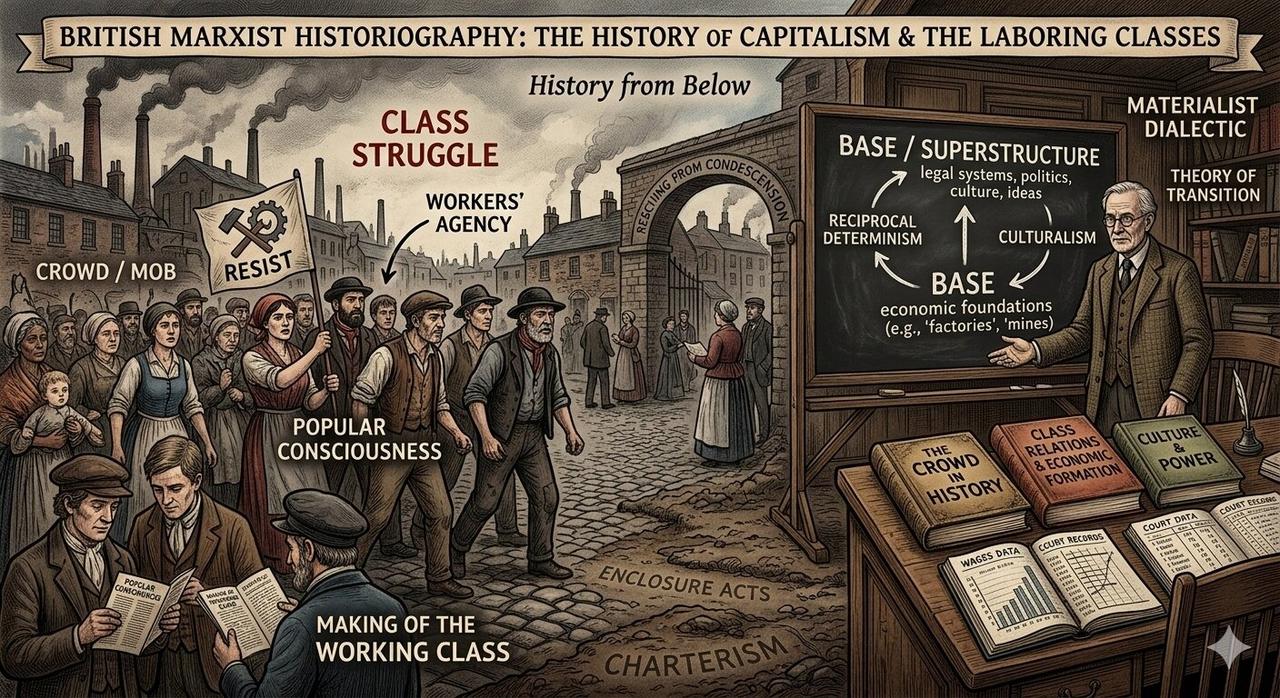
The British Marxist Historiography (Yapay Zeka ile Oluşturulmuştur.)
British Marxist historiography emerged as a revolutionary school of thought that fundamentally altered the historical profession by redirecting attention away from traditional narratives of "great men" and high-level politics. By centering on the day-to-day realities of ordinary individuals, this movement achieved significant academic influence in the middle of the 1900s. Its primary contribution was the development of the "history from below" methodology, an approach dedicated to recovering the voices and perspectives of those whom conventional historical accounts had systematically overlooked or excluded.
British Marxist historiography represents a transformative movement in historical scholarship that shifted the discipline's focus from "great men" and elite politics to the lived experiences of the common people. Established as a prominent academic force in the mid-twentieth century, it pioneered the "history from below" (or "grassroots history") approach. This methodology seeks to reconstruct the past through the eyes of those previously marginalized or ignored by mainstream records—the peasants, artisans, factory workers, and domestic servants whose labor and resistance shaped the modern world.
Until the mid-twentieth century, Marxist history existed largely outside the ivory tower, thriving primarily within labor movements, trade unions, and cultures of political dissent. It was rooted in the "materialist conception of history," an analytical framework derived from the works of Marx and Engels. This approach posits that the "mode of production of material life" (the economic base) is the primary conditioner of the social, political, and intellectual processes of life (the superstructure). However, the British tradition is noted for its "culturalist" turn, which moved beyond rigid economic determinism to explore the complex interplay between economic reality and human consciousness.
A new generation of British Marxists emerged between the 1930s and 1970s, establishing the movement within universities during the 1960s as part of a broader "turn to social history." This shift was catalyzed by the Communist Party Historians’ Group (CPHG), formed in 1946. This group, which included figures like Christopher Hill, Rodney Hilton, and Eric Hobsbawm, sought to apply Marxist theory to British history in a way that was both academically rigorous and politically relevant.
They were instrumental in moving the focus of history from the "top-down" narratives of kings and parliaments to the "bottom-up" struggles of the masses. By doing so, they joined the comparable influence of the Annales school in France, entering into a dialogue that helped define the modern "history of society."
The narrative's foundation rests on the "classical" Marxism of Karl Marx and Friedrich Engels. While Marx's Capital provided the essential theoretical framework for analyzing capitalist development and class struggle, Engels produced more formally historical works that set the stage for later inquiry:
The most influential modern figures of the British tradition include:
The movement's intellectual rigor and academic influence were cemented through dedicated journals and grassroots organizations:

The British Marxist Historiography (Yapay Zeka ile Oluşturulmuştur.)
No Discussion Added Yet
Start discussion for "The British Marxist Historiography" article
The Intellectual Landscape: From Determinism to Agency
The Communist Party Historians' Group and the Rise of Social History
Foundational Figures and Key Works
Institutional Influence: Journals
This article was created with the support of artificial intelligence.
