


This article was automatically translated from the original Turkish version.
+2 More
The concept of foster care emerged and evolved as a social institution throughout the historical transition from the Ottoman Empire to the Republic, closely linked to family structure, child care, remnants of slavery, and domestic labor relations. Unlike legal adoption, this concept typically involved the taking in, raising, and integration of orphaned or impoverished children into a household for domestic purposes.【1】
Foster care refers to the practice of bringing a child into a household at a young age without establishing a legal kinship bond, primarily for the purposes of upbringing, protection, or often exploitation of their labor. The term encompasses multiple layers of meaning and can describe various social practices, including children adopted as foster children, stepchildren, or domestic servants.【2】The practice of foster care diversified alongside socioeconomic changes and underwent a process of institutionalization over time.【3】
Historically, the institution of foster care has been viewed as an area intertwined with slavery, domestic service, and hierarchical relationships within the family. The presence of non-relatives—such as slaves, servants, and foster children—in the household was a widespread phenomenon, and these individuals often fulfilled functional roles in the household’s operation.【4】
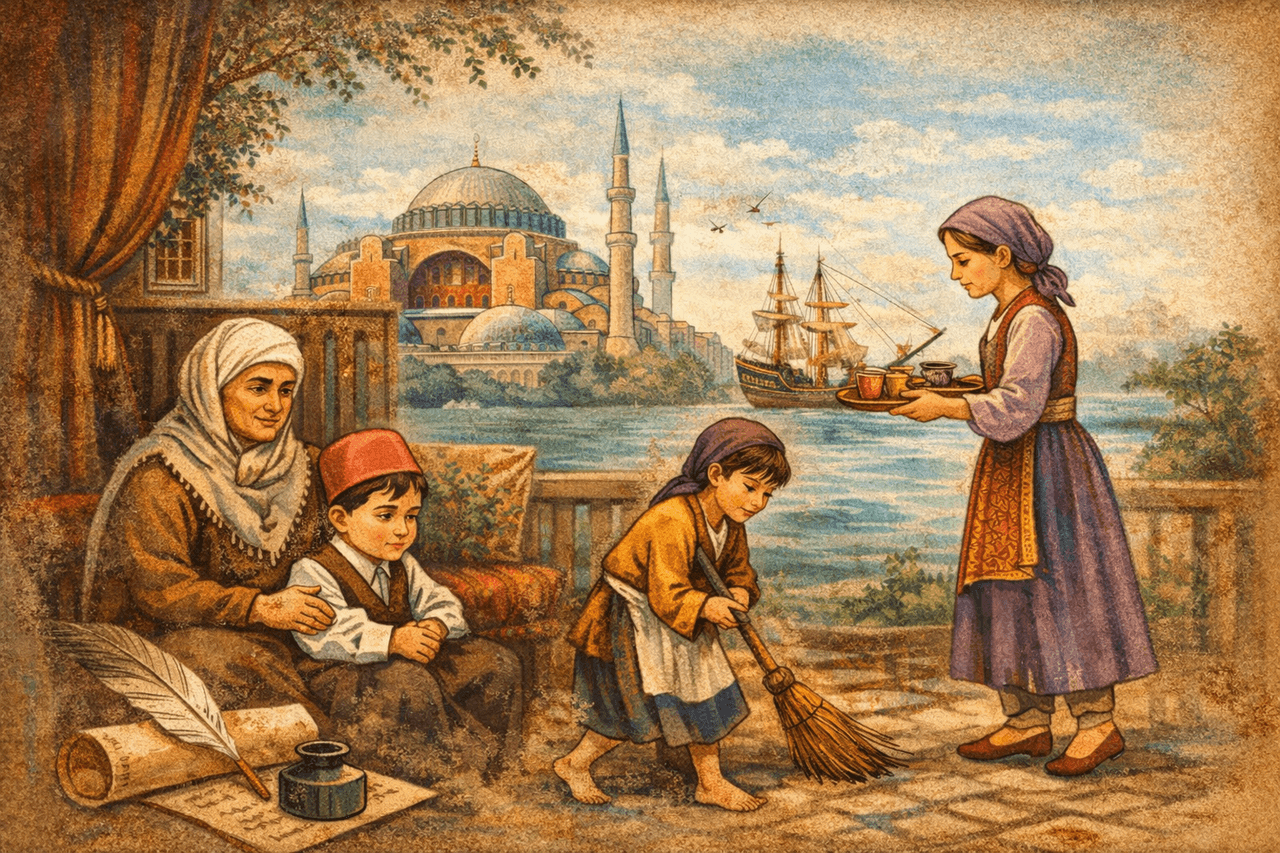
The status of foster children occupies an ambiguous position between “child” and “servant”; the use of girls specifically for domestic labor highlights this distinction. In this context, the institution of foster care represents a structure in which discourses of protection and upbringing converge with labor relations within the same social practice.【5】This context reveals foster care as a structure where care and labor relations merge within a single social practice.【6】
Generated by artificial intelligence.
In classical Islamic law, the institution of adoption was not recognized as creating a legal kinship bond; instead, the protection and upbringing of orphaned children were encouraged. Consequently, in Ottoman society, no legal lineage was established between foster children and their new families, and foster children did not possess fundamental legal rights such as inheritance.【7】This legal structure shaped foster care as a relationship governed not by formal adoption but by social and moral responsibilities.【8】
Slavery remained a legal institution in the Ottoman Empire, but over time initiatives emerged to restrict and eventually abolish the slave trade. Steps toward banning slave trading were taken with the imperial decrees of 1847 and 1857, and slavery lost its legal foundation with the establishment of the Republic and the abolition of Sharia law.【9】
During this process, foster care practices became more widespread as children taken in as foster children replaced slaves in domestic labor relations.【10】It is noted that the transition from slavery to foster care became more pronounced after 1864.【11】
During the Ottoman period, foster care became especially widespread in major cities and increasingly involved girls. This practice was linked to the employment of foster children in domestic chores, preparation for gendered roles, and their incorporation into domestic labor relations.【12】
The limited access of foster children to education, their classification as part of domestic labor, and their frequent positioning in roles similar to servants are among the sociological characteristics of this institution.【13】
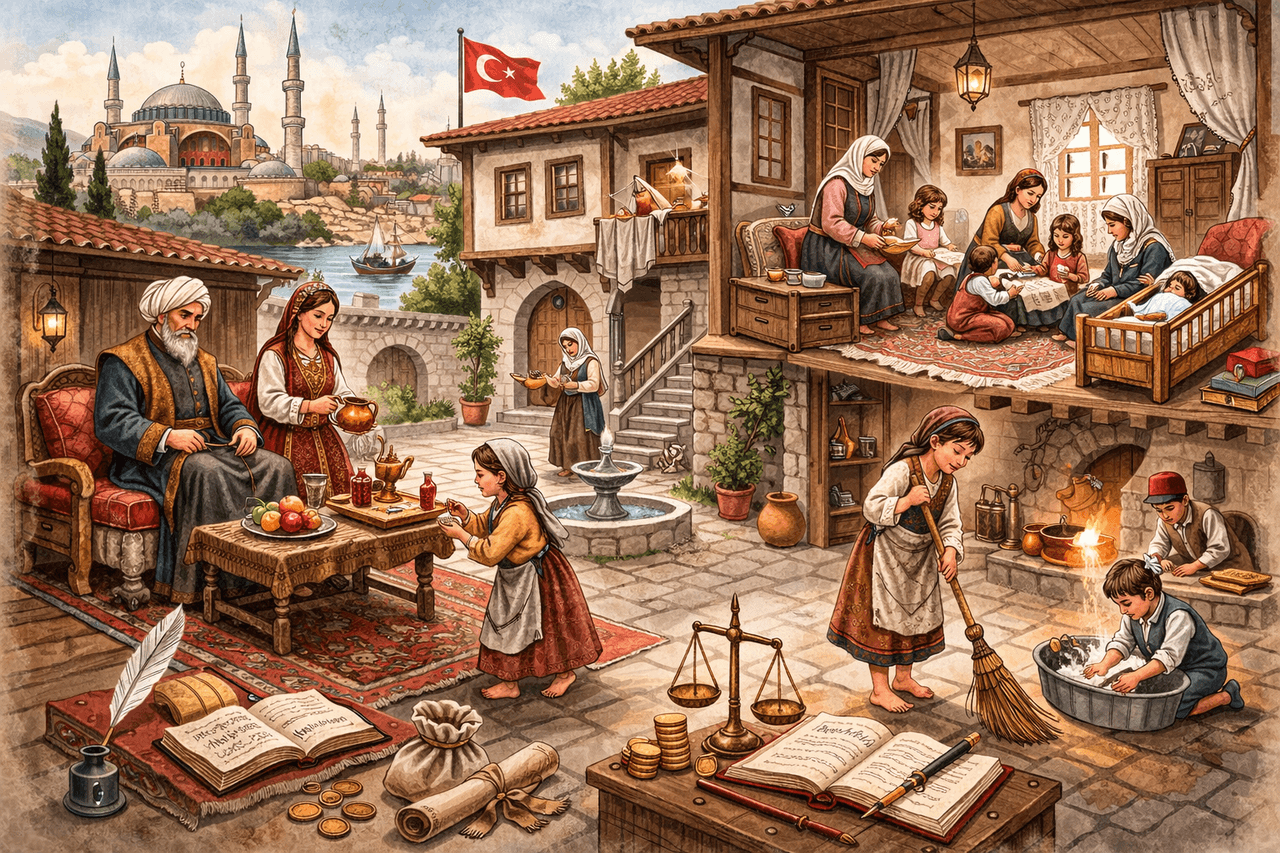
During the Republican period, slavery lost its legal foundation with the Civil Code of 1926, yet foster care practices inherited from the Ottoman era continued as social practices for some time.【14】The legal foundations of slavery and similar practices were formally abolished in 1964.【15】Nevertheless, foster care persisted in social life, particularly within domestic labor relations, and was not entirely eradicated despite legal prohibitions.【16】
Generated by artificial intelligence.
During the Republican period, the institution of foster care took on different forms in response to socioeconomic changes. Children from impoverished families were often placed with wealthier households, continuing a practice that combined care and labor relations.【17】
The increasing use of foster care in place of domestic servants among lower and middle-class households emerged as a phenomenon interpreted within the contexts of class relations and child labor.【18】
The institution of foster care is regarded as a social arrangement that extends the boundaries of the family by incorporating non-relatives into the household structure. Foster children were often positioned simultaneously as individuals requiring protection and as functional actors within the household.【19】
Moreover, the practice of foster care is directly linked to child labor, gender roles, class inequalities, and power dynamics within the family.【20】
During the transition from the Ottoman Empire to the Republic, the institution of foster care did not disappear entirely but persisted, adapting its form in accordance with legal and social transformations. The shift from slavery to foster care, followed by the continuation of social practices despite legal prohibitions, underscores the cultural and historical continuity of this institution.【21】
Within this framework, the concept of foster care is understood as a historical institution that, during both the Ottoman and Republican periods, encompassed legal, sociological, and cultural dimensions, situated at the intersection of family, labor, and childhood relations.
Olpak, Mustafa. “Osmanlı İmparatorluğu’nda Köle, Türkiye Cumhuriyeti’nde Evlatlık: Afro-Türkler.” *Ankara Üniversitesi Siyasal Bilgiler Fakültesi Dergisi* 68, no. 1. Accessed February 18, 2026. Accessed Linki
Özbay, Ferhunde. *Türkiye’de Evlatlık Kurumu: Köle mi, Evlat mı?* İstanbul, 1999. Accessed February 18, 2026. Accessed Linki
Ünal, Vehbi. “Dünden Bugüne Kültürümüzde Koruyucu Aile Hizmetleri Üzerine Bazı Değerlendirmeler.” *Turkish Studies* 10, no. 6 (2015): 875–900. Accessed February 18, 2026. Accessed Linki
[1]
Ferhunde Özbay, Türkiye’de Evlatlık Kurumu: Köle mi, Evlat mı? (İstanbul, 1999), 1.
[2]
Özbay, Türkiye’de Evlatlık Kurumu, 1–7.
[3]
Özbay, Türkiye’de Evlatlık Kurumu, 1–7.
[4]
Özbay, Türkiye’de Evlatlık Kurumu, 1–7.
[5]
Özbay, Türkiye’de Evlatlık Kurumu, 1–7.
[6]
Özbay, Türkiye’de Evlatlık Kurumu, 1–7.
[7]
Özbay, Türkiye’de Evlatlık Kurumu, 1–7.
[8]
Özbay, Türkiye’de Evlatlık Kurumu, 1–7.
[9]
Mustafa Olpak, “Osmanlı İmparatorluğu’nda Köle, Türkiye Cumhuriyeti’nde Evlatlık: Afro-Türkler,” Ankara Üniversitesi SBF Dergisi, 68, no. 1, 123–126.
[10]
Mustafa Olpak, “Osmanlı İmparatorluğu’nda Köle, Türkiye Cumhuriyeti’nde Evlatlık: Afro-Türkler,” Ankara Üniversitesi SBF Dergisi, 68, no. 1, 123–126.
[11]
Mustafa Olpak, “Osmanlı İmparatorluğu’nda Köle, Türkiye Cumhuriyeti’nde Evlatlık: Afro-Türkler,” Ankara Üniversitesi SBF Dergisi, 68, no. 1, 123–126.
[12]
Özbay, Türkiye’de Evlatlık Kurumu, 1–7.
[13]
Mustafa Olpak, “Osmanlı İmparatorluğu’nda Köle, Türkiye Cumhuriyeti’nde Evlatlık: Afro-Türkler,” Ankara Üniversitesi SBF Dergisi, 68, no. 1, 123–126.
[14]
Mustafa Olpak, “Osmanlı İmparatorluğu’nda Köle, Türkiye Cumhuriyeti’nde Evlatlık: Afro-Türkler,” Ankara Üniversitesi SBF Dergisi, 68, no. 1, 123–126.
[15]
Mustafa Olpak, “Osmanlı İmparatorluğu’nda Köle, Türkiye Cumhuriyeti’nde Evlatlık: Afro-Türkler,” Ankara Üniversitesi SBF Dergisi, 68, no. 1, 123–126.
[16]
Mustafa Olpak, “Osmanlı İmparatorluğu’nda Köle, Türkiye Cumhuriyeti’nde Evlatlık: Afro-Türkler,” Ankara Üniversitesi SBF Dergisi, 68, no. 1, 123–126.
[17]
Özbay, Türkiye’de Evlatlık Kurumu, 1–7.
[18]
Özbay, Türkiye’de Evlatlık Kurumu, 1–7.
[19]
Özbay, Türkiye’de Evlatlık Kurumu, 1–7.
[20]
Özbay, Türkiye’de Evlatlık Kurumu, 1–7.
[21]
Mustafa Olpak, “Osmanlı İmparatorluğu’nda Köle, Türkiye Cumhuriyeti’nde Evlatlık: Afro-Türkler,” Ankara Üniversitesi SBF Dergisi, 68, no. 1, 123–126.

No Discussion Added Yet
Start discussion for "The Concept of Adoption in the Ottoman and Republican Periods" article
Definition
Conceptual Framework: Foster Care, Slavery, and Household Structure
Foster Care in the Ottoman Period
Legal and Religious Framework
Transition from Slavery to Foster Care
Social Function and Gender Dimension
Foster Care in the Republican Period
Legal Transformation
Socioeconomic Structure and Institutionalization
Sociological Characteristics of the Foster Care Institution
Historical Continuity and Transformation