


This article was automatically translated from the original Turkish version.

One of the foundational principles of computer science, the Von Neumann Architecture was proposed by John von Neumann in 1945 and has since played a defining role in the design of digital computers. Despite the rapid advancement of technology today, the majority of modern computer systems still rely on the Von Neumann principle. This article examines the impact of the Von Neumann Architecture on contemporary technologies, both in hardware and software contexts, and explores its advantages, limitations, and relationship with modern alternatives.
A schematic representation showing its five classic components: CPU, Memory, Input/Output, Data Bus, and Control Unit:

Von Neumann Architecture Diagram (Generated by artificial intelligence.)
The Von Neumann Architecture consists of five fundamental components: the central processing unit (CPU), memory, input units, output units, and data buses connecting these components. Its most distinctive feature is the storage of both data and instructions in the same memory unit. This approach enabled the birth of programmable machines and revolutionized computer engineering.
Today, many digital devices—from personal computers and smartphones to servers and embedded systems—operate on Von Neumann-based architectures. The coordinated operation of the CPU and RAM allows programs to be fetched and executed sequentially from memory, which remains the fundamental operating principle of most processors.
In addition, the majority of modern operating systems and compilers have been developed to conform to the Von Neumann model. Software developers structure their programs according to this architecture; memory addressing, control flow, and data management are all designed with this structure in mind.
The greatest limitation of this architecture is known as the “Von Neumann bottleneck.” Since the CPU must access both instructions and data through a single data bus, it creates a performance bottleneck, especially in applications requiring high computational power. This issue has become increasingly pronounced in modern high-performance applications and has spurred the search for alternative architectures.
To mitigate this bottleneck, various solutions have been developed. The use of cache memory has become widespread to accelerate data flow between the processor and main memory. Additionally, modern approaches such as parallel processors, multi-core architectures, and the general-purpose use of graphics processing units (GPGPU) have been designed to overcome the Von Neumann bottleneck.
A graphic illustrating the bottleneck created by the single data path between the processor and memory:

Von Neumann Bottleneck Visualization (Generated by artificial intelligence.)
The Harvard Architecture offers an alternative to the Von Neumann model by storing data and instructions in separate memory units and is widely used in microcontrollers. Furthermore, experimental technologies such as quantum computers, neuromorphic processors, and biological computing systems are based on entirely different computational paradigms.
Nevertheless, the simplicity and universality provided by the Von Neumann Architecture continue to make it the preferred choice in many domains. Its influence can be traced across a broad spectrum, from education to industry.
A comparative table highlighting the key differences between the two architectures:
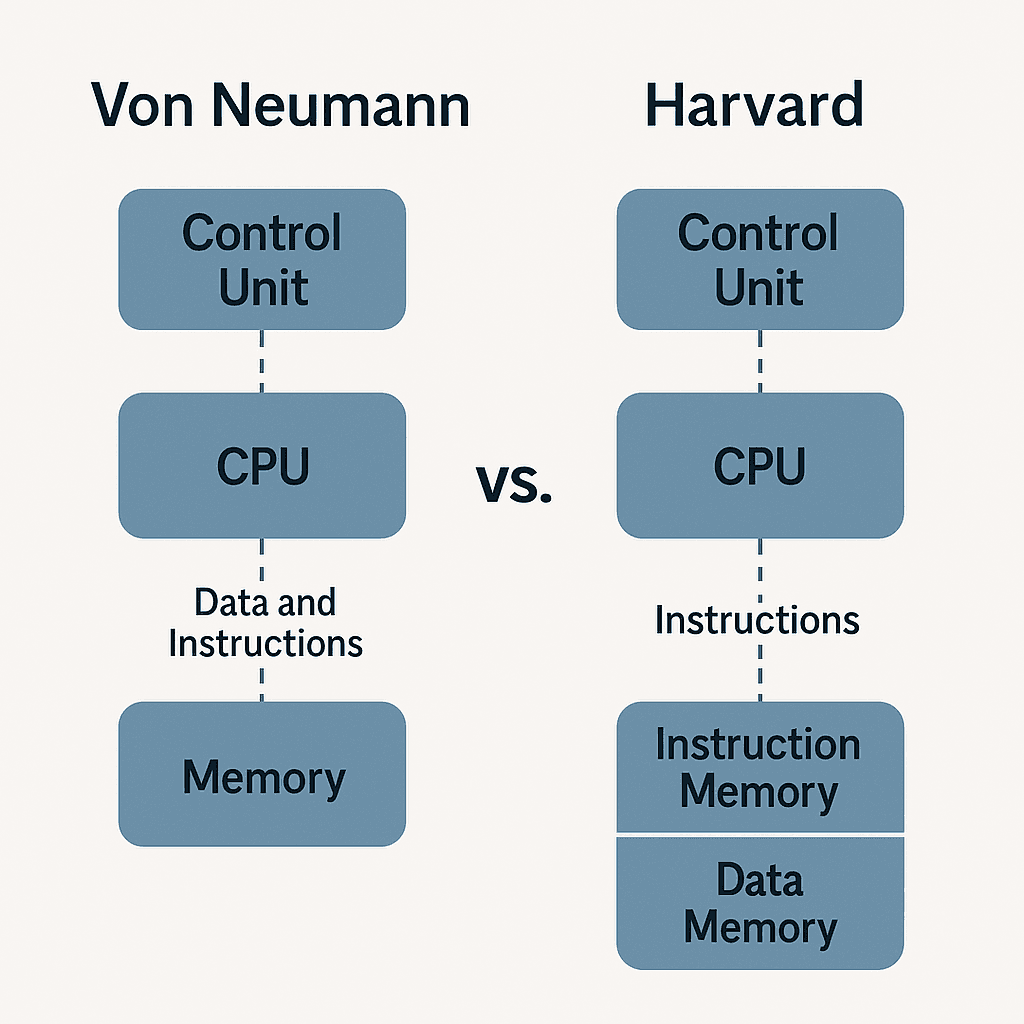
Von Neumann vs Harvard Architecture Comparison (Generated by artificial intelligence.)
The Von Neumann Architecture continues to form the backbone of modern computer technology. Although it has certain limitations, this structure has left deep imprints in both hardware and software domains and has served as inspiration for new technologies. The hybrid systems and alternative architectures developed today demonstrate how forward-thinking Von Neumann’s original vision was. Even if future architectures eventually replace it, its fundamental principles will remain among the foundational pillars of computing history.
Modern application examples illustrating how today’s devices (PCs, mobiles, servers, embedded systems) are architecturally based on Von Neumann principles:

Von Neumann Traces in Modern Technology (Generated by artificial intelligence.)
Accessed November 26, 2025.
GeeksforGeeks. "Difference between Von Neumann and Harvard Architecture." GeeksforGeeks, June 21, 2022.
Spiceworks. "Von Neumann Architecture vs Harvard Architecture." Spiceworks By Hossein Ashtari, April 20, 2023.
TechTarget. "Von Neumann Bottleneck." TechTarget By Robert Sheldon, May 5, 2025.
The provided input contains no actual citation text to translate—only HTML markup with a placeholder (`https://www.geeksforgeeks.org/difference-between-von-neumann-and-harvard-architecture/`) and a styled dot. There is no Turkish content to translate.Please provide the full Turkish citation text (e.g., author, title, access date, URL, etc.) for accurate translation according to the specified rules.
The provided text contains no citable content—only an empty citation placeholder with styling. There is no Turkish text to translate.If you have a citation in Turkish that needs translation, please provide it. Otherwise, this output remains as-is:
The provided text contains no citation content to translate—only an HTML placeholder (`https://alperenonal.com/blog/von-neumann-mimarisi-vs-hardvard-mimarisi`) and a styled dot. There is no Turkish text to translate.Please provide the actual Turkish citation text for translation.
Önal, Alperen. "Von Neumann Mimarisi vs Harvard Mimarisi." Alperen Önal Blogu, May 5, 2025.
Von Neumann Architecture Diagram
Core Principles of Von Neumann Architecture
Impact on Modern Computer Systems
Von Neumann Bottleneck and Its Contemporary Implications
Von Neumann Bottleneck Visualization
Alternative Architectures and Future Perspectives
Comparison of Von Neumann and Harvard Architectures
Von Neumann Traces in Modern Technology