


This article was automatically translated from the original Turkish version.
Saraybosna, due to its multicultural demographic structure that houses places of worship for communities of different faiths, is known as "the Jerusalem of Europe."【1】 In the city’s historical chronology, April 6 is a strategic turning point that embodies memories of both destruction and liberation.
A Breath on the Siege of Saraybosna: The Tunnel of Hope (TRT News)
During World War II, the city was bombed by Nazi Germany on April 6, 1941, and entered a harsh occupation period.【2】
This occupation ended exactly four years later, on April 6, 1945, when the former Yugoslavia army conducted military operations that cleared the city of hostile elements. During the conflicts of World War II, a total of 10,961 Saraybosna residents lost their lives, including 7,092 Jews. This historical background has cemented Saraybosna’s place in collective memory as both a symbol of resistance and a geography where peace remains fragile.【3】
During the dissolution of Yugoslavia, Bosnia and Herzegovina’s pursuit of independence acquired an international dimension. While the international community was inclined to recognize Bosnia and Herzegovina’s independence, it insisted on a referendum to legitimize the process. Despite open threats from Serbian political and military factions, Bosnia and Herzegovina’s government decided in February 1992 to hold a referendum, accelerating the independence process.【4】 As a result of the referendum held on March 1, 1992, Bosnia and Herzegovina officially declared its independence in accordance with the will of the people. However, this decision was met with military intervention by Serb forces, marking the beginning of what would become the longest siege in modern history.【5】
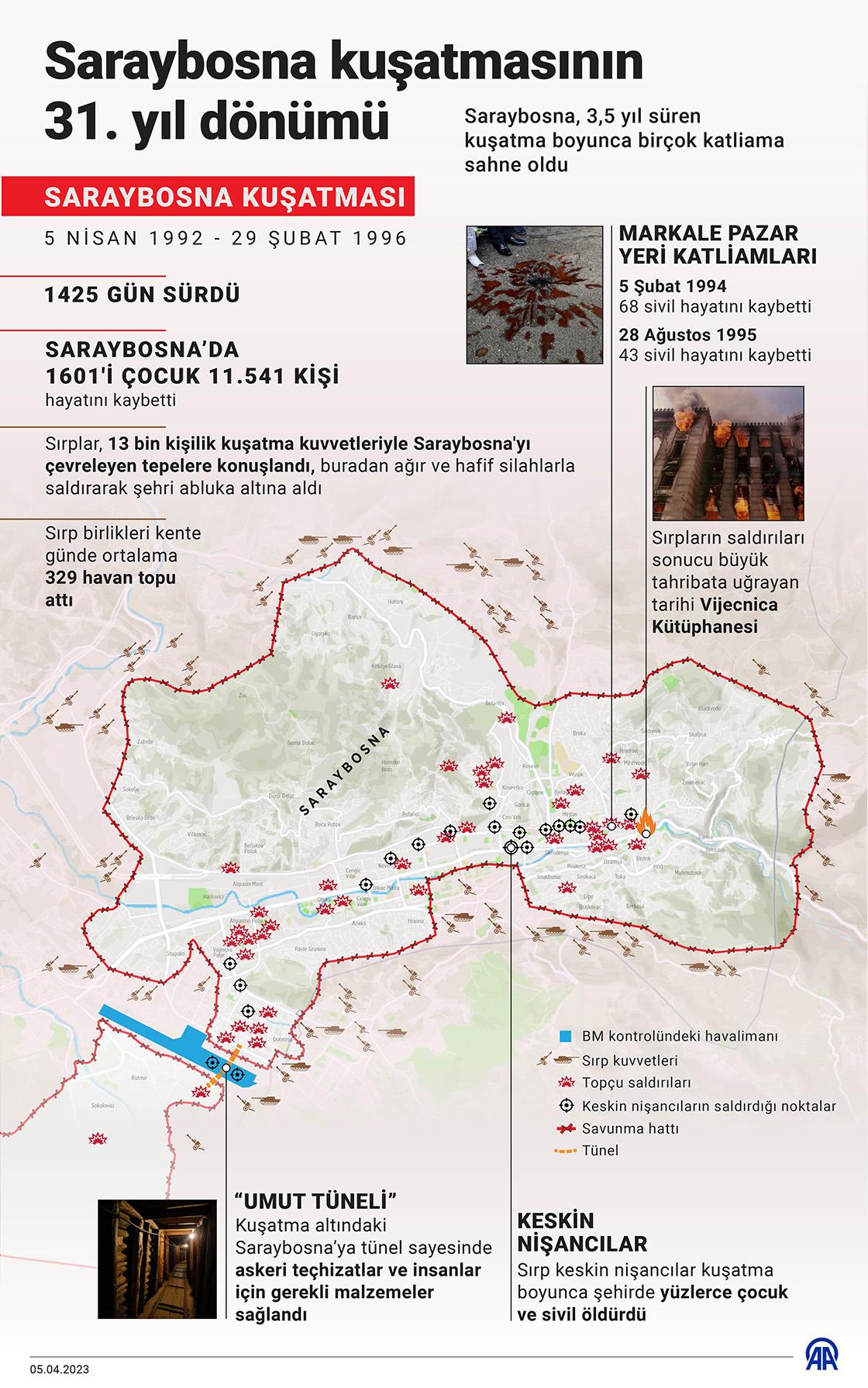
Infographic on the Siege of Saraybosna (Anadolu Ajansı)
Following the declaration of independence, tensions escalated, and on April 5, 1992, Serbian forces erected the first barricades around the city, seizing strategic positions. The event widely recognized as the official start of the siege occurred when Serbian snipers opened fire on peaceful demonstrators in Saraybosna on April 5. In this attack, two civilian women, Suada Dilberović and Olga Sučić, were killed and numerous protesters were wounded. Immediately after these assassinations, on April 6, 1992, Saraybosna was bombed for the first time, and the city was completely cut off from the outside world, beginning a 1,425-day blockade.【6】
The Siege of Saraybosna lasted a total of 1,425 days and is recorded as the longest siege in modern warfare history. From April 6, 1992, to February 29, 1996, the city endured relentless heavy bombardment and systematic attacks by Serbian forces. During this period, heavily armed units stationed on the hills and mountains surrounding the city controlled all entry and exit points, halting logistical supply lines. For nearly four years, the people of Saraybosna struggled to survive in an environment where access to basic human needs was blocked and the threat of death was constant.【7】
The human cost of the siege was extremely heavy. During the 1,425 days of attacks, 11,541 civilians in Saraybosna lost their lives. The most tragic aspect of these losses was the 1,601 children who perished under siege. Serbian forces carried out indiscriminate bombardments from positions dominating the city, while snipers directly targeted women, children, and the elderly going about their daily routines. Civilians became victims of aerial attacks while waiting in bread lines or shopping at markets. On average, 329 artillery shells landed on the city each day. In addition to human losses, the city’s cultural heritage—including libraries, madrasas, and historic structures—was systematically bombed and severely damaged.【8】
To provide the besieged city with breathing space and to meet its military and food needs, a tunnel construction plan was developed by Alija Izetbegović and his military staff. A house in the Butmir region near Mount Igman was identified as the ideal location for the tunnel entrance. Excavation work, initiated in 1993, was planned to pass beneath the Saraybosna Airport runway and lasted four months and four days. Completed on July 30, the tunnel is 800 meters long, one meter wide, and 160 centimeters high. Its floor was reinforced with wooden planks and logs, and later equipped with a rail system. This tunnel became Saraybosna’s only secure link to the outside world, significantly enhancing the city’s capacity to resist.【9】
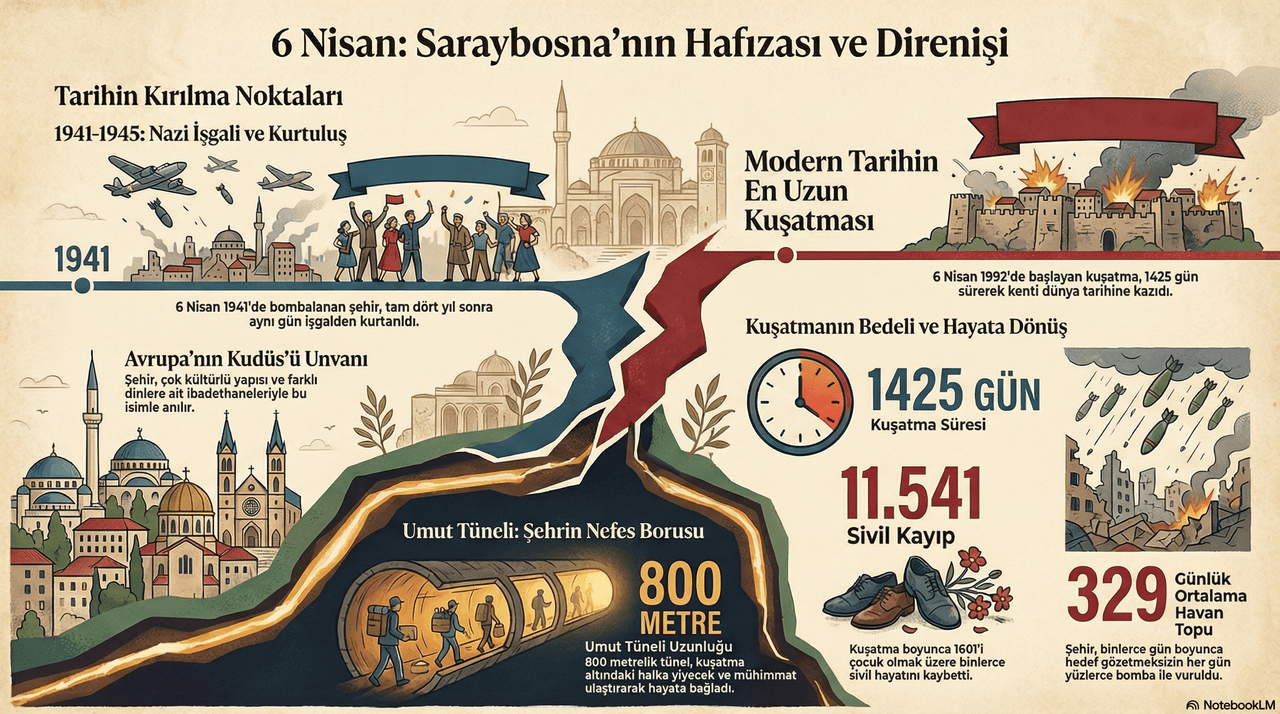
Infographic on the Siege of Saraybosna (Generated by Artificial Intelligence)
Militarily, the siege was based on a significant imbalance. Serbian forces deployed approximately 13,000 heavily armed troops and armored vehicles on strategic elevations surrounding the city. In contrast, within the besieged city, the Army of the Republic of Bosnia and Herzegovina (ARBiH) managed to organize a force of approximately 70,000 personnel over a period of 19 months. However, despite its numerical superiority, the ARBiH failed to achieve full success in its attempts to break the siege from the outside due to insufficient military equipment and heavy weaponry.【10】
The war in Bosnia ended not only through military efforts but also through intensive diplomatic negotiations. At the initiative of American diplomat Richard Holbrooke, an agreement was reached on November 21, 1995, at the Dayton Air Force Base in Ohio, USA. This peace agreement was initialed by Bosnia and Herzegovina’s first President Alija Izetbegović, former Serbian President Slobodan Milošević, and former Croatian President Franjo Tuđman. This diplomatic resolution halted hostilities on the ground and paved the way for the official lifting of the siege of Saraybosna.【11】
Today, April 6 is recognized in Saraybosna both as the anniversary of liberation from Nazi occupation—“City Day”—and as a day to commemorate the victims of the 1992–1995 siege. Annual ceremonies begin at the Eternal Flame Memorial, built in honor of those who died during World War II, and continue at the Kovači Cemetery, where Alija Izetbegović is also buried. High-level participation is ensured by members of the state presidency council, ministers, and ambassadors. Despite the passage of 34 years, the traces of the siege continue to be preserved in the city’s architecture and collective memory, with prayers offered and commemorative ceremonies held for those who lost their lives.【12】
Anadolu Ajansı. "Saraybosna kuşatmasının 34. yılında yaşatılan acılar unutulmuyor." Accessed April 6, 2024. https://www.aa.com.tr/tr/dunya/saraybosna-kusatmasinin-34-yilinda-yasatilan-acilar-unutulmuyor/3891434
Anadolu Ajansı. "Saraybosna kuşatmasının üzerinden 31 yıl geçti." Accessed April 6, 2026. https://www.aa.com.tr/tr/dunya/saraybosna-kusatmasinin-uzerinden-31-yil-gecti/2864018
Anadolu Ajansı. "Saraybosna'nın savunmasında hayatını kaybedenler için törenler düzenlendi." Accessed April 6, 2026. https://www.aa.com.tr/tr/ayrimcilikhatti/dun-bugun/saraybosnanin-savunmasinda-hayatini-kaybedenler-icin-torenler-duzenlendi/1830157
TRT Haber. "Saraybosna kuşatmasına bir nefes: Umut Tüneli." YouTube. Accessed April 6, 2026. https://www.youtube.com/watch?v=Ry8Rz4fSuGg
[1]
Anadolu Ajansı. "Saraybosna kuşatmasının 34. yılında yaşatılan acılar unutulmuyor." Erişim Tarihi 6 Nisan 2024. https://www.aa.com.tr/tr/dunya/saraybosna-kusatmasinin-34-yilinda-yasatilan-acilar-unutulmuyor/3891434
[2]
Anadolu Ajansı. "Saraybosna'nın savunmasında hayatını kaybedenler için törenler düzenlendi." Erişim Tarihi 6 Nisan 2026. https://www.aa.com.tr/tr/ayrimcilikhatti/dun-bugun/saraybosnanin-savunmasinda-hayatini-kaybedenler-icin-torenler-duzenlendi/1830157
[3]
Anadolu Ajansı. "Saraybosna kuşatmasının 34. yılında yaşatılan acılar unutulmuyor." Erişim Tarihi 6 Nisan 2024. https://www.aa.com.tr/tr/dunya/saraybosna-kusatmasinin-34-yilinda-yasatilan-acilar-unutulmuyor/3891434
[4]
Anadolu Ajansı. "Saraybosna kuşatmasının 34. yılında yaşatılan acılar unutulmuyor." Erişim Tarihi 6 Nisan 2024. https://www.aa.com.tr/tr/dunya/saraybosna-kusatmasinin-34-yilinda-yasatilan-acilar-unutulmuyor/3891434
[5]
TRT News. "A Breath on the Siege of Saraybosna: The Tunnel of Hope." Youtube. Access Date: April 6, 2026. https://www.youtube.com/watch?v=Ry8Rz4fSuGg
[6]
Anadolu Ajansı. "Saraybosna kuşatmasının 34. yılında yaşatılan acılar unutulmuyor." Erişim Tarihi 6 Nisan 2024. https://www.aa.com.tr/tr/dunya/saraybosna-kusatmasinin-34-yilinda-yasatilan-acilar-unutulmuyor/3891434
[7]
Anadolu Ajansı. "Saraybosna kuşatmasının 34. yılında yaşatılan acılar unutulmuyor." Erişim Tarihi 6 Nisan 2024. https://www.aa.com.tr/tr/dunya/saraybosna-kusatmasinin-34-yilinda-yasatilan-acilar-unutulmuyor/3891434
[8]
Anadolu Ajansı. "Saraybosna kuşatmasının 34. yılında yaşatılan acılar unutulmuyor." Erişim Tarihi 6 Nisan 2024. https://www.aa.com.tr/tr/dunya/saraybosna-kusatmasinin-34-yilinda-yasatilan-acilar-unutulmuyor/3891434
[9]
TRT News. "A Breath on the Siege of Saraybosna: The Tunnel of Hope." Youtube. Access Date: April 6, 2026. https://www.youtube.com/watch?v=Ry8Rz4fSuGg
[10]
Anadolu Ajansı. "Saraybosna kuşatmasının 34. yılında yaşatılan acılar unutulmuyor." Erişim Tarihi 6 Nisan 2024. https://www.aa.com.tr/tr/dunya/saraybosna-kusatmasinin-34-yilinda-yasatilan-acilar-unutulmuyor/3891434
[11]
Anadolu Ajansı. "Saraybosna kuşatmasının 34. yılında yaşatılan acılar unutulmuyor." Erişim Tarihi 6 Nisan 2024. https://www.aa.com.tr/tr/dunya/saraybosna-kusatmasinin-34-yilinda-yasatilan-acilar-unutulmuyor/3891434
[12]
Anadolu Ajansı. "Saraybosna kuşatmasının 34. yılında yaşatılan acılar unutulmuyor." Erişim Tarihi 6 Nisan 2024. https://www.aa.com.tr/tr/dunya/saraybosna-kusatmasinin-34-yilinda-yasatilan-acilar-unutulmuyor/3891434
Bosnia and Herzegovina’s Independence Process and the Referendum Decision (1992)
First Barricades and the Assassinations of Suada Dilberović and Olga Sučić
The Longest Siege in Modern History: The 1,425-Day Period
Civilian Casualties, Child Deaths, and Urban Destruction
Construction and Function of the Tunnel of Hope (Butmir)
Serbian Forces and the Army of the Republic of Bosnia and Herzegovina (ARBiH)
The Dayton Peace Agreement
The Siege in Collective Memory: City Day and Commemorative Ceremonies
