


This article was automatically translated from the original Turkish version.

The United States of America stands out as a society shaped by immigration throughout its history. Millions of people from Europe, Asia, and the Middle East have turned toward America over different periods, driven by economic political or religious motives in search of a new life. Ellis Island became the symbol of this immigration history, serving as a “gateway” through which approximately 12 million immigrants entered the country between 1892 and 1954. Yet this island was not merely a point of control; it was also a symbolic space where American identity and its multicultural structure were born.
Ellis Island was established in the late 19th century to manage the growing wave of immigration to the United States. Prior to its establishment, immigrant intake was handled at Castle Garden in New York; however, due to insufficient capacity, Ellis Island was officially designated as the primary immigration reception center in 1892.
Health and identity inspections conducted on the island reflected the disciplinary character of immigration policy in America at the time. Doctors marking immigrants’ shoulders with chalk letters such as “C” for chest disease, “E” for eye conditions, and “H” for heart problems demonstrated how thorough and exclusionary medical examinations were.

Visual Representation of New Arrivals at Ellis Island in the Early 20th Century (Generated by Artificial Intelligence)
This process also reflected the tension between America’s desire to regulate the labor force needed during its industrialization and its concerns over national security. Although America sought to secure the workforce it required, it also aimed to position itself appropriately within the turbulent political landscape of the era. Initially, immigration admission was relatively open, but laws enacted in the early 20th century introduced literacy tests and national quotas. These measures significantly hindered entry for groups originating outside Europe.
The historical function of Ellis Island is closely linked to the United States’ assimilation and multiculturalism policies. From its early days, America oscillated between two distinct social-political approaches regarding immigrant diversity: one promoting assimilation and the other embracing multiculturalism.
The “melting pot” metaphor long represented America’s effort to dissolve diverse cultures into a single national identity. Championed by the Chicago School of Sociology, this approach held that full integration of immigrants into the “American mainstream” was a prerequisite for social unity. However, in the second half of the 20th century, the discourse of multiculturalism gained prominence, and the preservation of immigrant identities began to be viewed as part of social richness.
Ellis Island became a tangible symbol of this transformation. Once a site of exclusion and selection, the island was designated a National Monument in 1976 and converted into the Ellis Island National Museum of Immigration. This change reflects an ideological shift in how America views its immigration past.
In the context of Turkish migration, Ellis Island witnessed the wave of emigration that began in the final years of the Ottoman Empire and continued throughout the 20th century. The first significant wave of migration from the Ottoman Empire to the United States occurred in the last quarter of the 19th century, with most migrants leaving rural areas of eastern Anatolia for economic reasons.
These migrants, largely young unmarried men, moved to cities such as New York, Chicago, and Detroit to take up low-wage jobs in America’s industrializing economy.【1】 Many of this first generation viewed their move to America as temporary, intending to return to Türkiye with the money they earned; however, some settled permanently and integrated into American society through intermarriage with other ethnic groups. It is important to note that these immigrants often identified themselves not as “Turks” but as “Ottomans” or “Muslims,” indicating that religious affiliation, rather than national identity, was the defining factor. This identification also exemplifies the enduring influence of imperial legacies, even as the 19th and 20th centuries witnessed the global rise of nationalism movements that threatened the very existence of empires.
Content Narrating the Experience of Immigrants at Ellis Island ()
Ellis Island holds significance not only as a historical site but also as a cultural and emotional space of memory. Today, the island represents the collective place of immigration in public memory through photography, literature, and contemporary art. American sociologist and photographer Lewis Hine, in the early 1900s, portrayed immigrants not as a “threat” but as individuals embodying human dignity through his portraits taken on Ellis Island. These photographs reveal that immigration was not merely an economic phenomenon but also a struggle for identity and belonging.
The immigrants captured in Hine’s lens are foundational pillars of modern American society. In this sense, Ellis Island has become a symbol where individual stories intersect with national identity. Today, the island is not only a witness to the past but also a reminder of the ongoing effort of diverse cultures to coexist in America.
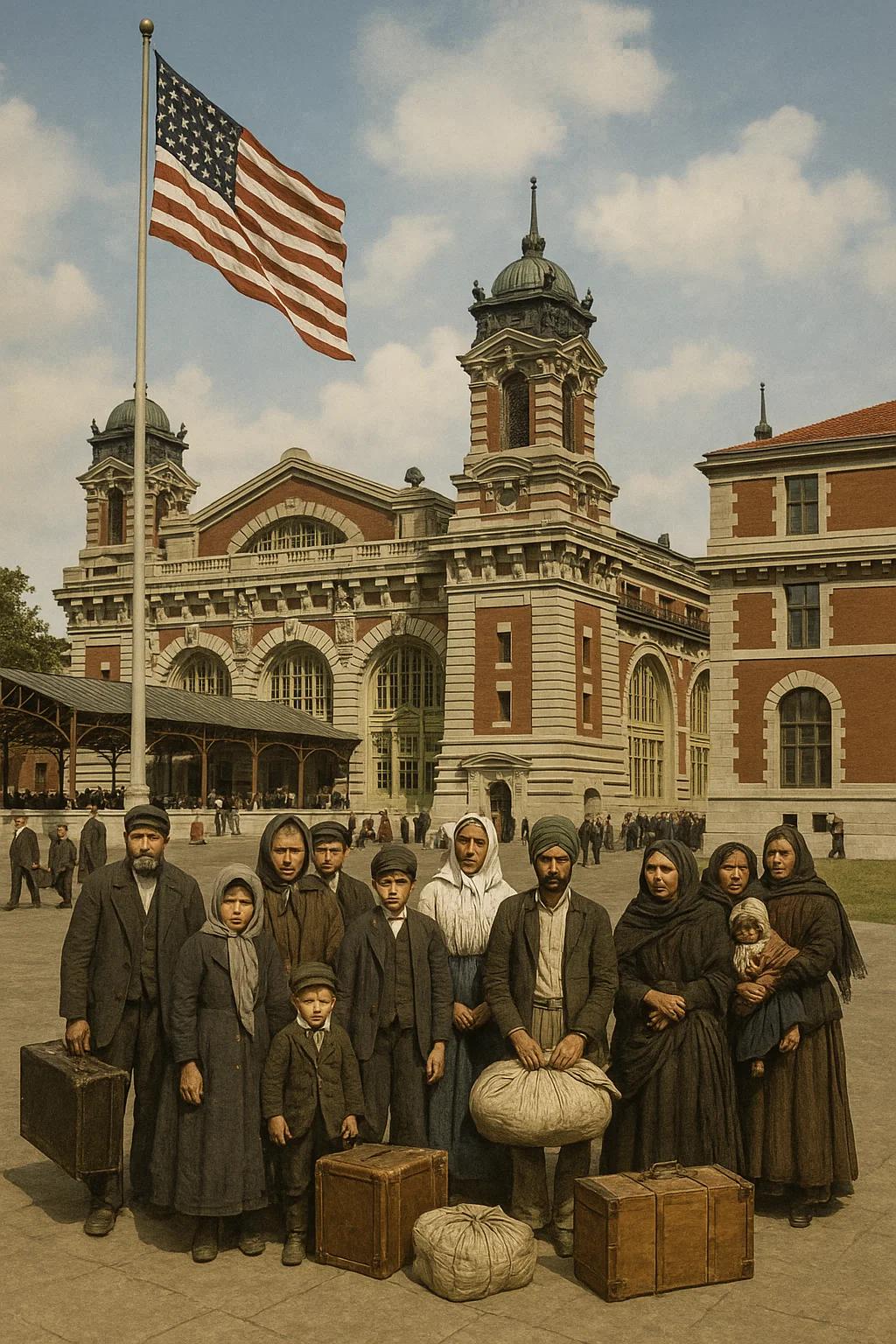
A Family Emigrating to the United States (Generated by Artificial Intelligence)
Ellis Island is more than a place synonymous with the immigration history of the United States of America; it is a memory space that sheds light on contemporary global debates about cultural pluralism. Once a site of selection, rejection, and exclusion, the island has transformed into a shared center of memory that recognizes difference. Ellis Island, home to the stories of millions of people including Turkish immigrants, continues to stand as the symbolic starting point of individual hopes and the global history of migration.
Kaya, İlhan. “Amerikalı Türkler [Turkish Americans].” *Coğrafi Bilimler Dergisi* 4, no. 2 (2006): 1–13. Accessed October 29, 2025. https://dergipark.org.tr/tr/download/article-file/691458
YouTube. "Ellis Island: Gateway to America." YouTube video, 5:12. Uploaded by National Archives, January 15, 2020. Accessed October 30, 2025. https://www.youtube.com/watch?v=bDNKHWzQiz8
Şan, Mustafa Kemal, and İrfan Haşlak. “Asimilasyon ile Çokkültürlülük Arasında Amerikan Anaakımını Yeniden Düşünmek [Between Assimilation and Multiculturalism: Rethinking the American Mainstream].” *Akademik İncelemeler Dergisi* 7, no. 1 (2012): 29–50. Sakarya: Sakarya Üniversitesi. Accessed October 29, 2025.
[1]
İlhan Kaya, “Amerikalı Türkler,” Coğrafi Bilimler Dergisi 4, no. 2 (2006): 4, https://dergipark.org.tr/tr/download/article-file/691458
Historical Function of Ellis Island
Immigration and the American Mainstream
The Experience of Turkish Immigrants
Ellis Island as a Site of Memory