


This article was automatically translated from the original Turkish version.
+1 More
Şivlilik is a traditional child-centered custom observed in Türkiye’s Konya province, marking the beginning of the three sacred months according to the Islamic lunar calendar. This practice takes place between the night before Regaip Kandili and the morning of the kandili itself, during which children visit homes in their neighborhoods collecting sweets, cookies, and similar treats. Şivlilik embodies a cultural practice that reflects the sharing of spiritual joy and the strengthening of communal solidarity as the three sacred months commence.
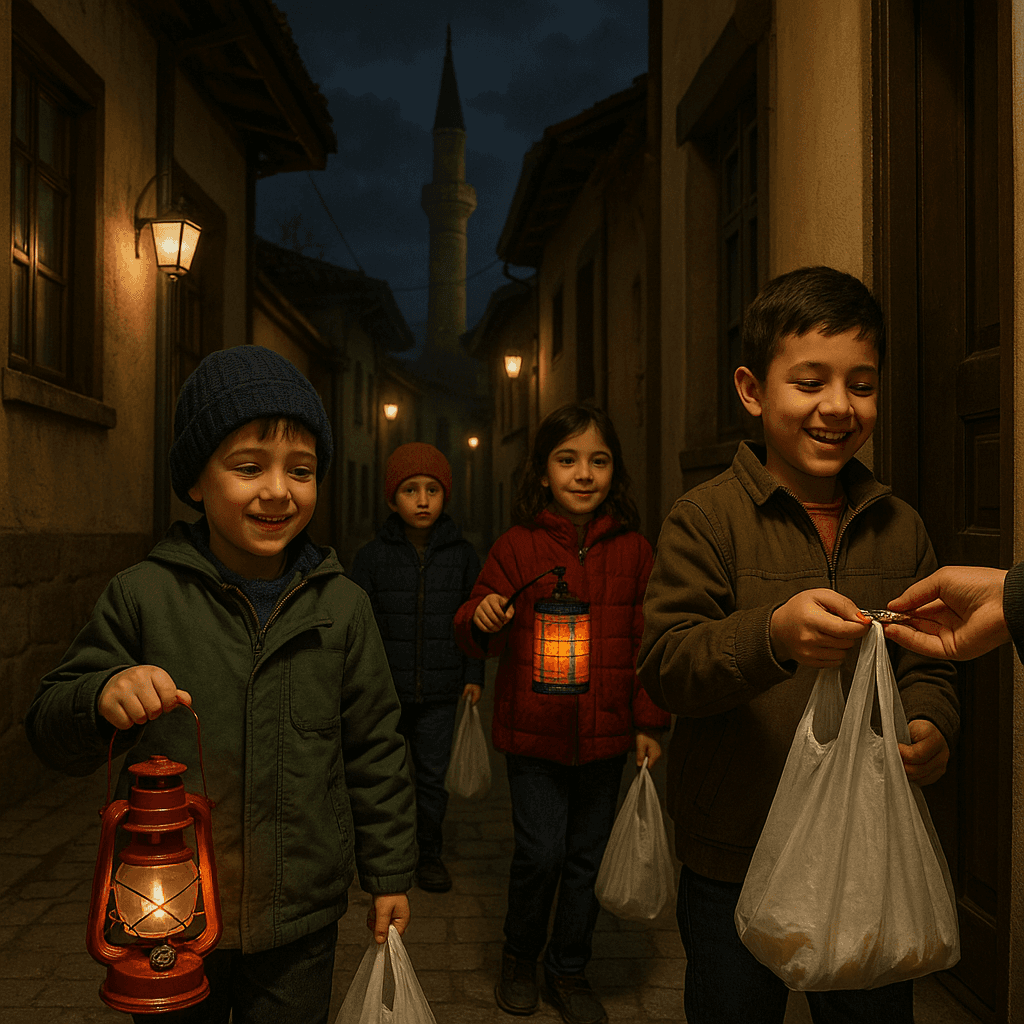
Şivlilik Tradition (generated by artificial intelligence.)
The exact origin of the Şivlilik tradition is unknown, but it is widely accepted to have been practiced for centuries within Konya’s folk culture. Like many other Anatolian customs, it developed in alignment with the religious calendar. Born as a way to welcome the start of the three sacred months, the tradition gradually became one of the defining symbols of Konya’s urban culture. Historical sources describe Şivlilik as a “blessing ritual” that has endured from the Ottoman period to the present. Within this framework, it has come to serve functions such as reinforcing neighborhood ties, fostering social cohesion, and instilling in children a sense of sharing and generosity.
Preparations for Şivlilik typically begin one day before Regaip Kandili. Families prepare sweets, chocolates, biscuits, cookies, dried fruits, and small gifts for the children. In some households, traditional homemade treats such as pişi, çörek, or lokma are also made. Children, meanwhile, prepare their bags, sacks, or nets in the evening; some even craft decorative lanterns. These lanterns were historically lit with candles and are now powered by battery-operated lights. Traditionally, children move in groups, and boys typically go door to door early in the morning.

Şivlilik Tradition (AA)
On the morning of Şivlilik, children take to the streets after the morning prayer. Going from door to door, they call out “Şivlilik, şivlilik!” When residents hear this call, they open their doors and place treats into the children’s bags. In some neighborhoods, children recite folk verses or rhymes, sometimes offering traditional blessings such as “Şivlilik has come to your door, may abundance fill your home.” The treats are usually shared among the children themselves, with care taken to ensure fair distribution.
Şivlilik Tradition (TRT Archive)
The primary tools used in the Şivlilik tradition are the bags, sacks, or cloth nets carried by children. Some children refer to these as “Şivlilik bags.” During evening lantern processions, small light sources known as “Şivlilik lanterns” are used. In the past, small tin lamps or gas lanterns were common; today, plastic lanterns and LED lights predominate. The lantern processions aim to joyfully embrace the spiritual atmosphere of the kandili night within the children’s world.

Şivlilik Lantern (AA)
Şivlilik is a child-centered tradition of solidarity and sharing in Konya. It fulfills three key social functions:
In this regard, Şivlilik is regarded in Konya society as both a religious and social educational element. Families involve their children in the tradition from an early age, facilitating their integration into the broader community.
Once a simple, neighborhood-based activity, Şivlilik has today become more organized with the participation of local authorities and civil society organizations. Municipalities, particularly in the districts of Karatay, Meram, and Selçuklu, now organize collective Şivlilik programs for children. These events include gift distributions and symbolic lantern parades, allowing the tradition to persist in new forms within modern urban life.
Meanwhile, the nature of the treats has also changed. In the past, dried fruits, pişi, or homemade sweets were given; today, packaged goods, candies, and chocolates are more common. Yet public interest has not diminished; the tradition remains a living element of the city’s collective memory.

Şivlilik Tradition (AA)
Şivlilik has firmly established itself as a cornerstone of the shared cultural memory of Konya’s residents. This tradition is not merely a children’s entertainment but a social gathering tied to the religious calendar. Today, it is preserved and passed on by educational institutions, foundations, and cultural associations. Introductions in schools, municipal events, and media coverage ensure that new generations remain engaged with the practice.
Şivlilik continues to thrive in Konya’s culture as one of the rare examples that seamlessly integrate local religious rituals with social solidarity, becoming an enduring symbol of the city’s identity.
Anadolu Ajansı. “Konya’da Çocukların Üç Aylar Sevinci: Şivlilik.” Accessed October 23, 2025. https://www.aa.com.tr/tr/turkiye/-konyada-cocuklarin-uc-aylar-sevinci-sivlilik/1746712
Anadolu Ajansı. “Çocukların Mutluluk Kervanı: Şivlilik.” Anadolu Ajansı. Accessed October 23, 2025. https://www.aa.com.tr/tr/yasam/cocuklarin-mutluluk-kervani-sivlilik/1097086
Bunsuz, Halil. “Kent İmgesi Bağlamında Şivlilik Geleneği”. *Milli Folklor* 19, no. 147 (2025): 53-66. Accessed October 23, 2025. https://dergipark.org.tr/tr/pub/millifolklor/issue/94721/1393043
Can, İslam, and Hüseyin Özil. "Konya’nın Sosyal İşareti: Şivlilik." Selçuk Üniversitesi Sosyal Bilimler Enstitüsü Dergisi 54, (2024): 489-507. Accessed October 23, 2025. https://doi.org/10.52642/susbed.1476385
Dost Eli Derneği. "Şivlilik Geleneği." Dost Eli Derneği Yayınları. Accessed October 23, 2025. https://dosteli.org.tr/files/d%C3%B6k%C3%BCman%20galerisi/%C5%9Eivlilik.pdf
TRT Archive. "Şivlilik Geleneği - Konya." TRT Archive YouTube Channel. Accessed October 23, 2025. https://www.youtube.com/watch?v=N8O5Vw7tr8Y
Örnekköy Ortaokulu (MEB). "Şivlilik Geleneği." Örnekköy Ortaokulu (MEB). Accessed October 23, 2025. https://ornekkoyortaokulu.meb.k12.tr/icerikler/sivlilik-gelenegi_9178879.html

No Discussion Added Yet
Start discussion for "The Tradition of Shivlilik" article
Historical Origins
Preparation Process
Ritual Process
Tools and Symbols Used
Social Function
Changes Over Time
Cultural Value and Sustainability