


This article was automatically translated from the original Turkish version.
The Twelve Labors of Heracles are a collection of mythological narratives describing the twelve arduous tasks that the hero Heracles was compelled to perform under the orders of King Eurystheus of Mycenae, as penance for a crime he committed. Heracles, known in Latin as Hercules, was the son of Zeus and Alcmene.
According to myth, during a fit of madness induced by the goddess Hera, Heracles killed his wife Megara and their children. To atone for this crime, he was required to enter the service of his cousin Eurystheus and carry out all tasks assigned to him. Eurystheus imposed upon Heracles twelve tasks that appeared impossible. These tasks, also known as the "Dodekathlos," rank among the most famous myths of antiquity.
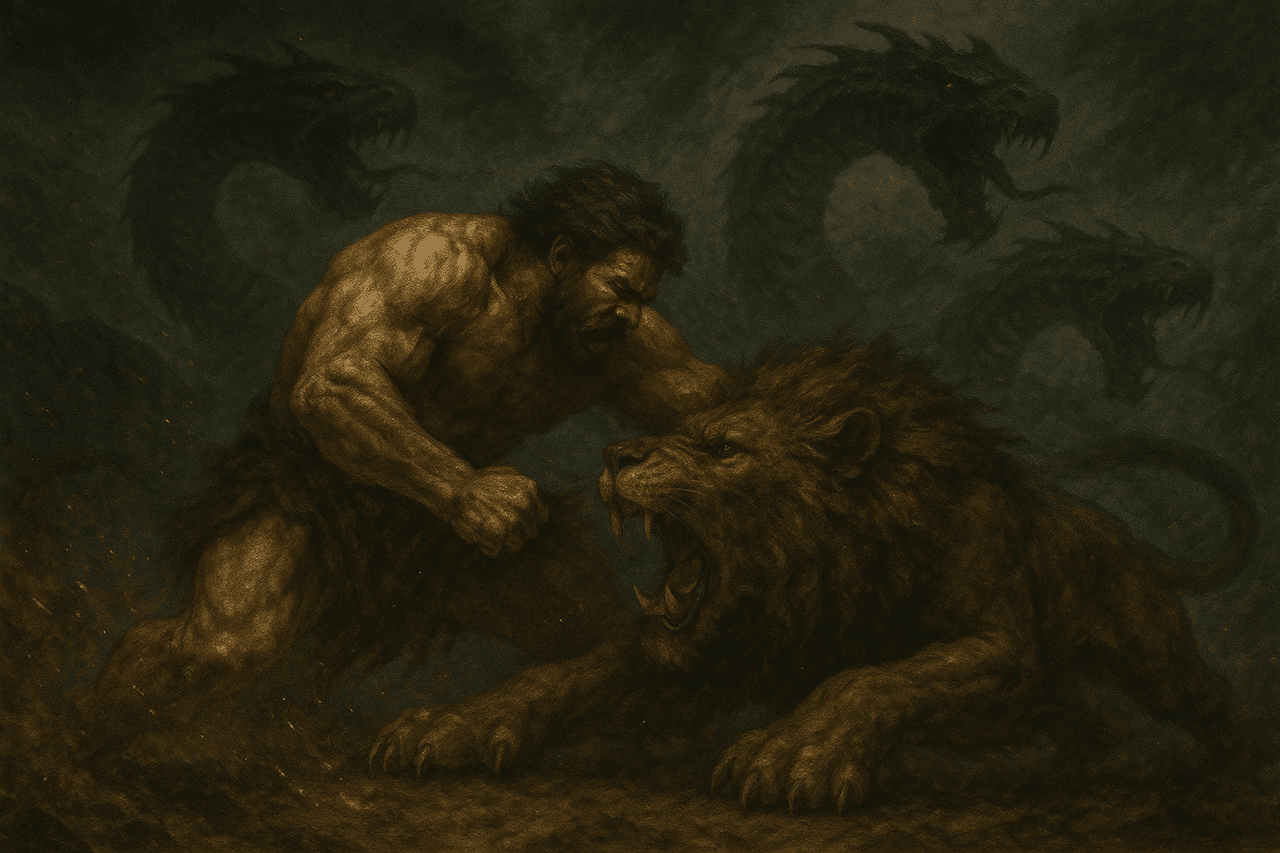
The Hero’s Fury and the End of the Monsters (Generated by Artificial Intelligence)
Hellenistic mythographers established a canonical list of the twelve labors accomplished by Heracles and classified them into two groups of six. According to this classification, the first six labors took place in the Peloponnese, while the remaining six occurred in Crete, Thrace, Scythia, and various other parts of the world. Although some sources vary in the order of the labors, Apollodorus’s sequence is generally accepted. This order is as follows:
Originally transmitted through oral tradition, these myths were later recorded in written and visual forms. The Twelve Labors of Heracles are widely represented in a variety of artistic media, including temple reliefs, ceramics, sarcophagi, coins, and mosaics.
Each labor has distinct mythological content and artistic representation. While artistic depictions remain faithful to the mythological narrative, they are shaped by the artist’s style and the artistic conventions of the period.
Heracles’s first labor was to slay the Nemean Lion, whose hide was impervious to weapons. Heracles strangled the lion with his bare hands and used its pelt as armor. In the Syedra mosaic, Heracles is depicted as young, beardless, and naked, crushing the lion with his left knee. On the coins of Heraclea Pontica, this struggle is shown in two different poses: one in which Heracles kneels, and another in which he stands. In the mosaic fragment believed to originate from Zeugma, Heracles is shown naked, grasping the lion’s head with his arms.
The nine-headed Lernaean Hydra regenerated new heads whenever one was cut off. With the help of his nephew Iolaus, Heracles cauterized the stumps with a torch to prevent regrowth and thus killed the monster. In the Syedra mosaic, Heracles is shown wearing the Nemean Lion’s pelt, gripping the Hydra’s head with his left hand and preparing to strike it with his club in his right. On the coins of Heraclea Pontica, Heracles is depicted raising a staff to strike the Hydra.
This golden-horned, bronze-footed hind was sacred to Artemis and had to be captured alive. After chasing it for a year, Heracles wounded it and captured it. In the Syedra mosaic, Heracles is shown seizing the hind by its left antler, wearing the lion’s pelt on his head and a cloak on his back. On the coins of Heraclea Pontica, Heracles is depicted holding the hind by its antlers and raising a staff as if to strike it.
Heracles’s task was to capture the wild boar of Mount Erymanthus alive. When he brought it to Eurystheus, the king, terrified, hid inside a storage jar. In the Syedra mosaic, this scene is heavily damaged, but Heracles’s left leg and what is believed to be Eurystheus’s arm inside the jar are visible. On the coins of Heraclea Pontica, Heracles is shown carrying the boar on his shoulders. In the fragment from Zeugma, Eurystheus is depicted hiding inside a large vessel out of fear.
Heracles cleaned the stables of King Augeas of Elis, which had not been cleaned for years, by diverting the courses of the Alpheios and Peneus rivers through them, completing the task in a single day. This labor is rarely depicted in art. In the Syedra mosaic, Heracles is shown washing his hands in water flowing from a high cliff, with his rake and staff laid aside as symbols of completion. On the coins of Heraclea Pontica, Heracles is depicted holding a tool resembling a rake.
These man-eating birds were driven from their nests by Heracles using bronze clappers given to him by Athena, and then shot down with arrows. In the Syedra mosaic, Heracles is shown wearing the lion’s pelt, holding a bow in his left hand and an arrow in his right. On the coins of Heraclea Pontica, a similar composition shows Heracles releasing an arrow while observing the birds.
King Minos of Crete had failed to sacrifice a bull to Poseidon, who then caused it to go mad. Heracles subdued the bull and brought it to Athens. Although the scene in the Syedra mosaic is damaged, it is clear that Heracles seized the bull by its horns; the mosaic artist rendered the bull in white, consistent with the myth. On the coins of Heraclea Pontica, Heracles is shown walking while holding the bull by its horns.
Heracles captured the man-eating mares of King Diomedes of Thrace by killing Diomedes and feeding him to the horses, then taming them and bringing them to Mycenae. The scene in the Syedra mosaic is largely destroyed; only Heracles’s head, his staff, and the hind leg of one horse remain visible. On the coins of Heraclea Pontica, Heracles is depicted holding one horse with his left hand and raising his staff to strike another.
At the request of Eurystheus’s daughter Admete, Heracles was tasked with obtaining the girdle of Hippolyta, Queen of the Amazons, a gift from Ares. Incited by Hera, a battle erupted, and Heracles killed Hippolyta to take the girdle. The central scene in the Syedra mosaic is heavily damaged, but parts of Heracles’s head, an Amazon’s bow, arm, leg, a horse, and a pelta (shield) are visible. On the coins of Heraclea Pontica, this confrontation is shown in two different poses: one in which Heracles attacks Hippolyta while she is on horseback, and another in which he strikes her as she lies on the ground with her horse.
To retrieve the cattle of the three-bodied giant Geryon from the far western edge of the world, Heracles killed Geryon and his herders and brought the cattle to Greece. In the Syedra mosaic, only Heracles’s legs, his staff, and fragments of a bull’s hoof and horn remain. On the coins of Heraclea Pontica, this labor is depicted only once, during the reign of Emperor Macrinus, showing Heracles walking with two oxen; it is among the least frequently represented labors.
Heracles obtained the golden apples, guarded by a dragon and given as a wedding gift to Hera, by tricking Atlas, who held up the sky, into retrieving them for him. In the Syedra mosaic, Heracles is shown standing full-face, having completed the task; his lion’s pelt hangs from his left arm, and he holds a staff resting on a stone in his right hand. On the coins of Heraclea Pontica, this scene is shown in two variants: one with Heracles beside a tree and the dragon, and another with only the apples, without the tree or dragon. In the fragment from Zeugma, Heracles (or possibly Atlas) is depicted raising his right hand to pluck an apple from the tree.
The final labor was to bring Cerberus, the three-headed dog guarding the Underworld, to the surface. With the aid of Hermes and Athena, Heracles descended into the Underworld and led Cerberus to Eurystheus. In the Syedra mosaic, Heracles is shown gripping Cerberus by the collar with his right hand. On the coins of Heraclea Pontica, this scene is depicted in three different variants and is among the most frequently represented labors. According to myth, the place where Heracles brought Cerberus to the surface was the Cehennemağzı Caves near Heraclea Pontica, and this event gave the city its name.
The depiction of Heracles in art shows a chronological development. In both the coins of Heraclea Pontica and the Syedra mosaic, Heracles is portrayed as young and beardless during the early labors, becoming more mature and bearded in the middle ones, and finally depicted with a thickened but muscular physique suggesting old age in the final labors.
The figure of Heracles was also regarded as a founding hero (ktistes) and cult figure in ancient cities. Archaeological evidence supports the active worship of Heracles in Heraclea Pontica. Some Roman emperors identified themselves with Heracles to reinforce their authority and were depicted on coins in his likeness. The preference for Heracles imagery in bath complexes in cities like Syedra reflects his association with athleticism, physical strength, and worldly grandeur.
Demirtaş, Nurgül, and Pınar Pınarcık. "Herakleia Pontike Sikkeleri Üzerinde Herakles'in On İki İşinin Tasvirleri." *Tykhe Sanat ve Tasarım Dergisi* 1, no. 1 (2016): 64–102. Accessed June 22, 2025. https://dergipark.org.tr/en/pub/tykhe/issue/55438/759898.
Ergürer, H. "Syedra Büyük Hamam Kompleksindeki Herakles’in On İki İşinin Betimlendiği Mozaik Üzerine İlk Değerlendirme." *Journal of Mosaic Research* 16 (November 1, 2023): 157–186. Accessed June 22, 2025. https://dergipark.org.tr/en/pub/jmr/issue/80430/1376778.
Önal, Mehmet. “Herakles’in On İki İşi Betimli Mozaik Hakkında Tespitler.” *Journal of Mosaic Research*, no. 5 (December 2012): 131–143. Accessed June 22, 2025. https://dergipark.org.tr/en/pub/jmr/issue/28656/306270.

No Discussion Added Yet
Start discussion for "The Twelve Labors of Heracles" article
Mythological Narrative and Sequence of the Labors
Evolution of Artistic Depictions
Iconography and Detailed Analysis of the Labors
1. The Nemean Lion
2. The Lernaean Hydra
3. The Ceryneian Hind
4. The Erymanthian Boar
5. The Augean Stables
6. The Stymphalian Birds
7. The Cretan Bull
8. The Mares of Diomedes
9. The Girdle of Hippolyta, Queen of the Amazons
10. The Cattle of Geryon
11. The Golden Apples of the Hesperides
12. Bringing Cerberus to the Surface
Evolution of the Figure and Symbolic Context