


This article was automatically translated from the original Turkish version.
The climate of the world exhibits highly variable temperature values across different geographic regions. The lowest temperature ever recorded was -89.2°C in eastern Antarctica. This extreme cold is so dangerous that it would make it impossible for a human to remain outdoors for even a few minutes. On the other hand, an extreme heat of 70.7°C detected in Iran’s Lut Desert in 2005 creates a lethal environment for any form of life. Even these extreme values are kept within limits thanks to the protective function of the atmosphere. What if there were no atmosphere?
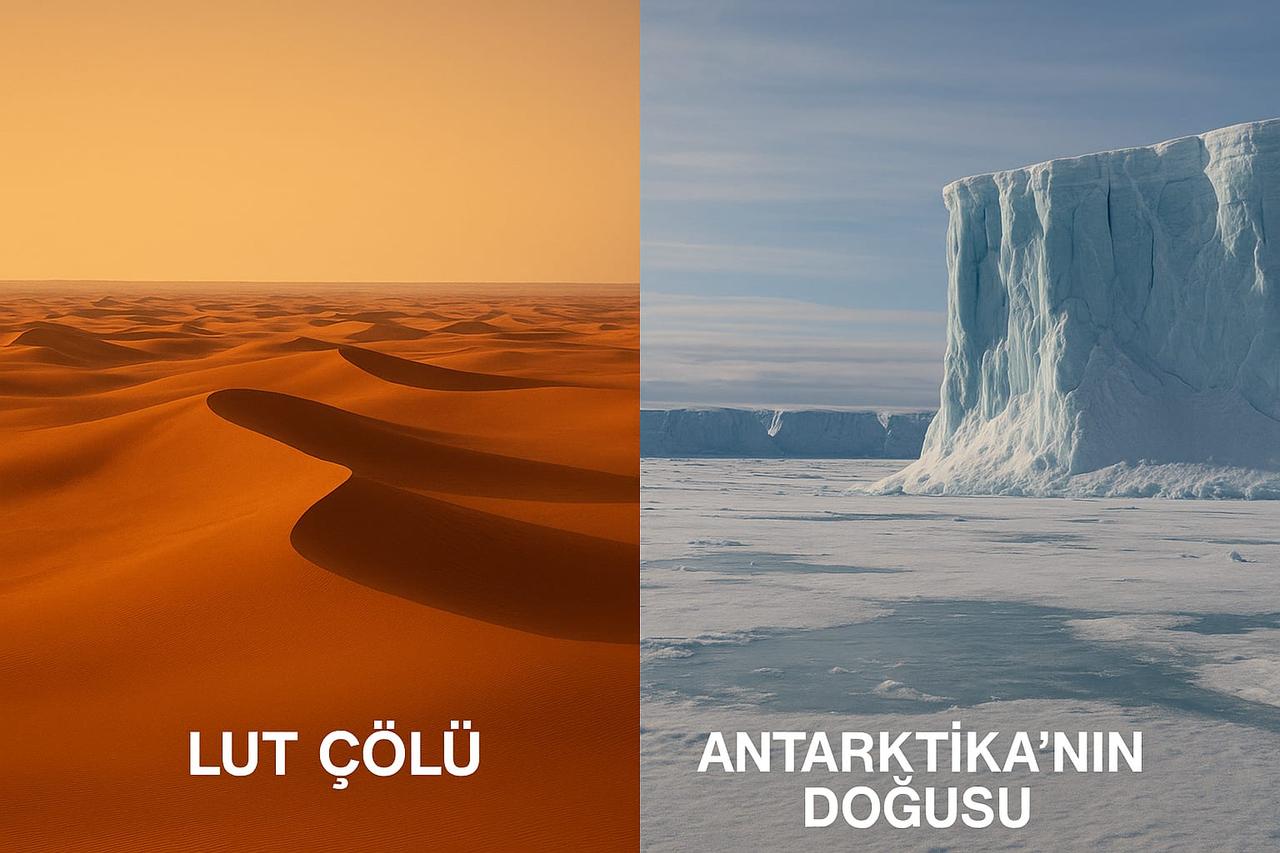
Lut Desert and eastern Antarctica (Generated by Artificial Intelligence.)
A temperature of 70.7°C was recorded in Iran’s Lut Desert and -89.2°C in eastern Antarctica.
Earth is located at a distance from the Sun known as the “habitable zone” within the Solar System. This is the most critical condition that allows liquid water to exist on the surface. However, suitable distance alone is not sufficient. The atmosphere is the fundamental element that transforms this advantage into a habitable climate.
On a planet without an atmosphere, daytime temperatures would rise above 100°C, while nighttime temperatures would plummet to as low as -180°C. Such an environment would make the presence of liquid water impossible and render life unsustainable. This scenario can be observed on the Moon, which lacks an atmosphere: its surface is exposed to scorching heat during the day and freezing cold at night. SübhanAllah
Earth’s temperature is maintained at a stable level by a delicate balance between the energy it receives and the energy it loses. This energy flow originates directly from the Sun and is radiated back into space.
The surface re-emits this energy as infrared radiation (thermal radiation) back into space. Interestingly, the amount of energy emitted from Earth’s surface is greater than the energy received from the Sun. Here, greenhouse gases play a critical role: gases such as carbon dioxide, methane, and water vapor trap a portion of the infrared radiation emitted by the surface, preventing heat from escaping entirely into space. This natural process is known as the “greenhouse effect” and ensures that Earth remains at a moderate temperature.
If the atmosphere were to vanish entirely, Earth’s average surface temperature would drop by approximately 30°C from its current level. This drop would freeze most of the planet’s surface, cover oceans with ice sheets, and cause the collapse of most ecosystems. Moreover, the absence of an atmosphere would mean no protection against harmful cosmic radiation or meteor impacts. Thus, temperature fluctuations alone do not make life impossible; the loss of the atmosphere would disrupt the planet’s entire life-sustaining balance.
The Qur’an frequently emphasizes that Allah created the universe with perfect order and profound wisdom. Every verse contains deep meanings and serves as a unique proof of the flawless system and divine plan evident in creation. This order offers us the opportunity to contemplate with awe the greatness and artistry of the Creator.
Here are three verses illustrating that Allah created everything in order:
In the name of Allah, the Most Gracious, the Most Merciful
"He is Allah, the Lord of the heavens and the earth, who has not taken a son, nor is there any partner in His sovereignty, who created everything and determined it with precise measure." Surah Al-Furqan, Verse 2【1】
"He who created the seven heavens in perfect harmony. You will not see any flaw in the creation of the Most Gracious. Look again: do you see any irregularity?" Surah Al-Mulk, Verse 3【2】
"Then look again, and again, and yet again. Your gaze will return to you, weary and defeated, unable to find any flaw." Surah Al-Mulk, Verse 4【3】
Allah (cc) has spoken the truth.
Accessed November 26, 2025.
Diyanet İşleri Başkanlığı. "Furkân Suresi 2-3. Ayet Tefsiri." Accessed August 10, 2025.
Diyanet İşleri Başkanlığı. "Mülk Suresi 1-5. Ayet Tefsiri." Accessed August 10, 2025.
Ocak, Mahir E. "Dünya Atmosferini Nasıl Koruyor?" TÜBİTAK Bilim Genç, Accessed August 10, 2025.
Sarıgül, Tuba. "Atmosfer Olmasaydı Dünya’nın Sıcaklığında Nasıl Bir Değişim Olurdu?" TÜBİTAK Bilim Genç, Accessed August 10, 2025.
Sarıgül, Tuba. “Atmosfer Olmasaydı Dünya’nın Sıcaklığında Nasıl Bir Değişim Olurdu?” TÜBİTAK Bilim Genç, Erişim: 10 Ağustos 2025.
UCAR Center for Science Education. "What Is the Atmosphere?" UCAR Center for Science Education, Accessed August 10, 2025.
UCAR Center for Science Education. “What Is the Atmosphere?” UCAR Center for Science Education, Erişim: 10 Ağustos 2025.
Two Essential Conditions for a Habitable Earth
The Nuances of Energy Balance
The Absence of the Atmosphere and Its Consequences
Allah (cc) Created Everything in Perfect Order
