


This article was automatically translated from the original Turkish version.
+2 More
Thermionic emission is the emission of electrons from the surface of a metal or other conductive material due to the application of sufficient thermal energy. This phenomenon plays a critical role in vacuum tubes, cathode ray tubes, and certain types of diodes and transistors. Thermionic emission occurs when electrons acquire kinetic energy exceeding the work function of the heated metal surface, enabling them to escape the material.
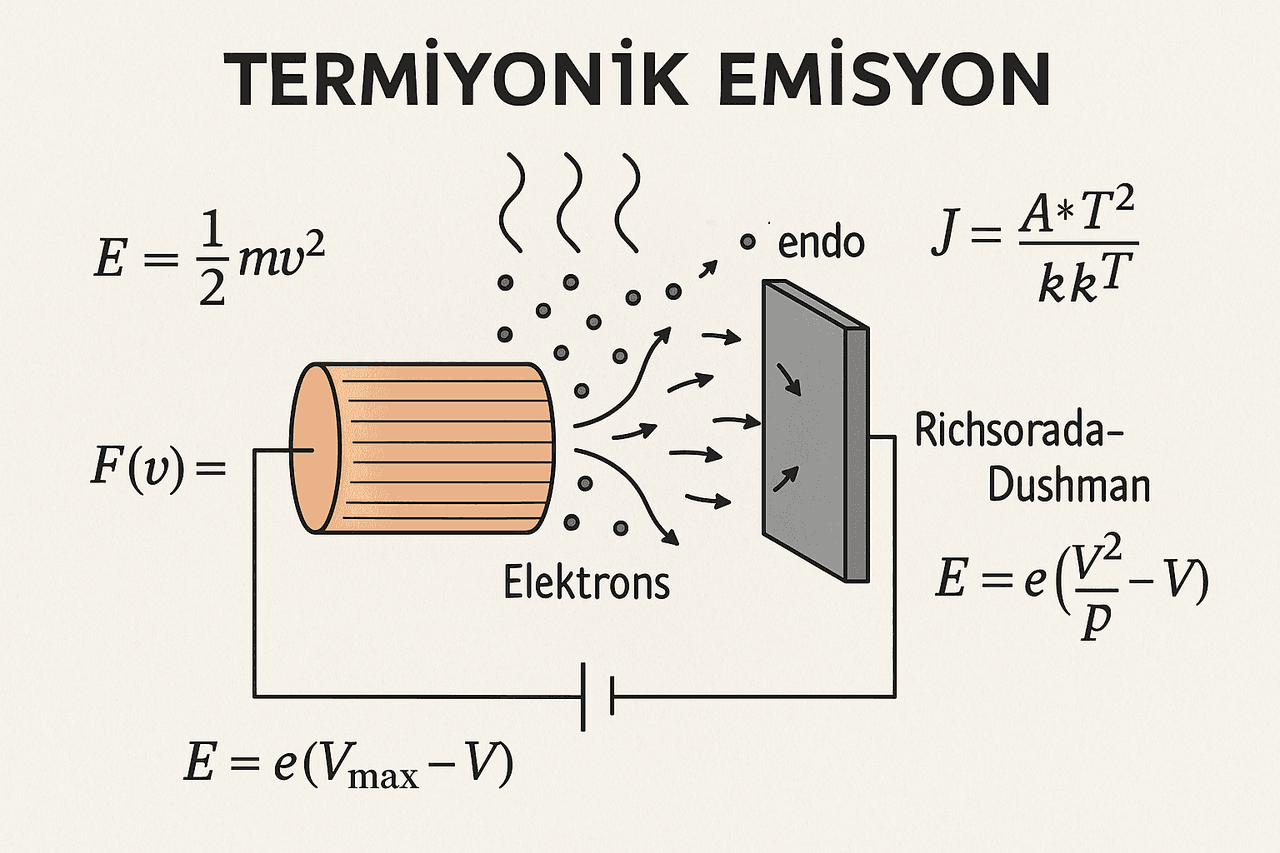
Thermionic Emission (generated by artificial intelligence)
Thermionic emission was first observed in the late 19th century. In 1901, Owen Richardson investigated this phenomenon experimentally and demonstrated that electron emission depends on temperature; this relationship became known as Richardson’s Law (or the Richardson-Dushman equation). This discovery paved the way for vacuum tube technology and became one of the foundational principles of the modern electronic age.
Understanding thermionic emission is possible through the kinetic theory of gases and electron energy distribution. In heated metals, free electrons follow a Maxwell-Boltzmann distribution. Electron emission from the metal occurs only when an electron’s kinetic energy equals or exceeds the metal’s work function ϕ. The work function is the minimum energy required for an electron to escape the metal surface.
In thermionic emission experiments, two metal plates are typically placed in a vacuum, with one (the cathode) being heated. Heating causes thermal electrons to detach from the surface. These electrons are then accelerated toward the anode (a positively charged metal) by an electric field. Electrons reaching the anode generate a current. As the applied potential difference increases, more electrons with higher energy reach the anode.
This principle is applied in many technologies, including:
Today, the concept of thermionic emission has regained importance particularly in the fields of nanoelectronics and space engineering. High-temperature-resistant cathode materials such as tungsten, tantalum, and LaB₆ have been developed to enhance emission efficiency.
Additionally, recent studies have analyzed thermionic emission mechanisms in structures such as organic-inorganic hybrid diodes and Schottky diodes. For example, experiments on structures like Al/p-Si/Al use thermionic emission theory to calculate parameters such as the diode ideality factor and barrier height.
Explains the energy barriers formed at metal-semiconductor interfaces. Thermionic emission is interpreted as electron transport across these barriers.
Mathematical approaches used to analyze experimental data of thermionic emission.
Other current transport mechanisms observed in Schottky diodes, distinct from thermionic emission.
Thermionic emission is a fundamental physical principle essential for understanding and developing both classical and modern electronic systems. The emission of electrons from metals due to heat finds applications across a wide range of fields, from energy conversion systems to vacuum electronics. Understanding this phenomenon enables improved efficiency in thermal electronic devices.
Yılmaz, Serkan. “Al/p-Si/Al Yapısının Termiyonik Emisyon Teorisiyle İncelenmesi.” Master's thesis, Süleyman Demirel Üniversitesi, 2015. https://acikbilim.yok.gov.tr/bitstream/handle/20.500.12812/296812/yokAcikBilim_10218476.pdf?sequence=-1&isAllowed=y
“Termoiyonik Emisyon.” *Fizik II Laboratuvar Föyü*, İstanbul Teknik Üniversitesi. Accessed June 14, 2025. https://web.itu.edu.tr/~iscisev/mfl/mfl_foy/08Termoiynik_emis.doc.

No Discussion Added Yet
Start discussion for "Thermionic Emission" article
History
Physical Basis
Experimental Observation and Applications
Modern Interpretations and Developments
Related Theories
Schottky-Mott Theory
Cheung and Norde Methods
Tunneling and Diffusion Theories