


This article was automatically translated from the original Turkish version.

Third Space
Definition(s) | Public spaces where people voluntarily and informally socialize outside of home (1. space) and work/school (2. space) | ||||||||
|---|---|---|---|---|---|---|---|---|---|
Basic Objectives | and create intimate conversation environments strengthen community bonds Offer an escape from daily routines | ||||||||
Distinguishing Characteristics | with active participants comfortable and welcoming conversation-focused Equitable and inclusive | ||||||||
Classic Examples | Cafes, public libraries, parks, bars, barbershops | ||||||||
Modern Examples | online communities co-working spaces Shopping centers (AVMs) | ||||||||
Third place is a sociological concept introduced by urban sociologist Ray Oldenburg in the 1980s to describe public spaces that host regular voluntary and informal gatherings outside the primary place (home) and secondary place (work/school). According to Oldenburg, these spaces serve as a counterbalance to the individual isolation, weakening of neighborhood ties, and routine monotony brought about by modern urban life. Examples of third places include cafes, bars, parks, public libraries, beauty salons, bookstores, and shopping centers.
Their fundamental function is to provide environments where individuals can step away from home and work responsibilities to socialize, converse, relax, and build community bonds. The presence of third places can serve as a source of social fulfillment, while their absence may lead to weakened interpersonal relationships in cities and a sense of loneliness even amidst crowds.
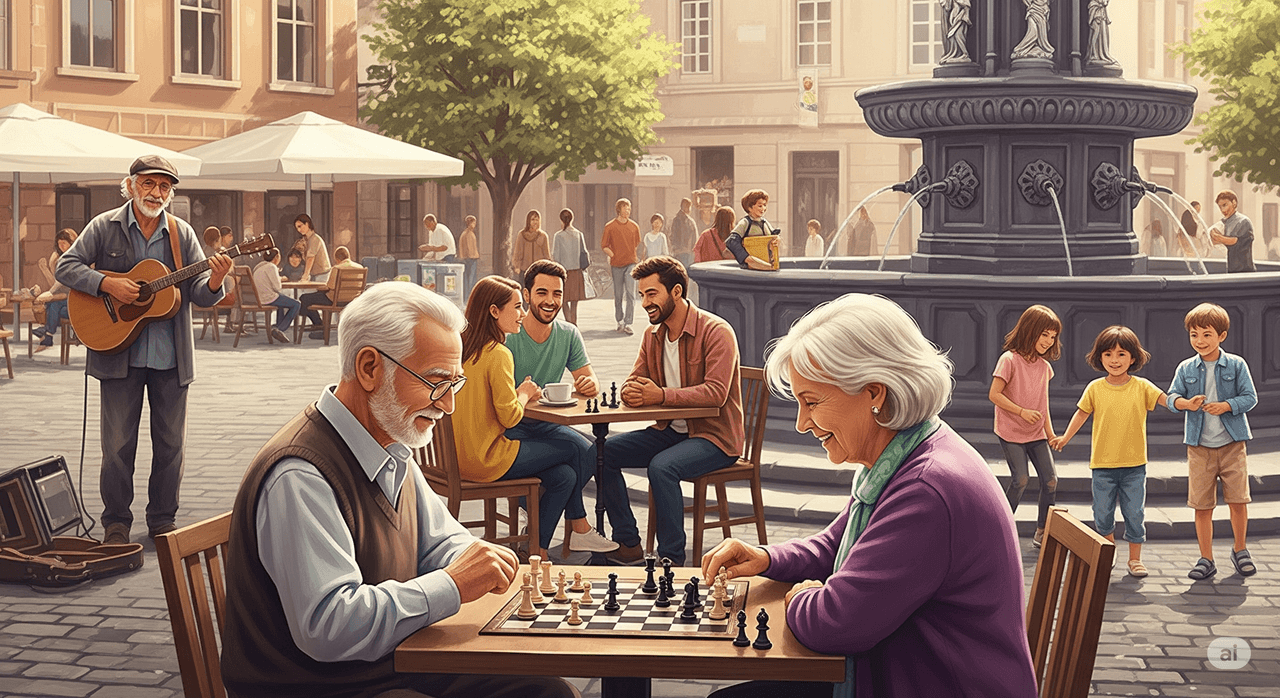
Life, Conversation and Music in Public Space (Generated by Artificial Intelligence)
Ray Oldenburg identified a set of defining characteristics that a place must possess to qualify as a third place. These features describe the social function of the space and its impact on users:
Third places are spaces where individuals can enter and leave freely without any sense of obligation. No one assumes the role of host, allowing everyone to feel equal and at ease.
These spaces invalidate hierarchical distinctions based on social status, economic condition, or title. An individual’s identity is valued through their personality rather than their roles in work or family life, fostering more authentic relationships.
The central activity in third places is lively, cheerful, and engaging conversation. These spaces are structured around the exchange of diverse ideas and stories, making communication the core experience.
Third places are easily accessible and remain open for extended hours. Individuals can drop by at any time of day with the expectation of encountering familiar faces.
Third places are locations with a distinct character and atmosphere that are visited consistently. These regular patrons embody the spirit of the place and help newcomers adapt to the environment.
These spaces typically lack elaborate decoration; instead, they feature simple, modest, and comfortable settings. This simplicity encourages people to be themselves without feeling the need to perform or impress.
Conversations and interactions in third places are generally lighthearted and spirited. These environments offer an escape from the seriousness of daily life and provide an experience akin to play.
Third places offer the comfort and sense of belonging associated with home, while leaving behind domestic responsibilities and routines. They serve as a source of psychological support and relaxation for individuals.
In addition to Oldenburg’s foundational sociological framework, the concept of the third place has been enriched over time by various theoretical perspectives.
Edward Soja built upon Henri Lefebvre’s triad of space—perceived, conceived, and lived—to develop the concept of “Thirdspace.” Lefebvre’s “representational spaces,” or lived spaces, become in Soja’s theory an experiential realm that unites the real and the imagined, where oppositions and dialectics are constructed. This approach views space not merely as a physical setting but as a continuously reproduced process shaped by political, cultural, and social forces.
Postcolonial theorist Homi Bhabha defines the third place as a “hybrid” space where different cultures and identities meet, negotiate, and transform. These “in-between” forms are dynamic arenas where cultural meaning is not fixed, and new identities and practices emerge.
Gilles Deleuze and Félix Guattari’s concept of the “rhizome” is used to describe the non-hierarchical, decentralized, and multi-connected network structure of third places. In a rhizomatic system, there is no fixed order; instead, relationships are continuously reshaped through contingent associations, flows, and ruptures.
The third place theory is widely used to analyze various urban spaces and institutions.
As centers of modern consumer culture, shopping malls have become significant third places, especially for young people. They offer more than just shopping; they serve as meeting points, socialization areas, and escapes from daily routines. Research shows that young people experience in malls elements aligned with third place characteristics such as “social interaction,” “escape,” “symbolic meaning,” “social comfort,” and “freedom.” These experiences largely stem from interactions among consumers themselves (consumer-consumer interaction).
Traditionally seen as repositories of information, libraries are increasingly adopting third place characteristics. Public and university libraries are creating spaces where users can socialize, collaborate, and spend time comfortably. The relaxation of food and drink rules, the provision of group study rooms, comfortable seating areas, and the offering of open, egalitarian environments are signs of this transformation. Additionally, emerging practices such as “makerspaces” and “FabLabs” within libraries represent innovative third places where users gather to create, learn, and socialize.
Third places also play a decisive role in creativity and innovation ecosystems. They enable people from different disciplines and sectors to meet informally, facilitating the spread of “tacit knowledge”—knowledge that is difficult to codify. The social and cultural opportunities that attract the creative class to cities are often found in these types of third places. In recent years, the rise of co-working spaces has produced hybrid environments that blur the boundaries between work (second place) and socialization (third place), representing a reimagining of the third place concept.
A music venue in Istanbul, functioning as a “Thirdspace” in its own right, has the potential to reshape the daily rhythm and social fabric of its neighborhood. Such spaces bring together diverse musical genres and identities, fostering new cultural interactions, while also being linked to processes of urban gentrification and commercial interests.
There is ongoing debate about whether virtual environments such as the internet, social media platforms, and online gaming worlds qualify as new third places. These digital spaces share some characteristics identified by Oldenburg—accessibility, comfort, and the ability to bring together people with similar interests. However, the absence of face-to-face cues such as gestures and facial expressions is seen as limiting the naturalness and depth of these virtual interactions. Research indicates that users increasingly prefer hybrid environments that integrate both virtual and physical spaces rather than choosing one exclusively.
Oldenburg’s idealized vision of simple, non-commercial third places conflicts with the commercial nature of many contemporary examples such as shopping malls and chain coffee shops. Critics argue that these spaces prioritize consumption over community building. This raises the question of how third places have become instruments within capitalist structures.
With the rise of co-working spaces, the boundaries between work (second place) and socialization (third place) are becoming increasingly unclear. This reflects a transformation in traditional functional distinctions and the emergence of more fluid, multi-use spaces.
Armatlı Köroğlu, Bilge. "Üçüncü Mekanlar: Kentte Yaratıcılık ve İnovasyonu Yeniden Düşünmek." In *Kentleşme ve Kentsel Alan Sorunları*, 33–49. Ankara: İksad Yayınevi, 2024. Accessed July 9, 2025. https://avesis.gazi.edu.tr/yayin/d98fc2b4-5bf0-46be-851f-b9c22381fa6f/ucuncu-mekanlar-kentte-yaraticilik-ve-inovasyonu-yeniden-dusunmek.
Demir, Güler. 2017. “Oldenburg’un Üçüncü Mekân Paradigması Bağlamında Kütüphane Mekânının Sorgulanması”. *Bilgi Dünyası* 18, no. 2: 195–223. Accessed July 9, 2025. https://doi.org/10.15612/BD.2017.628.
Gümüş, İmran. "Üniversite-Kent Etkileşiminde Melez ‘Üçüncü Mekan’ Kavramı Doğrultusunda ‘Rizomatik Kampüs Yerleşim Sistemi Modeli’ Önerisi." *Online Journal of Art & Design* 8.2 (2020). Accessed July 9, 2025. https://www.adjournal.net/articles/82/8216.pdf.
Mert, Ceren. "İstanbul’da Bir Üçüncü Mekân Okuması: ‘Pozitif’ Titreşimler ve Babylon." *İDEALKENT* 1.2 (2010): 86–112. Accessed July 9, 2025. https://dergipark.org.tr/en/download/article-file/460442.
Uygun, Mutlu. "Tüketicilerin alışveriş merkezi deneyimlerinin üçüncü mekan kuramı çerçevesinde incelenmesi." *Aksaray Üniversitesi İktisadi ve İdari Bilimler Fakültesi Dergisi* 8, no. 2 (2016): 122–143. Accessed July 9, 2025. http://aksarayiibd.aksaray.edu.tr/en/download/article-file/415056.

Third Space
Definition(s) | Public spaces where people voluntarily and informally socialize outside of home (1. space) and work/school (2. space) | ||||||||
|---|---|---|---|---|---|---|---|---|---|
Basic Objectives | and create intimate conversation environments strengthen community bonds Offer an escape from daily routines | ||||||||
Distinguishing Characteristics | with active participants comfortable and welcoming conversation-focused Equitable and inclusive | ||||||||
Classic Examples | Cafes, public libraries, parks, bars, barbershops | ||||||||
Modern Examples | online communities co-working spaces Shopping centers (AVMs) | ||||||||
Definition and Core Characteristics
Neutral Ground
Leveler
Conversation as the Main Activity
Accessibility and Accommodation
Regulars
A Plain and Unpretentious Atmosphere
A Playful Mood
A Home Away From Home
Theoretical Development and Alternative Approaches
Soja and Lefebvre’s “Thirdspace” Approach
Bhabha and “Hybrid Spaces”
Deleuze, Guattari, and “Rhizomatic Networks”
Applications and Examples
Shopping Malls (AVM’ler)
Libraries
Creativity and Innovation Spaces
Musical Spaces and Urban Transformation
Contemporary Debates and Critiques
Virtual Third Places
Commercialization and Consumption
Blurring Boundaries