

badge icon

This article is not approved yet.

Article

Thorium Molten Salt Reactor

Quote
Reactor Type
Thorium Molten Salt Reactor (MSR)
Fuel Cycle
Thorium-Uranium (Th-U)
Fuel State
Liquid (Dissolved in Molten Salt)
Coolant Type
Molten Fluoride or Chloride Salt
Operating Pressure
Near Atmospheric
Operating Temperature
High (Typically >700°C)

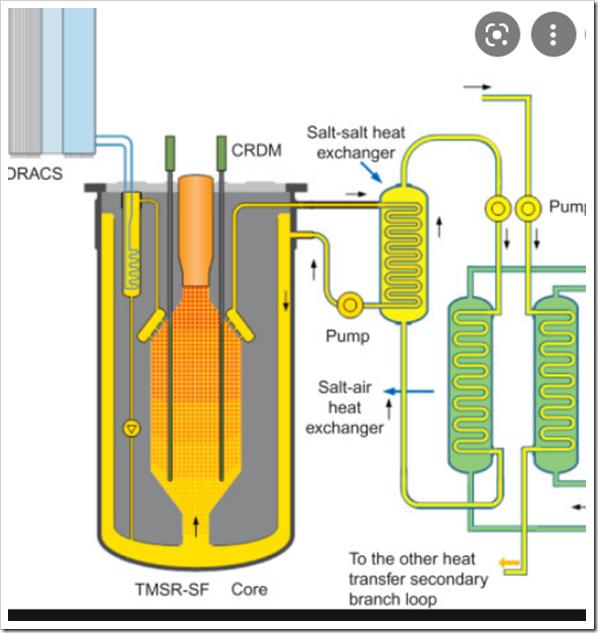
A thorium molten salt reactor (TMSR) is a Generation IV nuclear reactor that uses thorium dissolved in fluoride or chloride salts as fuel. Operating at atmospheric pressure and temperatures of 600–750°C, this design emerged from the U.S. Oak Ridge National Laboratory's Molten Salt Reactor Experiment (1965–1969). TMSRs leverage liquid fuel circulating through graphite channels, enabling online refueling, inherent safety from negative temperature coefficients, and reduced long-lived radioactive waste. They are researched globally for potential deployment in nuclear energy systems .

Historical Development and Core Principles

Origins at Oak Ridge National Laboratory

The Molten Salt Reactor Experiment (MSRE) validated key principles: fluoride salt fuels (LiF-BeF₂-ZrF₄-UF₄) could sustain fission at 650°C while resisting radiation damage. Alvin Weinberg’s team demonstrated:

  • Negative Void Coefficient: Fuel expansion during overheating reduces reactivity.
  • Online Processing: Fission products like xenon-135 were continuously removed via helium bubbling.
  • Thorium Breeding: Neutron capture converted thorium-232 to fissile uranium-233 at 1.01 breeding ratio .

Thorium Fuel Cycle Mechanics

  • Transmutation: ²³²Th absorbs neutrons, becoming ²³³U after beta decays (27-day half-life).
  • Sustainability: 200× more energy-dense than uranium; 99% of mined thorium is usable.
  • Waste Profile: Dominated by cesium-137 (30-year half-life); produces <1% transuranics vs. uranium reactors .

Technical Design and Safety Systems

Primary Components

  1. Core Assembly: Graphite moderators with embedded fuel channels withstand neutron flux.
  2. Primary Loop: Hastelloy-N alloy pipes circulate fuel salt to heat exchangers.
  3. Freeze Plugs: Salt solidifies at 500°C; melt during power loss to drain fuel into passive cooling tanks .

Inherent Safety Mechanisms

  • Passive Decay Heat Removal: Natural convection transfers heat to air-cooled dump tanks.
  • Low-Pressure Operation: Avoids high-pressure explosions (vs. water-cooled reactors).
  • Corrosion Control: Redox buffers (e.g., beryllium additions) suppress nickel leaching .

Fuel Cycle and Waste Management

Fuel Composition and Reprocessing

  • Base Salts: FLiBe (LiF-BeF₂) or FLiNaK (LiF-NaF-KF) with 1–5% ThF₄.
  • Chemical Separation: Fluorination extracts uranium as UF₆ electrorefining isolates rare-earth fission products.
  • Radiotoxicity: 10,000× lower plutonium-239 inventory than light-water reactors .

Waste Characteristics

Plutonium-239 inventories are reduced by over 99.9% compared to uranium reactors, with a half-life of 24,000 years. Tritium (³H), produced via neutron capture in beryllium (half-life: 12.3 years), is contained through permeation-resistant coatings on heat exchangers .

Global Development Status

Active Projects

  • China (TMSR-LF1): 2 MWt prototype operational since 2021; 100 MWt commercial unit planned for 2030.
  • India (AHWR300-LEU): Integrates thorium fuel with molten salt coolant.
  • Terrestrial Energy (IMSR-400): 195 MWe reactor targeting 2028 deployment .

Technical Challenges

  • Material Durability: Graphite swelling under neutron flux; Hastelloy-N embrittlement.
  • Tritium Control: FLiBe produces 10–100 Ci/GW-year via neutron capture.
  • Regulatory Hurdles: No licensing framework for liquid-fuel reactors in IAEA states.


Author Information

Avatar
AuthorMuhammed HasanAugust 16, 2025 at 9:25 AM

Tags

Discussions

No Discussion Added Yet

Start discussion for "Thorium Molten Salt Reactor" article

View Discussions

Contents

  • Historical Development and Core Principles

    • Origins at Oak Ridge National Laboratory

    • Thorium Fuel Cycle Mechanics

  • Technical Design and Safety Systems

    • Primary Components

    • Inherent Safety Mechanisms

  • Fuel Cycle and Waste Management

    • Fuel Composition and Reprocessing

    • Waste Characteristics

  • Global Development Status

    • Active Projects

    • Technical Challenges

This article was created with the support of artificial intelligence.
Ask to Küre