This article was automatically translated from the original Turkish version.
Original Title | Three Colors: Red | ||||||||
|---|---|---|---|---|---|---|---|---|---|
Production Year / Country | 1994 / European co-production (France–Switzerland–Poland) | ||||||||
Genre | Drama | ||||||||
Director(s) | Krzysztof Kieślowski | ||||||||
Screenplay(s) | Krzysztof Kieślowski Krzysztof Piesiewicz | ||||||||
Main Cast | Irène Jacob (Valentine), Jean-Louis Trintignant (retired judge), Jean-Pierre Lorit (young law student) | ||||||||
Music(s) | Zbigniew Preisner | ||||||||
Language(s) | French | ||||||||
Duration | Approximately 99 minutes | ||||||||
Notable Awards | Oscar – 3 nominations (Best Director & Best Original Screenplay & Best Cinematography), Cannes – Golden Palm nomination, BAFTA – 4 nominations, César – Best Music award, Independent Spirit – Best Foreign Film, NYFCC & LAFCA & NSFC – Best Foreign Language Film awards | ||||||||
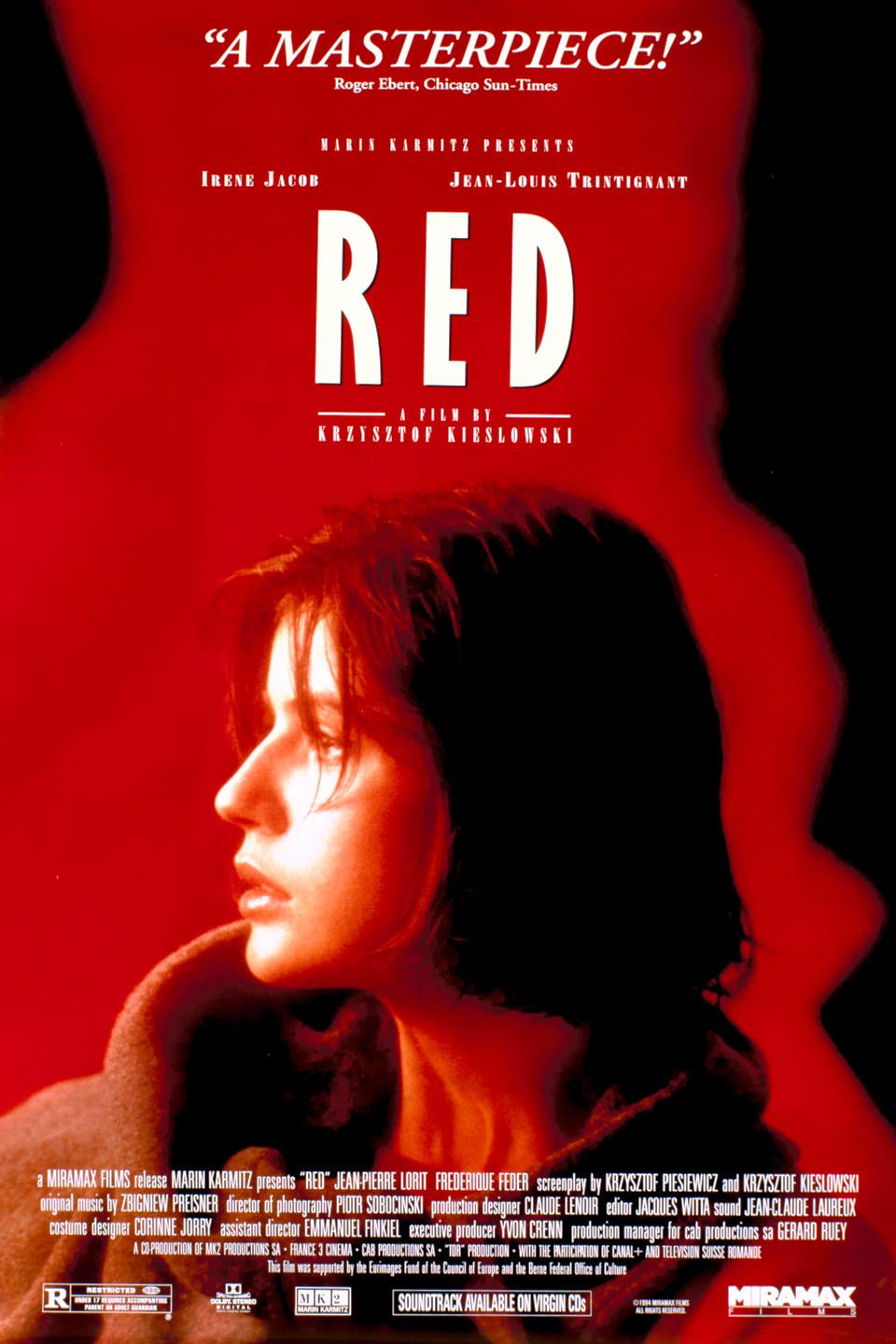
Three Colors: Red is the final feature film in Krzysztof Kieślowski’s trilogy and explores the idea of fraternity through personal relationships within the context of modern urban life. The production relies on a restrained dramatic tone and a balanced interplay of visual and auditory elements. The lead roles are played by Irène Jacob and Jean-Louis Trintignant, with Jean-Pierre Lorit fulfilling a significant supporting role in the narrative. The film entered international circulation during the 1994 festival season and was subsequently released in various countries. Thematically, the narrative maintains continuity with the previous installments of the trilogy through its use of color dramaturgy and musical motifs. This cohesion allows the film to examine social themes within a character-driven drama on a symbolic level.
Visually, the production embeds the connotations of “red” into set design, lighting, and costume details. The color strategy operates in tandem with the network of unexpected connections and coincidences woven between characters. Urban spaces function as stages where the distance and closeness between characters are measured. Music and silence are carefully structured to convey dramatic intensity without overstating it; in powerful moments, music comes to the fore, while in weaker ones, silence dominates. The film adopts a cinematic language that harmonizes form and content. As the closing chapter of the trilogy, it provides both a structural finale and a thematic resolution.
The story unfolds around a chance encounter between Valentine, a young model, and a retired judge. The intersection of their paths arises from an ordinary event in the city, revealing unexpected links between past and present. Valentine’s personal uncertainties become visible when contrasted with the judge’s withdrawn world. These encounters establish first a distant curiosity, then a mutual confrontation between the two individuals. As the film progresses, the viewer witnesses small interactions through which the characters transform one another. Simultaneously, the narrative incorporates the story of another character into this web of relationships. This structure aims to visualize the themes of chance and fate.
The narrative follows a linear timeline while juxtaposing the inner worlds of the characters through parallel scenes. The economy of dialogue, the length of scenes, and the duration of gazes determine the dramatic tension. The camera manages emotional intensity through transitions between close-ups and medium shots. The city is not merely a backdrop; it functions as a dramatic element through its flow, traffic, lighting, and spatial alignments. In the final section, motifs accumulated throughout the trilogy reappear in a brief closing scene. Thus, the film constructs a narrative arc that expands from individual stories toward a collective notion of “fraternity.”
The production is a European co-production, with its financing and creative team composed of professionals from different countries. Real locations are used in filming; particularly Geneva and its surroundings provide a city scale that matches the story’s rhythm. Cinematography is shaped by an approach that balances the tones of red under varying lighting conditions. Editing maintains a continuous flow between scenes, favoring rhythmic movement over abrupt cuts. Music is carefully placed to serve as the dramatic counterpart to visual decisions; in sound design, urban ambience and interior silences are preserved.

The character of Valentine, portrayed by Irène Jacob (IMDb)
The camera tracks the characters’ internal deliberations through facial expressions and body language. Close-ups reveal subtext and indecision within dialogue. Color transmission, in conjunction with set and costume, determines the emotional warmth or coldness of scenes. In post-production, rhythm, musical placement, and sound levels are balanced. The result is a visual-auditory composition that aims to achieve intense expression through minimal gestures.
Irène Jacob’s portrayal of Valentine embodies an internal rhythm that moves between curiosity, empathy, and uncertainty. Jean-Louis Trintignant brings to life the inward-looking yet perceptive world of the retired judge. Jean-Pierre Lorit provides a concrete counterpart to the dramatic unfolding of coincidences through his character in the parallel storyline. Supporting roles, even in brief scenes, fulfill a functional structure, making visible the social fabric beyond the central narrative. Dialogue reveals the boundaries of the characters and their modes of connection. Silence, particularly between the two leads, serves as a vehicle for processes of judgment and understanding.
The casting is arranged to evoke a sense of community alongside individual performances. The rhythm of entrances and exits of secondary characters aims to introduce variety without disrupting the narrative’s center. The age difference between the two main characters becomes a cinematic measure of the themes of experience and innocence. Visual storytelling is designed to match the actors’ rhythms, creating fluctuations in intensity from scene to scene. This approach seeks to generate a consistent texture of performance throughout the film. Especially in the finale, the proximity of secondary stories to the central axis further highlights the connections established by the actors.
Critical readings discuss the film’s intellectual axis through encounters, coincidences, and ethical questions centered on the idea of “fraternity.” The symbolic structure of the visual composition is balanced against the narrative’s minimalist flow. Particularly, the use of color and the organic connection with music are regarded as elements that enhance the narrative’s impact. The overall approach emphasizes a cinematic language that prioritizes the harmony between form and content.
In addition, evaluations frequently note that the structural connections in the final sequence serve as a gesture uniting the trilogy’s universe. The narrative renders personal ethical choices and the capacity for empathy visible through small actions. The rhythm of the urban fabric generates an atmosphere that supports the characters’ inner voices. Narrative continuity provides a framework that carries the fluctuations of emotional intensity. The placement of music fulfills a supportive role, presenting conflict without amplifying it. These critiques have contributed to the film’s recognition as a generally positive work and have helped it secure numerous awards.
Beyazperde. “Üç Renk: Kırmızı – Oyuncular ve Kadro.” Beyazperde. Accessed October 7, 2025. https://www.beyazperde.com/filmler/film-74338/oyuncular/.
Beyazperde. “Üç Renk: Kırmızı.” *Beyazperde.* Accessed October 7, 2025. https://www.beyazperde.com/filmler/film-74338/.
IMDb. "Three Colors: Red – Awards." IMDb. Accessed October 7, 2025. https://www.imdb.com/title/tt0111495/awards/?ref_=tt_ov_at_op_awd.
IMDb. "Three Colors: Red – Full Cast & Crew." IMDb. Accessed October 7, 2025. https://www.imdb.com/title/tt0111495/fullcredits/?ref_=tt_ov_at_pop_cst.
IMDb. "Three Colors: Red – Media Index." IMDb. Accessed October 7, 2025. https://www.imdb.com/title/tt0111495/mediaindex/?ref_=tt_ov_at_pop_ph.
IMDb. "Three Colors: Red – Plot Summary." IMDb. Accessed October 7, 2025. https://www.imdb.com/title/tt0111495/plotsummary/?ref_=tt_ov_at_pl_pl.
IMDb. "Three Colors: Red." IMDb. Accessed October 7, 2025. https://www.imdb.com/title/tt0111495/.
IMDb. “Three Colors: Red – Filming Locations.” IMDb. Accessed October 7, 2025. https://www.imdb.com/title/tt0111495/locations/?ref_=tt_ov_at_dt_flmg.
IMDb. “Three Colors: Red – Release Info.” IMDb. Accessed October 7, 2025. https://www.imdb.com/title/tt0111495/releaseinfo/?ref_=tt_ov_at_dt_rdat.
MUBI. “Three Colors: Red – Awards.” MUBI. Accessed October 7, 2025. https://mubi.com/tr/films/three-colors-red/awards.
MUBI. “Three Colors: Red.” MUBI. Accessed October 7, 2025. https://mubi.com/tr/tr/films/three-colors-red.
Mazlum, Özge, and Pınar Eke. “Duygular Sosyolojisi Bağlamında Kieslowski Sineması: Üç Renk Üçlemesi.” The Journal of International Civilization Studies 8, no. 1 (May 2023). Accessed October 7, 2025. https://www.researchgate.net/publication/371436940_Duygular_Sosyolojisi_Baglaminda_Kieslowski_Sinemasi_Uc_Renk_UclemesiKieslowski’s_Cinema_in_the_Context_of_The_Sociology_of_Emotions_Three_Color_Trilogy.
The Guardian. “Three Colours: Red Review – Kieslowski.” The Guardian. Accessed October 7, 2025. https://www.theguardian.com/film/2023/apr/11/three-colours-red-review-kieslowski.
Özonur Çöloğlu, Defne. “Sinemada Bir Anlam Yaratma Süreci Olarak Renk ve Krzystof Kieslowski’nin ‘Üç Renk: Mavi, Beyaz, Kırmızı’ Üçlemesi.” Kocaeli Üniversitesi İletişim Fakültesi Araştırma Dergisi. Accessed October 7, 2025. https://dergipark.org.tr/en/download/article-file/1734538.

Original Title | Three Colors: Red | ||||||||
|---|---|---|---|---|---|---|---|---|---|
Production Year / Country | 1994 / European co-production (France–Switzerland–Poland) | ||||||||
Genre | Drama | ||||||||
Director(s) | Krzysztof Kieślowski | ||||||||
Screenplay(s) | Krzysztof Kieślowski Krzysztof Piesiewicz | ||||||||
Main Cast | Irène Jacob (Valentine), Jean-Louis Trintignant (retired judge), Jean-Pierre Lorit (young law student) | ||||||||
Music(s) | Zbigniew Preisner | ||||||||
Language(s) | French | ||||||||
Duration | Approximately 99 minutes | ||||||||
Notable Awards | Oscar – 3 nominations (Best Director & Best Original Screenplay & Best Cinematography), Cannes – Golden Palm nomination, BAFTA – 4 nominations, César – Best Music award, Independent Spirit – Best Foreign Film, NYFCC & LAFCA & NSFC – Best Foreign Language Film awards | ||||||||
No Discussion Added Yet
Start discussion for "Three Colors: Red (Film)" article
Plot and Narrative Structure
Production and Technical Features
Actors and Characters
Critical Evaluation
Awards