



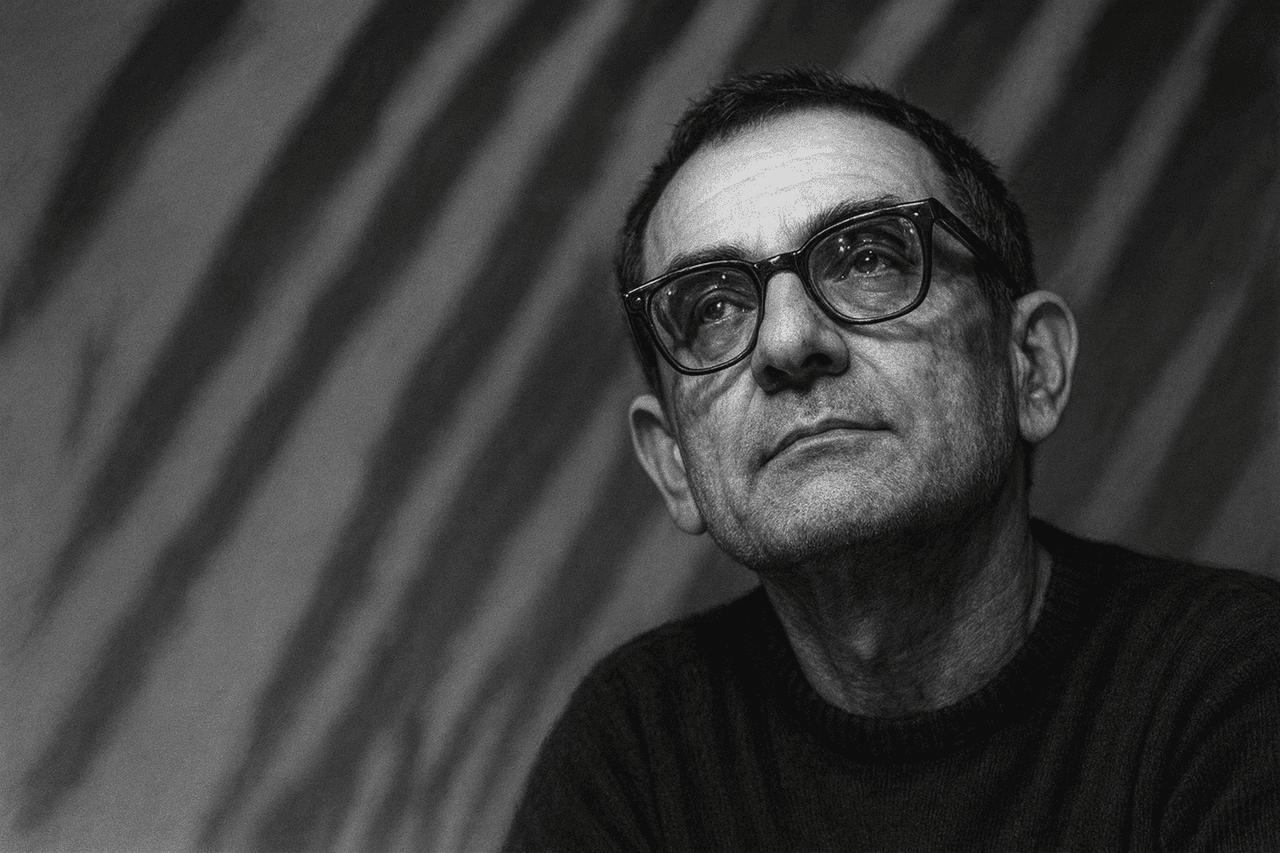
(Generated with Artificial Intelligence)
Krzysztof Kieslowski
Birth | 27 June 1941, Warsaw, Poland | ||||||||
|---|---|---|---|---|---|---|---|---|---|
Death | 13 March 1996, Warsaw, Poland | ||||||||
Education | Łódź Film School | ||||||||
Spouse(s) | Maria Czarnecka | ||||||||
Child | Marta Kieślowska | ||||||||
Profession(s) | Director Screenwriter | ||||||||
Important Films | Dekalog (1988), The Double Life of Veronique (1991), Three Colours: Blue (1993), Three Colours: White (1994), Three Colours: Red (1994) | ||||||||
Award(s) | Cannes Best Director European Film Academy Awards Venice Jury Prize | ||||||||
Krzysztof Kieślowski (1941–1996) is one of the most internationally recognized directors of Polish cinema. His films focus on the individual’s conscience, moral choices, and the limits of free will in modern society. His works evolved from documentary-inspired realism toward philosophical and metaphysical themes.
Kieślowski’s output, spanning from the 1970s to the 1990s, addresses both Poland’s historical and social transformations and the inner world of the individual. At the heart of his dramatic structures are the ethical dilemmas of ordinary people. During his transition from short television films to feature cinema, he sought a balance between formal simplicity and intellectual depth.
Kieślowski’s cinema is evaluated within the European film tradition through themes such as individual responsibility, fate, and the meaning of human behavior. In this regard, his work represents a line that unites formal aesthetics with philosophical content.
Kieślowski was born in Warsaw in 1941. He spent his childhood and youth in various cities across Poland. His interest in the arts began during high school and, after a brief period of theater training, he turned to cinema. He was admitted to the Łódź Film School in 1964, an institution that trained many of Poland’s most important directors.
During his student years, he developed a strong interest in the documentary genre. His early works consisted of short documentaries on the working class and everyday life, reflecting the social realism of Poland at the time. Kieślowski began questioning the susceptibility of reality to manipulation within the documentary form, an approach that carried over into his later fictional films.
In the early 1970s, his television documentaries frequently encountered censorship and state control. While avoiding direct political messaging, he subtly conveyed tensions within the social structure. This period marked the maturation of Kieślowski’s narrative style.
Kieślowski’s first major turning point in cinema came with Personnel (1975), a film that portrays the world behind the scenes of a theater with documentary realism. This was followed by Camera Buff (Amator, 1979), which explores individual freedom and self-censorship. Blind Chance (Przypadek, 1981) established his thematic direction through its structure centered on fate and chance.
In the late 1980s, the director gained international acclaim for his television series Dekalog (1988). Comprising ten episodes, the series draws inspiration from the Ten Commandments, each episode examining the reflection of a moral principle in modern life. Dekalog holds a central position in Kieślowski’s filmography due to its formal simplicity and ethical depth.
In the 1990s, Kieślowski established a strong presence in international cinema with his Three Colours trilogy (Blue, White, Red; 1993–1994), produced in France. The trilogy uses the colors of the French flag to question the concepts of liberty, equality, and fraternity on an individual level. The films also symbolize European cinema’s search for a unified identity.
Kieślowski’s cinematic language is defined by minimal dialogue, symbolic use of color, and a narrative style based on silent observation. Characters’ inner worlds are expressed more through silence, glances, and ambient sounds than through external actions. This approach aims to invite viewers to experience the film on a reflective level.
Color, light, and framing are decisive elements in his visual storytelling. Especially in the Three Colours trilogy, color functions not merely as a visual element but as a symbol that determines the emotional axis of the narrative. In Blue, blue represents the tension between grief and freedom; in White, white embodies equality and revenge; in Red, red signifies connection and fate.
Although his films do not contain direct political messages, they offer observations on the relationship between the individual and society. At the center of this observation is the human struggle with conscience and the search for an unseen order.
Kieślowski married Maria Czarnecka in 1967. The couple had one daughter. Throughout his life, the director preferred to keep his private life away from the media. While he subtly incorporated personal experiences into his work, he avoided directly translating his autobiography into film.
Intense work schedules and production pressures led to health problems for Kieślowski in the early 1990s. After completing Red, he announced his retirement from directing. Nevertheless, he continued to contemplate new projects, though none were completed.
Kieślowski died of a heart attack in Warsaw on 13 March 1996. After his death, three screenplays titled Heaven, Hell, and Purgatory were completed by his collaborator, writer Krzysztof Piesiewicz, and subsequently filmed by other directors.
Bağcı, Yanat Yelda, and Akyılmaz, Öznur. "Bir Auteur Olarak Kieślowski ve Veronique’in İkili Yaşamı Filmi." Elektronik Sosyal Bilimler Dergisi 21, no. 82 (April 2022). Accessed October 11, 2025. https://dergipark.org.tr/tr/download/article-file/2190155.
Culture.pl. "Krzysztof Kieślowski." Accessed October 11, 2025. https://culture.pl/en/artist/krzysztof-kieslowski.
Istanbul Modern. “Kieslowski Hakkında Her Şey.” Accessed October 11, 2025. https://www.istanbulmodern.org/basin-bultenleri/kieslowski-hakkinda-her-sey.
Kieślowski, Krzysztof. “Awards.” IMDb. Accessed October 11, 2025. https://www.imdb.com/name/nm0001425/awards/?ref_=nm_ov_at_pop_4.
Kieślowski, Krzysztof. “Biography.” IMDb. Accessed October 11, 2025. https://www.imdb.com/name/nm0001425/bio/?ref_=nm_ov_at_pop_2.
Kieślowski, Krzysztof. “Quotes.” IMDb. Accessed October 11, 2025. https://www.imdb.com/name/nm0001425/quotes/?ref_=nm_ov_at_dyk_1.
Letterboxd. "Krzysztof Kieślowski." Accessed October 11, 2025. https://letterboxd.com/director/krzysztof-kieslowski/.
MUBI. “Krzysztof Kieślowski.” Accessed October 11, 2025. https://mubi.com/tr/cast/krzysztof-kieslowski.
Sinemalar. "Krzysztof Kieślowski." Accessed October 11, 2025. https://www.sinemalar.com/sanatci/31850/krzysztof-kieslowski.

(Generated with Artificial Intelligence)
Krzysztof Kieslowski
Birth | 27 June 1941, Warsaw, Poland | ||||||||
|---|---|---|---|---|---|---|---|---|---|
Death | 13 March 1996, Warsaw, Poland | ||||||||
Education | Łódź Film School | ||||||||
Spouse(s) | Maria Czarnecka | ||||||||
Child | Marta Kieślowska | ||||||||
Profession(s) | Director Screenwriter | ||||||||
Important Films | Dekalog (1988), The Double Life of Veronique (1991), Three Colours: Blue (1993), Three Colours: White (1994), Three Colours: Red (1994) | ||||||||
Award(s) | Cannes Best Director European Film Academy Awards Venice Jury Prize | ||||||||
No Discussion Added Yet
Start discussion for "Krzysztof Kieślowski" article
Education and Early Career
Film Career and Themes
Artistic Style
Personal Life
Krzysztof Kieślowski Filmography
Feature Films
Television and Short Films
Awards Received by Krzysztof Kieślowski
International Awards
National and Other Awards