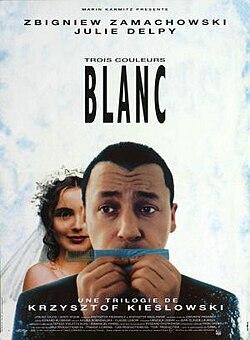
This article was automatically translated from the original Turkish version.
Original Title | Three Colors: White | ||||||||
|---|---|---|---|---|---|---|---|---|---|
Production Year / Country | 1994 / European co-production (France–Poland–Switzerland) | ||||||||
Genre | Drama (contains black comedy elements) | ||||||||
Director(s) | Krzysztof Kieślowski | ||||||||
Screenplay(s) | Krzysztof Kieślowski Krzysztof Piesiewicz | ||||||||
Main Cast | Zbigniew Zamachowski (Karol Karol), Julie Delpy (Dominique), Janusz Gajos (Mikołaj) | ||||||||
Music(s) | Zbigniew Preisner | ||||||||
Language(s) | Polish and French | ||||||||
Duration | 92 minutes | ||||||||
Notable Achievement | 1994 Berlin – Best Director (Silver Bear); 1994 European Film Awards – Nomination; 1994 Chicago IFF – Official Selection; 1995 CFCA – Nomination | ||||||||
Three Colors: White is the second film in Krzysztof Kieślowski’s “Three Colors” trilogy and constructs a dramatic narrative that explores the idea of equality through personal fate and social transformation. On one hand, the film tells the story of individual humiliation and resurgence; on the other, it maintains as backdrop the economic and cultural climate of Europe at the time. Structurally, elements of black comedy and emotional drama intertwine; the rhythm is carefully calibrated around the protagonist’s plans and reversals. The visual-musical unity of the trilogy is preserved; the color strategy of “white” becomes visible through space, light, and objects. The camera language approaches the character’s face and gestures through measured framing rather than flamboyant movement. Thus, the film aims to produce an narrative that balances formal simplicity with thematic sharpness.
While the other two films in the trilogy, Blue and Red, treat the concepts of “liberty” and “brotherhood” through distinct aesthetic strategies, White concretizes the possibility of equalization between these extremes through the cycle of a single individual’s collapse and rise. This connection generates a tight interplay among the characters, spatial transitions, and motifs of the three films. The film is readable as a standalone work but finds broader resonance within the trilogy’s shared symbolic universe. White leans on the sharp contours of comedy while avoiding melodrama; subtle humor sits alongside themes of pain and pride. Thus, at the very center of the trilogy, a film emerges that, despite aesthetic continuity, establishes a unique tonal balance. The result is a coherent synthesis between thematic clarity and narrative economy.

Julie Delpy as Dominique. (IMDb)
The story unfolds around Karol Karol, whose life unravels after a failed marriage in Paris, as he seeks to reclaim what he has lost and restore his sense of equality. Karol’s initial steps appear clumsy and helpless; then his return to his homeland, Poland, introduces new relationships and opportunities. The plot advances through small but impactful turning points; at each stage, the character’s intelligence, patience, and ethical boundaries are tested. The romantic thread is reshaped around themes of revenge and self-respect; a tense equilibrium develops between the parties. Humor softens the intensity of scenes laden with heavy emotion. The narrative opens not through the character’s inner voice but through actions and brief glances.
The structure follows a linear timeline; however, transitions between countries visibly alter the tone and rhythm of the story. The contrast between Paris’s cold order and Warsaw’s pragmatic realism functions throughout the film. Dialogue is restrained; silence, facial expressions, and ambient sounds carry much of the emotional weight. The ending concludes with a closing gesture that leaves room for interpretation on both ethical and romantic levels. Thus, the narrative presents the idea of equality not merely as a legal or social abstraction but as the reconfiguration of power dynamics between two individuals. These choices enable the film to carry both black comedy and dramatic tension simultaneously.
The production operates within a European co-production framework, with filming taking place in real locations across Paris and Warsaw. The visual design emphasizes white surfaces, cold lighting, and a neutral palette; these choices evoke the theme of “equality” on a visual level. The camera favors close and medium shots, carefully observing the characters’ bodily movements and subtle changes in their expressions. Editing establishes rhythm between planned maneuvers and unexpected reversals, favoring fluid transitions over abrupt cuts. In sound design, interior silence is balanced against the noise of crowded environments; music completes scenes without amplifying dramatic emphasis. Thus, technical choices provide the flexibility needed to carry tonal shifts between humor and solemnity.
Art direction frames the protagonist’s inner world through simple homes and workplaces; the use of emptiness visually manifests the oscillation between power and vulnerability. Costume and prop selections highlight shifts in class and status. Color transmission is calibrated through natural light and selective illumination; the multiple connotations of “white” are revealed as appropriate. In post-production, rhythm and sound levels are scaled according to the dramatic intent of each shot. This restrained approach sustains the measured quality felt throughout the trilogy. The overall outcome is a technical framework that conveys a character-driven story with cinematic intensity without resorting to exaggeration.

Zbigniew Zamachowski as Karol Karol. (IMDb)
Zbigniew Zamachowski portrays Karol Karol with a blend of fragility and calculation, revealing the character’s mental strategies through minute gestures. Julie Delpy creates the dramatic counterweight through Dominique’s distance and resolve, clearly defining the emotional axis of their relationship even in brief scenes. Janusz Gajos brings a measured performance to the figure who embodies the gray area between opportunity and risk. Supporting characters appear in short but functional scenes that materialize the networks of economic transformation and urban relationships. The economy of dialogue is completed by the actors’ body language and facial expressions. Thus, scenes progress under the weight of what remains unsaid.
The power dynamics between characters reveal the personal consequences of the desire for equality. Karol’s strategies continuously reshape the direction of his relationships; boundaries of trust and suspicion are redrawn with each development in the plot. Dominique’s presence, sometimes conveyed by a single line or glance, disrupts the dramatic context. The rhythm of entrances and exits among secondary characters adds variety without disrupting the main narrative, making class and status transitions visible. The acting approach rejects exaggeration; even in moments of heightened humor, realism is preserved. This unity allows the film’s tonal transitions to feel convincing.
Critical readings note the film’s careful balance between black comedy and personal drama. The cold palette and varied use of the “white” motif elevate the symbolic dimension and reinforce thematic focus. The selection of urban spaces makes class and status transitions perceptible within the mise-en-scène. The economy of dialogue, duration of scenes, and length of glances determine the tension’s modulation. The narrative treats revenge and the desire for equality without veering into melodrama; wit balances the darker aspects of the protagonist’s schemes. Thus, the film captures a tone within the trilogy that is distinct yet complementary.
Additionally, reviews emphasize that the final gesture offers an open-ended conclusion with emotional and ethical dimensions, leaving ample interpretive space for the viewer. The step-by-step execution of Karol’s plans is transparently tracked through the film’s rhythmic structure. The restraint of the performances maintains credibility even in the most intense scenes. Music and silence function as two primary elements that convey emotional tone without amplification. The conceptual backbone of the trilogy is made tangible in this film through everyday details. The overall picture presents a mature cinematic language that prioritizes form-content harmony.
The film received awards and nominations at prominent international festivals and institutions. Its recognition with the Best Director award at the 1994 Berlin International Film Festival stands as its most notable achievement. It was also nominated in a main category at the 1994 European Film Awards. Its inclusion in the 1994 Chicago International Film Festival program supported its festival visibility during the year. A nomination from the Chicago Film Critics Association in 1995 demonstrated the film’s continued resonance in the following season. The film was officially selected for screening at festivals such as Thessaloniki in 1995 and Valdivia in 1996.
The film’s circulation continued in subsequent years, with screenings at programs such as the 2014 São Paulo Film Festival and the 2022 Atlantic International Film Festival.
Beyazperde. “Üç Renk: Beyaz.” Accessed October 7, 2025. https://www.beyazperde.com/filmler/film-85307/
Defne Özonur Çöloğlu. “Sinemada Bir Anlam Yaratma Süreci Olarak Renk ve Krzystof Kieslowski’nin ‘Üç Renk: Mavi, Beyaz, Kırmızı’ Üçlemesi.” Kocaeli Üniversitesi İletişim Fakültesi Araştırma Dergisi. Accessed October 7, 2025. https://dergipark.org.tr/en/download/article-file/1734538
Engin Ertan. “Üç Renk: Avrupa’nın Renkleri.” Altyazı.net. Accessed October 7, 2025. https://altyazi.net/yazilar/elestiriler/uc-renk-avrupanin-renkleri/
IMDb. "Three Colors: White – Awards." Accessed October 7, 2025. https://www.imdb.com/title/tt0111507/awards/?ref_=tt_ov_at_op_awd
IMDb. "Three Colors: White – Filming Locations." Accessed October 7, 2025. https://www.imdb.com/title/tt0111507/locations/?ref_=tt_ov_at_dt_flmg
IMDb. "Three Colors: White – Full Cast & Crew." Accessed October 7, 2025. https://www.imdb.com/title/tt0111507/fullcredits/?ref_=tt_ov_at_pop_cst
IMDb. "Three Colors: White – Media Index." Accessed October 7, 2025. https://www.imdb.com/title/tt0111507/mediaindex/?ref_=tt_ov_at_pop_ph
IMDb. "Three Colors: White – Plot Summary." Accessed October 7, 2025. https://www.imdb.com/title/tt0111507/plotsummary/?ref_=tt_ov_at_pl_pl
IMDb. "Three Colors: White – Release Info." Accessed October 7, 2025. https://www.imdb.com/title/tt0111507/releaseinfo/?ref_=tt_ov_at_dt_rdat
IMDb. "Three Colors: White." Accessed October 7, 2025. https://www.imdb.com/title/tt0111507/
MUBI. "Three Colors: White – Awards." Accessed October 7, 2025. https://mubi.com/tr/films/three-colors-white/awards
MUBI. "Three Colors: White." Accessed October 7, 2025. https://mubi.com/tr/tr/films/three-colors-white
Peter Bradshaw. The Guardian. "Three Colours: White Review – Kieslowski, Julie Delpy, and the Black Comedy of Gangster Capitalism." April 5, 2023. Accessed October 7, 2025. https://www.theguardian.com/film/2023/apr/05/three-colours-white-review-kieslowski-julie-delpy-black-comedy-gangster-capitalism

Original Title | Three Colors: White | ||||||||
|---|---|---|---|---|---|---|---|---|---|
Production Year / Country | 1994 / European co-production (France–Poland–Switzerland) | ||||||||
Genre | Drama (contains black comedy elements) | ||||||||
Director(s) | Krzysztof Kieślowski | ||||||||
Screenplay(s) | Krzysztof Kieślowski Krzysztof Piesiewicz | ||||||||
Main Cast | Zbigniew Zamachowski (Karol Karol), Julie Delpy (Dominique), Janusz Gajos (Mikołaj) | ||||||||
Music(s) | Zbigniew Preisner | ||||||||
Language(s) | Polish and French | ||||||||
Duration | 92 minutes | ||||||||
Notable Achievement | 1994 Berlin – Best Director (Silver Bear); 1994 European Film Awards – Nomination; 1994 Chicago IFF – Official Selection; 1995 CFCA – Nomination | ||||||||
No Discussion Added Yet
Start discussion for "Three Colors: White (Film)" article
Plot and Narrative Structure
Production and Technical Features
Actors and Characters
Critical Evaluation
Awards