This article was automatically translated from the original Turkish version.
+1 More
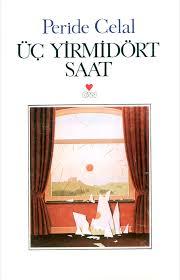
Book Title | Three Twenty-Four Hours | ||||||||
|---|---|---|---|---|---|---|---|---|---|
Author(s) | Peride Celal | ||||||||
Type(s) | Novel | ||||||||
Publisher(s) | Can Yayınları | ||||||||
Language(s) | Turkish | ||||||||
First Publication Date(s) | 1991 | ||||||||
Peride Celal’s novel Üç Yirmidört Saat is a work in which modernist narrative techniques emerge prominently, interrogating the relationship between time and space and bringing together the individual’s inner world with social structures. The novel focuses on the final three days of an elderly woman’s life in a hospital. Within this limited temporal frame, the events unfold not only as a physical process of dying but also as an exploration of memory, female identity, family bonds, and intergenerational relationships. Time does not progress linearly but in a fragmented structure, constantly transcending the boundary between past and present through dreams, memories, and internal monologues.
The novel centers on three female characters representing three generations: the dying grandmother, her daughter, and her granddaughter. Each embodies a distinct experience of womanhood shaped by different historical, cultural, and social conditions. The grandmother represents the more traditional and silent generation; as illness progresses, she confronts inner reckonings. The daughter is a figure caught in between, grappling with issues of belonging; she is trapped between societal roles and personal desires. The granddaughter adopts a more individualistic and distant attitude, reflecting the alienated stance of the new generation.
The auxiliary character, the servant Dilber, reveals the novel’s class stratifications. Her presence generates not only a spatial but also a conceptual opposition: themes such as domestic hierarchy, invisible labor, and class difference are represented through this character. Throughout the novel, the characters’ inner voices and streams of consciousness convey in detail emotions such as identity, repression, guilt, and vulnerability. In this respect, the novel transforms into a psychological interior narrative in which the individual confronts her own self.
The novel treats the emotional disconnection among the three generations not merely as a family drama but as a historical and sociological process of transformation. The distance between the grandmother and the granddaughter symbolizes the dissolution of traditional female roles and the alienation of the individualized new generation. In this context, the work highlights the modern individual’s sense of belonginglessness.
The novel disrupts the classical continuity of time and space to construct a modernist narrative. Past and present intertwine; the narrative structure is fractured through internal monologues, dreams, recollections, and stream of consciousness. Time ceases to be a straight line and becomes a field of consciousness shaped by inner experience.
Through the varied experiences of the female characters from different classes and generations, the historical, social, and individual layers of “being a woman” are laid bare. The grandmother embodies tradition, the daughter the transitional phase, and the granddaughter the individualistic generation. This structure offers a multidimensional analysis of the woman’s burdens in both public and private spheres.
The relationship between servant and mistress is questioned through the character of Dilber. This questioning encompasses not only economic but also cultural and emotional boundaries. The internalized forms of class difference point to the invisible mechanisms of social hierarchy.
The elderly woman’s death is not merely a physical end but an existential threshold at which the individual confronts her past and her family. Alienation manifests as a distance from both society and family.
While the novel explores the individual’s isolation and vulnerability through the lens of female identity, it also draws attention to the contradictions of modernization. With the dissolution of the traditional family structure, the modern lifestyle imposes upon the individual a new sense of “belonginglessness.” In this regard, the novel is not merely a personal inner journey but also a spiritual map of a modernizing society.
The characters’ entrapment between social norms and personal desires allegorically reflect Türkiye’s social transformation, class fragmentation, and the disintegration of the family structure over the course of the three days spent in the hospital room. Throughout the novel, the fragmented self of the individual is powerfully felt through the modernist narrative style.
Celal, Peride. *Üç Yirmidört Saat*. İstanbul: Can Yayınları.
Nurdan, Gülçin Tuğba. “Üç Yirmidört Saat Romanında Modernizm Algısı.” STAD Sanal Türkoloji Araştırmaları Dergisi. https://dergipark.org.tr/en/download/article-file/1988121

Book Title | Three Twenty-Four Hours | ||||||||
|---|---|---|---|---|---|---|---|---|---|
Author(s) | Peride Celal | ||||||||
Type(s) | Novel | ||||||||
Publisher(s) | Can Yayınları | ||||||||
Language(s) | Turkish | ||||||||
First Publication Date(s) | 1991 | ||||||||
No Discussion Added Yet
Start discussion for "Three Twenty-Four Hours (Book)" article
Characters
Themes
Intergenerational Tension and Modern Loneliness
The Fragmentation of Time and the Disintegration of Narrative
Female Experience and the Search for Identity
Class Tensions
Illness, Death, and Alienation
Intellectual and Social Context