

This article was automatically translated from the original Turkish version.
+1 More
Type of Geographical İndication | Mahreç Sign | ||||||||
|---|---|---|---|---|---|---|---|---|---|
Application Date | 23.06.2023 | ||||||||
Registration Number | 1696 | ||||||||
Registration Date | 04.02.2025 | ||||||||
Product / Product Group(s) | Handcraft products other than carpets kilims and textiles | ||||||||
Province(s) | Tokat | ||||||||
Applicant/Registrant(s) | Tokat Provincial National Education Directorate | ||||||||
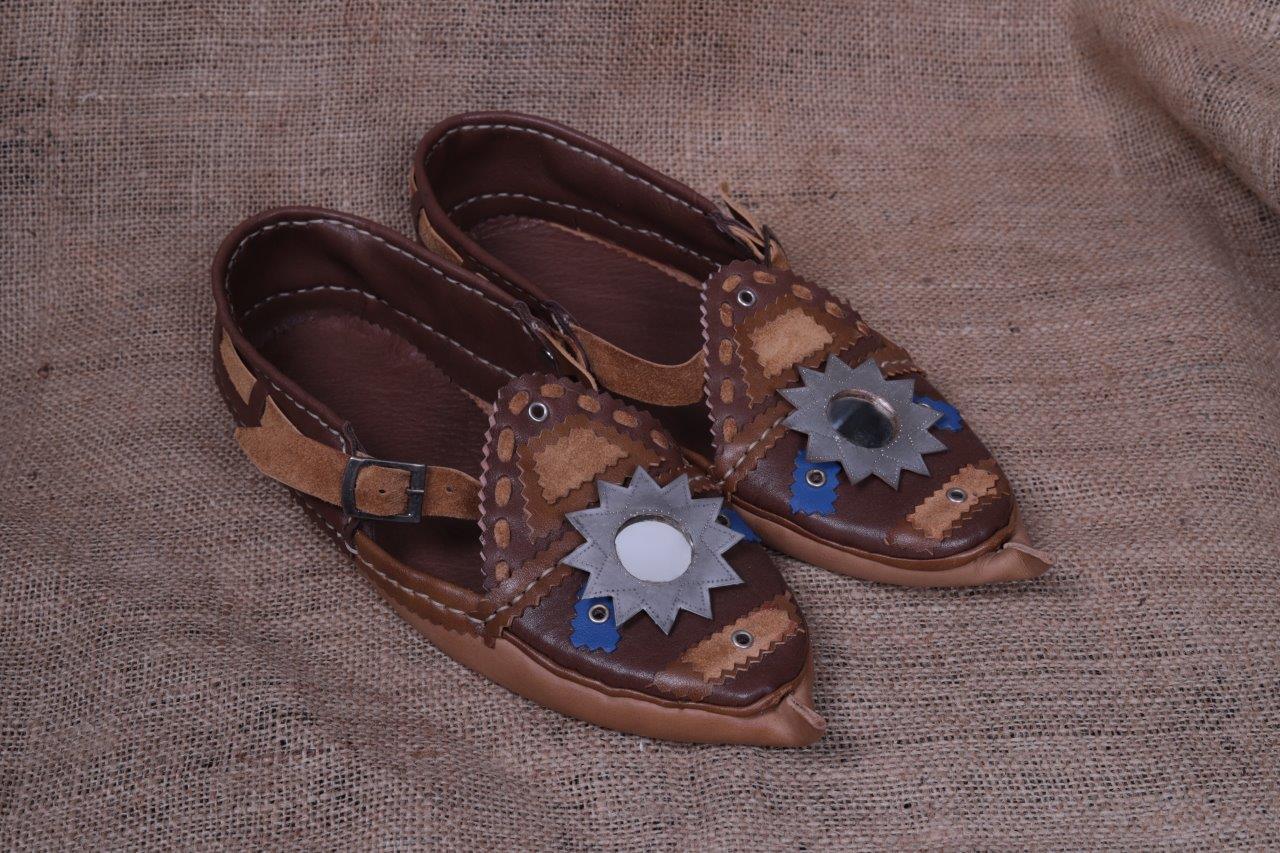
Tokat Aynalı Çarık is a type of shoe unique to the Tokat province that carries both technical and symbolic traces of traditional leather craftsmanship in Anatolia. This product, documented historically as far back as the 18th century, has been officially registered with a geographical indication by the Tokat Provincial Directorate of National Education and must be produced exclusively within the region’s boundaries. Considered a significant representative of material culture, the çarık is valued both for its technical characteristics and its position within folk culture.

Tokat Aynalı Çarık (Anadolu Agency)
The çarık is a type of footwear made from well-tanned buffalo or cattle leather, typically formed by folding a single piece of leather and securing it around the ankle with thongs or leather straps. In the Tokat Aynalı Çarık, this basic form has been diversified in terms of decoration and design:
There are three main types commonly found in Tokat: thonged çarık, mirror-decorated çarık, and buckle-decorated çarık. The mirror-decorated and buckle-decorated varieties are predominantly worn by women, while the thonged type is preferred by men.
The production process is entirely manual. Leather pieces are cut using specific templates. The sole and upper parts are bonded with glue, then stitched together using cotton thread treated with wax and passed through holes punched with a awl. The traditional tools used in production include:
In the mirror-decorated type, the mirror placed inside the lining is secured with a button. Decorative elements such as pom-poms are attached by punching holes with a punch.
Shoemaking in Anatolia has a history spanning four thousand years. Shoe forms resembling the çarık appear in reliefs from the 14th century BCE at Alacahöyük. Introduced to Anatolia with the Seljuks, çarıks diversified during the Ottoman period and were systematically produced within craft guilds.
The cultural significance of the çarık extends beyond functionality. In Tokat, brides wearing mirror-decorated çarıks were believed to have an enhanced ability to see their surroundings, carrying both aesthetic and ritual value. In folk literature, the expression “to have one’s feet in çarıks” symbolizes migration from village to city, while the term “çarıklı” itself refers to poverty. The çarık has left a broad cultural imprint, appearing in folk songs, poems, and oral traditions.
The word “çarık” has been adopted from Turkish into Balkan and Persian languages, appearing in various forms such as çarog, şoru, and sarok. Another theory suggests the term entered Turkish from Persian. Geographically, it has been used across a wide area stretching from the Taurus Mountains to Anatolia. Production also occurred in other centers such as Sivas, Amasya, and Zara, outside of Tokat.
With the Industrial Revolution, factory-made footwear pushed traditional çarık production into the background, leaving handcrafted production to only a small number of artisans. In Tokat today, production is largely sustained for tourist and decorative purposes. Master craftsmen residing in historic centers such as Taş Han continue to preserve this craft.
The product is protected under a geographical indication, with inspections conducted at least once a year under the coordination of the Tokat Provincial Directorate of National Education. These inspections evaluate production techniques, decorative elements, and the correct use of official marks.
Tokat Aynalı Çarık Documentary (Maturity Academy)
Anadolu Ajansı. “Tescilli Tokat aynalı çarığı Olgunlaşma Enstitüsü atölyesinde yaşatılıyor.” Anadolu Ajansı, March 10, 2025. Accessed July 3, 2025. https://www.aa.com.tr/tr/kultur/tescilli-tokat-aynali-carigi-olgunlasma-enstitusu-atolyesinde-yasatiliyor/3505120
Turk Patent and Trademark Office. "Geographical Indication No. 9684." *Geographical Indications Portal*. Accessed July 3, 2025. https://ci.turkpatent.gov.tr/cografi-isaretler/detay/9684
Özdemir, Melda. “Günümüzde Tokat İlinde Çarık Yapımı.” *Folklor/Edebiyat* 18, no. 69 (2012): 71–85. Accessed July 3, 2025. https://dergipark.org.tr/tr/pub/fe/issue/26056/274471

Type of Geographical İndication | Mahreç Sign | ||||||||
|---|---|---|---|---|---|---|---|---|---|
Application Date | 23.06.2023 | ||||||||
Registration Number | 1696 | ||||||||
Registration Date | 04.02.2025 | ||||||||
Product / Product Group(s) | Handcraft products other than carpets kilims and textiles | ||||||||
Province(s) | Tokat | ||||||||
Applicant/Registrant(s) | Tokat Provincial National Education Directorate | ||||||||
Definition and Structural Features
Production Techniques and Stages
Historical and Cultural Background
Linguistic Origins and Geographic Spread
Contemporary Status and Preservation Efforts