


This article was automatically translated from the original Turkish version.
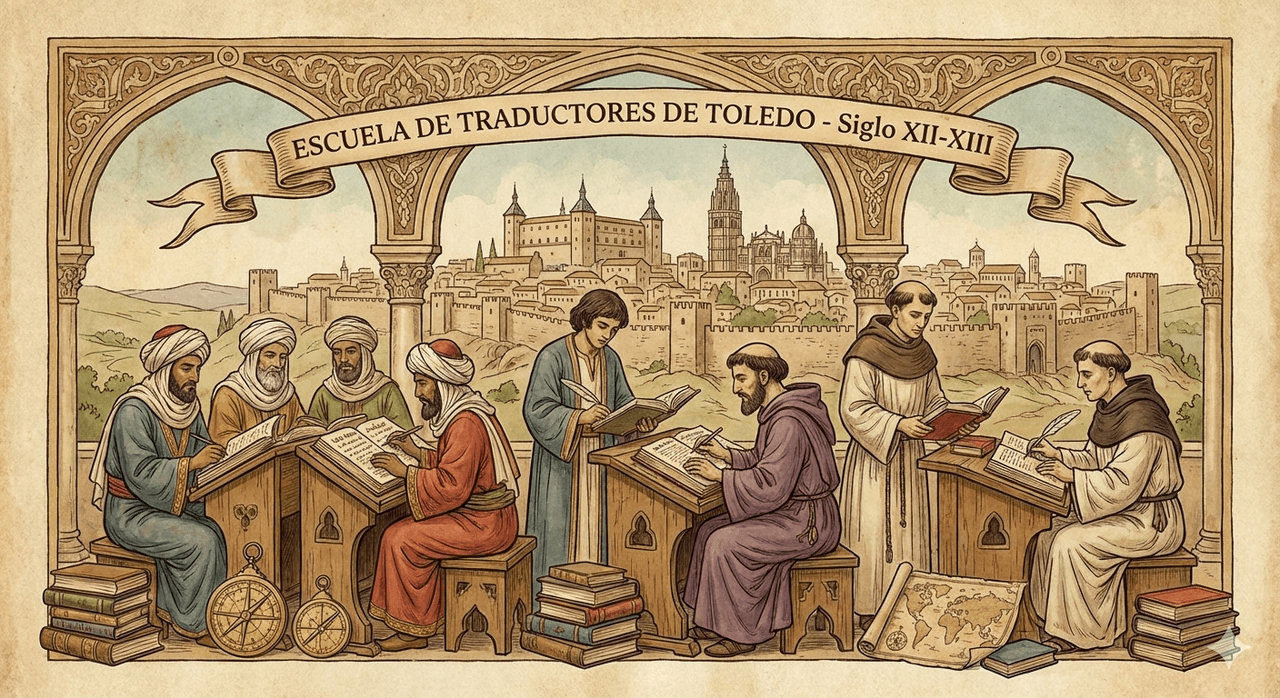
Generated with YZ
Toledo School of Translators
Foundation and Historical Framework | It was established around 1140 under the patronage of Archbishop Don Raimundo of Toledo (1125–1151). | ||||||||
|---|---|---|---|---|---|---|---|---|---|
Important Translators | Gerard of Cremona, Dominicus Gundisalvi, Michael Scott | ||||||||
Translation Fields | Astronomy, Mathematics, Medicine, Philosophy, Natural Sciences, Religious Texts, History | ||||||||
Toledo has historically been an important city, serving as the capital and cultural center during the Visigothic period. Its demographic composition, comprising Christians, Jews, Arabs, and Berbers, transformed Toledo into a cultural mosaic. After the conquests, the local population was granted the opportunity to preserve its identity, enabling the continuation of the city’s cultural diversity.
Toledo’s acquisition by Christians' in 1085 marked the beginning of cultural interaction between Muslims and Western society. Alfonso VI declared Toledo the capital of Castile and established a translation school there, spearheading the translation of Arabic works into Latin. This school facilitated the translation of Arabic texts in fields such as astronomy, medicine, mathematics, and philosophy into Romance languages.
The Translation School of Toledo became a major center of translation through the collaboration of Christian clerics and Jewish translators. Most of the translated works had previously been rendered into Arabic in schools in Baghdad, Egypt, and North Africa. This process contributed to the development of the idea that vernacular languages could serve as languages of science and helped establish a sense of national identity.
One of the most important figures of the Translation School of Toledo was Archbishop Raymond of Toledo. Raymond supported translation activities and brought together Muslim, Jewish, and Christian scholars. Under Raymond’s leadership, a community of translators known as the “Toledanos Colegio de Traductores” (School of Translators of Toledo) was formed.
The school produced translations in numerous fields, including mathematics, astronomy, medicine, chemistry, natural science, and history. After Raymond’s death, Archbishop Rodrigo Jiménez de Rada continued to support the translation movement. During this period, the most significant translation was the second Latin version of the Qur’an, completed by Marcus of Toledo.
The Translation School of Toledo played a crucial role in transferring the Islamic world’s body of knowledge to the West through translations into Latin and vernacular languages following Spanish’s dominance. These transmissions significantly influenced the establishment of many the university's. Moreover, these translation efforts were a key factor in the emergence of the Renaissance.
The activities of the Translation School of Toledo contributed to the cultural development of The West's and facilitated the recognition of Greek and Eastern sciences. The school played a critical role in advancing progress in science and literature and marked a turning point in the heritage of human culture.
Aksoy Arıkan, Rabia. "Orta Çağ İspanya’da Çeviri Faaliyetleri." RumeliDE Dil ve Edebiyat Araştırmaları Dergisi, no. 21 (2020): 967-978. Accessed October 27, 2025.
Arkan, Zeynep. "Çeviri Faaliyetleri Tarihinde Toledo Çeviri Okulu ve Çevirmenlerinin Yeri." İSLARA Uluslararası İslam Araştırmaları Kongresi, February 12, 2022. Accessed October 27, 2025. https://www.academia.edu/90654714/Çeviri_Faaliyetleri_Tarihinde_Toledo_Çeviri_Okulu_ve_Çevirmenlerinin_Yeri.

Generated with YZ
Toledo School of Translators
Foundation and Historical Framework | It was established around 1140 under the patronage of Archbishop Don Raimundo of Toledo (1125–1151). | ||||||||
|---|---|---|---|---|---|---|---|---|---|
Important Translators | Gerard of Cremona, Dominicus Gundisalvi, Michael Scott | ||||||||
Translation Fields | Astronomy, Mathematics, Medicine, Philosophy, Natural Sciences, Religious Texts, History | ||||||||
No Discussion Added Yet
Start discussion for "Toledo School of Translators" article
Cultural Interaction
Translation Activities
Key Figures
Important Translators
Translation Methods
Impacts and Consequences