


This article was automatically translated from the original Turkish version.
+1 More
Tömbelek is the name of a traditional practice performed especially during Ramadan nights in the Black Sea Region, and it is also a term used to refer to a type of struck instrument. In various sources, tömbelek is classified among a family of percussion instruments made by stretching skin over a frame, and it is also known by names such as dümbelek and similar variants. It holds cultural significance both as the name of an instrument and as a ritual practice specific to Ramadan nights.
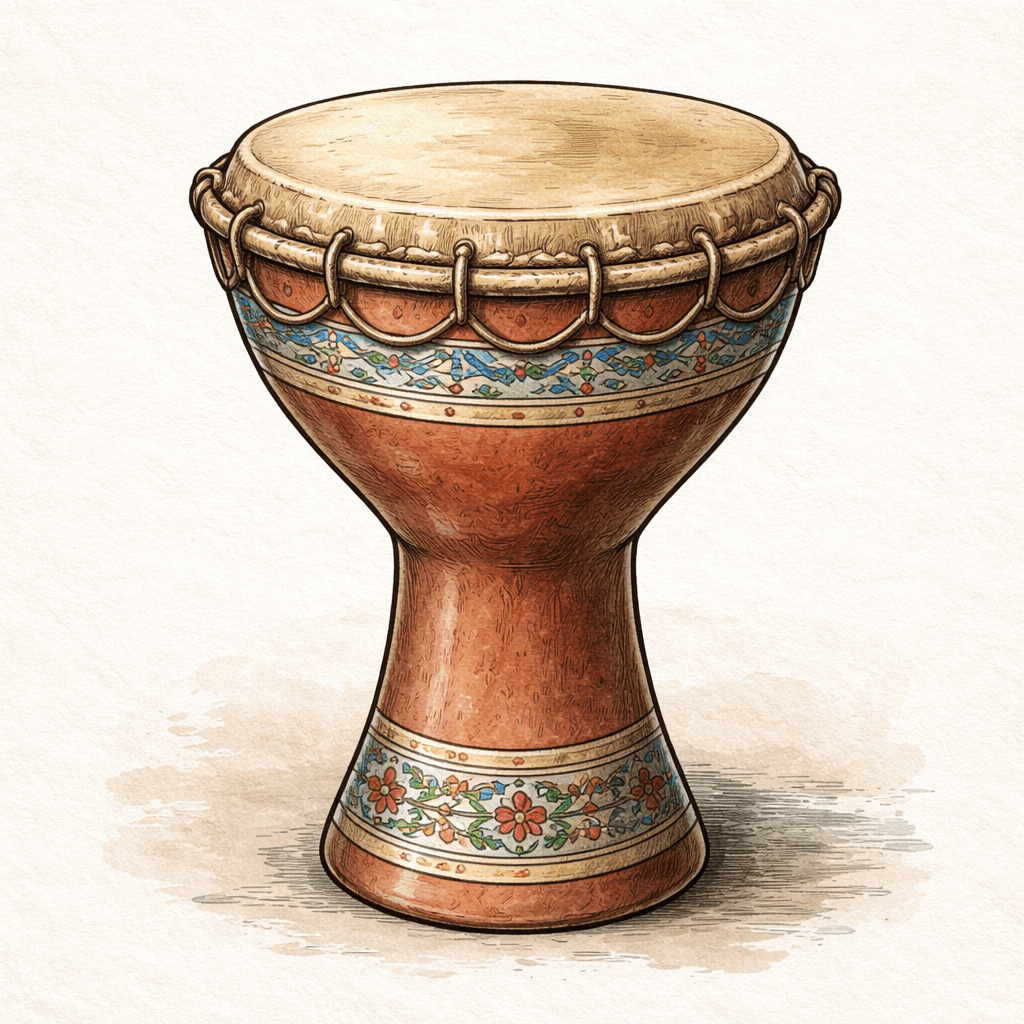
Tömbelek (Generated by Artificial Intelligence)
Tömbelek is one of several names used for this percussion instrument, which is also referred to in various sources as dümbelek, dünbek, dönbet, deblek and deplek. Azerbaijani Turks use the terms darbeki and debulak. The modern Turkish term darbuka, also used in Arabic-speaking countries, is believed to derive from the Ottoman Turkish word “darb”, meaning “to strike.” It is further associated with the Arabic word “darba”, which denotes “repeated strikes.” The sound produced by successive finger strikes on the stretched skin surface is directly linked to this etymology.【1】
The term tömbelek is one variant among this diversity of names and can refer both to the instrument and to a specific local practice.
Dümbelek is a musical instrument made by stretching skin over an open-ended vessel. In Türkiye, naming varies according to the material used in its construction. Metal-bodied versions are called darbuka, while earthenware versions are known as dümbelek. In the context of folk music, earthenware variants are also referred to as çömlek. This demonstrates that while the fundamental structure of the instrument remains consistent, its name changes depending on the material. Sound is produced by striking the stretched skin surface with the hand or fingers.
Historically, this instrument in the mehter ensemble was known as nakkâre and çiftenağra. It continues to be used in mehter bands in Türkiye today. The nakkâre variant consists of two small drum-like bowls connected together. It is played with two small sticks, each tipped with leather or fabric. It is noted that the instrument was introduced to Western countries through Muslim influence, where it became known as nacchare in Italy and nacarois in Spain. These names indicate that the instrument was recognized and used across different cultures.【2】
Tömbelek Tradition in the Black Sea Region (Hendek Tv)
In the Black Sea Region, the practice known as tömbelek or dömbelek is defined as a tradition performed specifically during Ramadan nights. This tradition is typically carried out by groups of four to eight children and young people. Manis, folk verses developed specifically for Ramadan, hold an important place in Turkish culture. Ramadan nights serve as key contexts for the performance of atma songs and manis across many regions. This street-based practice is evaluated alongside the performance customs of Ramadan drummers.
Tömbelek Manisi (İlitköyü)
In some areas, it is noted that over time this tradition has acquired an economic function and now primarily serves economic purposes. This indicates a shift in the functional context of the tradition. In this context, the term tömbelek is used both as the name of a percussion instrument and as the name of a verbal and musical traditional practice performed during Ramadan nights.
A legend regarding the origin of the instrument is recounted. According to this tale, the famous Kyrgyz hunter Kamber Kân took the skin of a dead donkey and stretched it over the animal’s hollow skull, producing sound by striking it. It is claimed that the names dool, davul, and dümbelek originated from this practice. This narrative functions as a mythical account explaining the emergence of the instrument.【3】
Dümbelek appears in classical literary texts as both a means of communication and a metaphorical element. In Mevlana’s works, davul and dümbelek are mentioned together, with the instruments described as tools for announcing news.【4】 Additionally, dümbelek is used metaphorically through its capacity to produce sound. The comparison of the davul and dümbelek to objects that cannot produce sound without a beater illustrates that an effect cannot arise without a necessary element. These examples demonstrate that dümbelek is not only a musical instrument but also a cultural and literary symbol.
[1]
Esra Karaol and Nilgün Doğrusöz. "Mısırlı Ahmet: The Clay Darbuka Technique and Its Performance Analysis." RAST Musicology Journal/Rast Muzikoloji Dergisi 2, no. 1 (2014): 54. Accessed 19 February 2026. http://www.channelingstudio.ru/texts/Misirli_Ahmet_The_Clay_Darbuka_Technique.pdf
[2]
Mustafa Yıldırım and Murat Ak. "Mevlânâ'nın Eserlerinde Mûsikî Aletleri ve Metaforik Kullanımları." Yegah Müzikoloji Dergisi 8, no. 4 (2025): 3272. Accessed 19 February 2026. https://dergipark.org.tr/en/pub/ymd/article/1808669
[3]
Yıldırım ve Ak. "Mevlânâ'nın Eserlerinde Mûsikî Aletleri ve Metaforik Kullanımları." (2025): 3272. Erişim 19 Şubat 2026. https://dergipark.org.tr/en/pub/ymd/article/1808669
[4]
Yıldırım ve Ak. "Mevlânâ'nın Eserlerinde Mûsikî Aletleri ve Metaforik Kullanımları." (2025): 3272-3273. Erişim 19 Şubat 2026. https://dergipark.org.tr/en/pub/ymd/article/1808669


Nomenclature and Etymology
Structural Features and Materials
Historical Use and Mehter Tradition
Tömbelek Tradition in the Black Sea Region
Legendary Origin Story
Dümbelek in Literary Texts