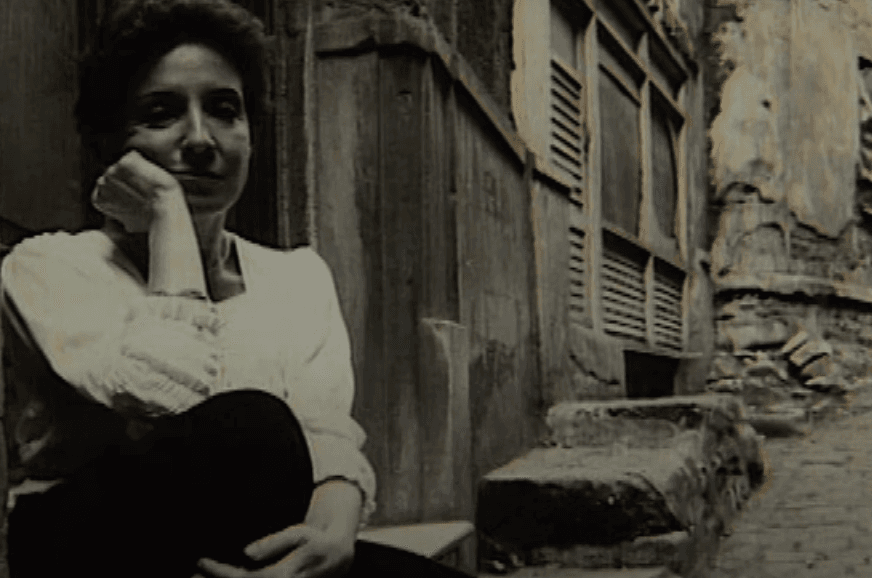
Tomris Uyar
Birth | 15 March 1941 | ||||||||
|---|---|---|---|---|---|---|---|---|---|
Death | 4 July 2003 | ||||||||
Spouses | Ülkü Tamer, Turgut Uyar | ||||||||
Child | Ekin Tamer Hayri Turgut | ||||||||
Profession(s) | Writer Critic Translator | ||||||||
Tomris Uyar, known by her full name Tomris Gedik, (1941–2003) was a short story writer, translator, and critic. She focused particularly on the short story genre in her literary career and introduced numerous works to Turkish readers. She was also a founding member of the Turkish Writers’ Union.
Tomris Uyar was born on 15 March 1941 in Istanbul. Her father was Fuat Gedik and her mother was Celile Girgin. She began her education at Yeni Kolej in Istanbul and continued her secondary studies at English High School. She completed her high school education at Arnavutköy American College for Girls and graduated in 1963 from the Institute of Journalism at Istanbul University Faculty of Economics.
The education she received, combined with her accumulated knowledge in language and literature, enabled Uyar to carve out a unique place for herself in the literary world. From an early age, Uyar showed interest in literature and translation, and during her university years she developed expertise in journalism and literary production.
Video on the Life of Tomris Uyar. (TRT Archive)
Tomris Uyar began her literary career in 1963 with translations published in the magazine Varlık. Her first published translation was Rabindranath Tagore’s fairy tale Baby of Sugar (1962, Varlık Publishing House). In subsequent years, her translations appeared in journals such as Dost, Papirüs, Yeni Dergi, Soyut, Yeni Edebiyat, and Yeni Düşün.
Uyar’s short stories were published in journals including Türkiye Defteri, Yeni Dergi, Papirüs, and Soyut. She also authored eleven short story collections, in addition to translations and diaries.
Her critical essays and articles were compiled in the books Kitapla Direniş and Aşkın Yıpranma Payı.
In her works, Tomris Uyar examined simple moments of everyday life, focusing on the emotions and thoughts of individuals confronting these situations.
Tomris Uyar occupies a significant place in Turkish literature through her observations of daily life and psychological depth in her short stories and diaries. In her narrative style, characters’ inner worlds are explored through the situations they experience. Her prose combines simplicity with intensity, forming a distinctive structure. Although her sentences are typically brief and concise, they carry multiple layers of meaning. Using an imaginative language, Uyar aimed to convey emotional and mental states to the reader through the subtleties of linguistic expression.
In her short stories, women characters and their social roles, as well as their personal quests, are central. The internal conflicts, expectations, and disappointments of women are portrayed. Furthermore, themes such as individual loneliness, alienation, and existential questioning recur in her works. Uyar shapes her characters not through external events but through internal experiences and perceptions.
In addition to her literary activities, Tomris Uyar taught elective courses on Contemporary Short Story and Turkish Short Story Writing at Boğaziçi University. She organized a workshop titled Kıyıdan Açılmak at Bilgi University. In 1978, at the invitation of an international organization, she traveled to the United States and participated in conferences held in Chicago and Washington. She also attended the meeting titled Literature and Memory in Finland, held from 16 to 20 June 1991.
Tomris Uyar’s circle of literary figures provided the context for traces of the Second New poetry movement to appear in her stories. She engaged artistically with her husband, the poet Turgut Uyar, and stated that her primary inspiration came from the poems of Edip Cansever. Her short story Zula was inspired by poems Cansever wrote to her on her birthday.
Tomris Uyar’s Gündökümü series is a collection of diaries she kept between 1975 and 1984. The texts comprising the first volume closely resemble personal journals, directly reflecting her immediate experiences, observations, and inner states in chronological order. The section titled On Beş Yılın Dökümü in the second volume approaches the essay form in both content and style. Relationships and memories with literary figures such as Edip Cansever, Turgut Uyar, and Cemal Süreya are documented in these diaries, particularly in the second volume.
The first volume of Tomris Uyar’s Gündökümü consists of two main sections. Under the title Sesler, Yüzler, Sokaklar, her diary entries from 1975 to 1979 are compiled. This section reflects the observations, impressions, and personal experiences of that period. The following section, Günlerin Tortusu, contains diary entries from 1980 to 1984. Together, these two parts form Gündökümü I, presenting Uyar’s intellectual and emotional accumulation during a specific time frame. The second volume, Gündökümü II, contains records from after 1984.
Tomris Uyar received the following awards for her translations and short stories:
She married Ülkü Tamer in 1963, and they had a daughter named Ekin. After her daughter’s death, she ended her marriage with Ülkü Tamer. In 1967, she married the poet Turgut Uyar, with whom she had a son named Hayri Turgut.
Tomris Uyar died on 4 July 2003 after a four-year battle with esophageal cancer and was buried at Zincirlikuyu Cemetery.
CNN Türk. "Tomris Uyar Kimdir? Eserleri Nelerdir? Tomris Uyar’a Aşık Olan Şairler Kimlerdir?" Accessed June 19, 2025. https://www.cnnturk.com/kultur-sanat/tomris-uyar-kimdir-eserleri-nelerdir-tomris-uyara-asik-olan-sairler-kimlerdir-1743404.
TRT Archive. "Tomris Uyar | TRT Arşiv." YouTube video, July 22, 2024. Accessed June 19, 2025. https://www.youtube.com/watch?v=mIneTzDgBDo.
Türkiye Yazarlar Sendikası. "Tomris Uyar." Accessed June 19, 2025. https://turkiyeyazarlarsendikasi.org/duyurular/tomris-uyar/.
Uyar, Tomris. "Karanlıkta Bir Deneme: Özyaşam Öyküsü ve Öykü." PDF. Accessed June 19, 2025. https://core.ac.uk/download/38329329.pdf.
Uyar, Tomris. Gündökümü I ve Gündökümü II. Istanbul: YKY, 1994.

Tomris Uyar
Birth | 15 March 1941 | ||||||||
|---|---|---|---|---|---|---|---|---|---|
Death | 4 July 2003 | ||||||||
Spouses | Ülkü Tamer, Turgut Uyar | ||||||||
Child | Ekin Tamer Hayri Turgut | ||||||||
Profession(s) | Writer Critic Translator | ||||||||
Early Life and Education
Literary Career
Literary Personality
Academic and Social Contributions
Literary Interactions
Works
Short Stories:
Diaries:
The Gündökümü Diary Series
Awards
Personal Life and Death