This article was automatically translated from the original Turkish version.
+1 More
Location | Trabzon | ||||||||
|---|---|---|---|---|---|---|---|---|---|
Visiting Hour(s) | Daily 09.00 – 17.00 | ||||||||
Construction Date(s) | 1250–1260 Empire of Trebizond | ||||||||
Conversion to Mosque | 1583 (by Kürd Ali Bey) | ||||||||
Conversion to Museum | 1964 | ||||||||
Reopening as Mosque | 28 June 2013 | ||||||||
Architectural Feature(s) | twelve-sided dome drum (named after the apostles) opus sectile marble mosaic flooring one pentagonal and two circular apses three naves high drum central dome Closed cross plan | ||||||||
The Trabzon Hagia Sophia Museum is a Byzantine church built in the mid-13th century by Manuel I Komnenos of the Komnenos dynasty of Trebizond (reigned 1238–1263). Its construction date is also recorded in various sources as 1250–1260. This structure is one of the most important examples of medieval Byzantine provincial architecture and was converted into a mosque after Trabzon joined Ottoman territories in 1461. According to Evliya Çelebi, this conversion took place in 991 AH (1583 CE) through the initiative of Kürd (or Körlet) Ali Bey, and a minbar and mahfil were added to the building by imperial decree. Although some sources cite 1544–1545 as the conversion date, the general consensus favors 1583.

Trabzon Hagia Sophia Museum (Museums)
The building served as a mosque through various periods until the mid-19th century. In 1864, it underwent restoration funded by 95,000 kurush collected by the public under the leadership of Rıza Efendi of Bursa. During the Russian occupation in World War I, it was used as a storage facility and military hospital, and after the war it reverted to its function as a mosque. In 1957, it was closed for worship to begin efforts to uncover its frescoes, and in 1964 it was opened to the public as a museum. In 2013, an administrative decision restored its status as a mosque and it was reopened for worship.
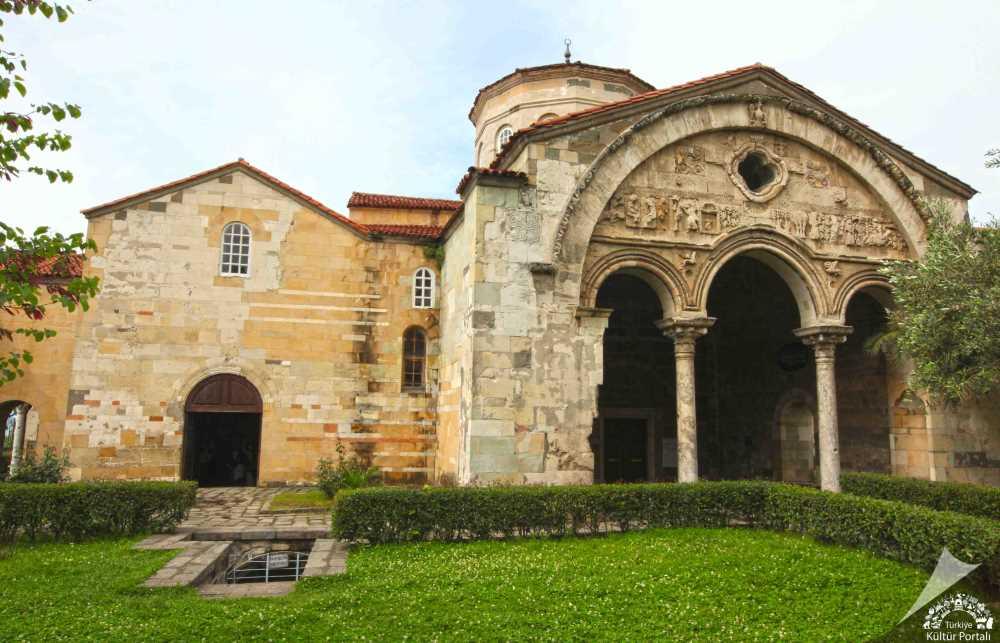
The Trabzon Hagia Sophia Museum is a structure with four columns, a closed cross plan, and a high drum supporting a dome. The central dome rests on four monolithic marble columns via arches and pendentives. The twelve-sided drum is designed to allude to the number of apostles. The interior consists of three naves; the central nave ends in a pentagonal apse while the side naves terminate in circular apses. The narthex contains a chapel above it. The building has three three-arched entrances on its north, west, and south facades.
On the north side, remains of an early-period chapel with three apses can be found; on the west side stands a square bell tower dated 1427. This tower, bearing Venetian influence, is a rare example in Byzantine architecture and served as a minaret during the Ottoman period. The floor beneath the dome features a polychrome marble mosaic created using the opus sectile technique. The building reflects a synthesis of Byzantine style with Seljuk and Caucasian stonework. Geometrically decorated medallions and muqarnas niches on the west and north facades reveal Seljuk influence. The south facade is the most richly decorated architectural element. Here, the scene of the creation of Adam and Eve is rendered as a frieze in relief. The same facade also features the single-headed eagle motif, the symbol of the Komnenos dynasty.
One of the building’s most significant artistic elements is the series of frescoes uncovered between 1957 and 1961 with support from the Russell Trust of the University of Edinburgh. These frescoes depict scenes from the Bible. At the center of the dome is a depiction of Christ Pantocrator symbolizing Christ’s divine nature, beneath which is a band of inscriptions and below that a frieze of angels. The pendentives illustrate scenes such as the Nativity, Baptism, Crucifixion, and Last Judgment. The twelve apostles are portrayed between the windows, and various biblical scenes are painted on the vaults. The frescoes in the south narthex have not survived to the present day. The frescoes in the choir area are covered by curtains, while those in the narthex remain exposed.
%2520kopya.jpg&w=1280&q=75)
Frescoes of the Hagia Sophia Museum Dome (Türkiye Culture Portal)
Hagia Sophia was converted into a museum in 1964 and reopened for worship in 2013. Today it functions simultaneously as both a mosque and a museum. This dual use has sparked debates regarding how functional transformations of such structures should be evaluated within the field of cultural heritage. A study conducted with tour guides in Trabzon revealed a consensus that Hagia Sophia has not been fully restored to its mosque form and that its frescoes have suffered damage. The guides noted that foreign tourists reacted negatively to the decision to convert it into a mosque, while local tourists showed limited reaction. The same study also found that the surrounding area is kept cleaner and that other mosques exist in the vicinity.
The Trabzon Hagia Sophia Museum is located in the Ortahisar district of Trabzon, near the seashore. Opening hours are daily from 09:00 to 17:00. Address: Fatih Neighborhood, Zübeyde Hanım Street, 61040 Ortahisar/Trabzon. Phone number: (0462) 223 30 43.
Demirbulat, Özge Güdü, and Sebahattin Karaman. “Trabzon Ayasofya Müzesi’nin Camiye Dönüştürülmesine İlişkin Turist Rehberlerinin Değerlendirmesi.” *Balıkesir Üniversitesi Sosyal Bilimler Enstitüsü Dergisi* 17, no. 32 (2014): 37–54. Accessed July 3, 2025. https://dergipark.org.tr/tr/download/article-file/852825
“Karadeniz’s Cultural Heritage: Trabzon Ayasofya Museum.” *Karsem –Karatay Üniversitesi Continuing Education Application and Research Center.* Accessed July 3, 2025. https://karsem.karatay.edu.tr/trabzon-ayasofya-muzesi-karadenizin-kulturel-mirasi
“Trabzon Ayasofya Camii.” *Türkiye Diyanet Vakfı İslam Ansiklopedisi.* Accessed July 3, 2025. https://islamansiklopedisi.org.tr/ayasofya-camii--trabzon
“Trabzon Ayasofya Müzesi.” *Kültür Portalı.* Accessed July 3, 2025. https://www.kulturportali.gov.tr/turkiye/trabzon/gezilecekyer/ayasofya--muzesi
“Trabzon Ayasofya Müzesi.” Müzeler.org. Accessed July 3, 2025. https://muzeler.org/trabzon-ayasofya-muzesi--353447
“Trabzon Ayasofya Müzesi.” Karadeniz Bölge Kalkınma İdaresi Başkanlığı. Accessed July 3, 2025. https://karadeniz.gov.tr/trabzon-ayasofya-muzesi/

Location | Trabzon | ||||||||
|---|---|---|---|---|---|---|---|---|---|
Visiting Hour(s) | Daily 09.00 – 17.00 | ||||||||
Construction Date(s) | 1250–1260 Empire of Trebizond | ||||||||
Conversion to Mosque | 1583 (by Kürd Ali Bey) | ||||||||
Conversion to Museum | 1964 | ||||||||
Reopening as Mosque | 28 June 2013 | ||||||||
Architectural Feature(s) | twelve-sided dome drum (named after the apostles) opus sectile marble mosaic flooring one pentagonal and two circular apses three naves high drum central dome Closed cross plan | ||||||||
No Discussion Added Yet
Start discussion for "Trabzon Hagia Sophia Museum" article
Architectural Features
Frescoes and Decorations
Museum and Mosque Use
Access and Visit Information