


This article was automatically translated from the original Turkish version.
Translation Studies is an academic discipline that examines translation as an activity in terms of its theoretical foundations, descriptive approaches, and practical dimensions. This field investigates the processes of meaning transfer between different languages on one hand, and on the other hand explores the cultural, social, and cognitive aspects of these processes. Translation Studies has a multilingual and interdisciplinary character; it is closely related to fields such as linguistics, cultural studies, philosophy, semiotics, history, and sociology.
There is a conceptual distinction between translation and Translation Studies. Translation refers to the process and the act of transferring a text from a source language to a target language. Translation Studies, by contrast, is the scientific field that systematically investigates this activity, develops theories, and proposes methodologies.
Although translation has played a significant role in human communication throughout history, theoretical and systematic studies on translation are relatively recent.
The term translation derives from the Latin word meaning “to transfer or carry something from one place to another.” The distinction made by ancient Roman writers Cicero and Horace between “metaphrase” (word-for-word translation) and “paraphrase” (restating the meaning) formed the foundation of early translation theories. These debates have persisted for centuries, centering on tensions such as “fidelity” and “intelligibility.”
The idea of translation as a science was first introduced by Eugene A. Nida in 1964. In his work Towards a Science of Translating, Nida attempted to explain the translation process using a scientific approach, particularly through the analysis of biblical translations. However, this approach primarily addresses technical and linguistic issues within the translation process.
Translation Studies emerged as an independent academic discipline in the 1970s. The 1972 work by James S. Holmes titled “The Name and Nature of Translation Studies” is widely regarded as a turning point in the field. Holmes argued that translation should not be viewed merely as a practical activity but as a distinct scientific discipline with its own concepts and methods. The term “Translation Studies” proposed by Holmes remains in use today. In Turkish, this field is generally accepted as “çeviribilim.” The widespread adoption of the term “çeviribilim” in Turkish is linked to the German tradition of “Übersetzungswissenschaft” and the acceptance of the term “dilbilim” (linguistics) in Turkish academic circles.
In his work “The Name and Nature of Translation Studies,” James Holmes not only named the field but also produced the first map outlining its scope.
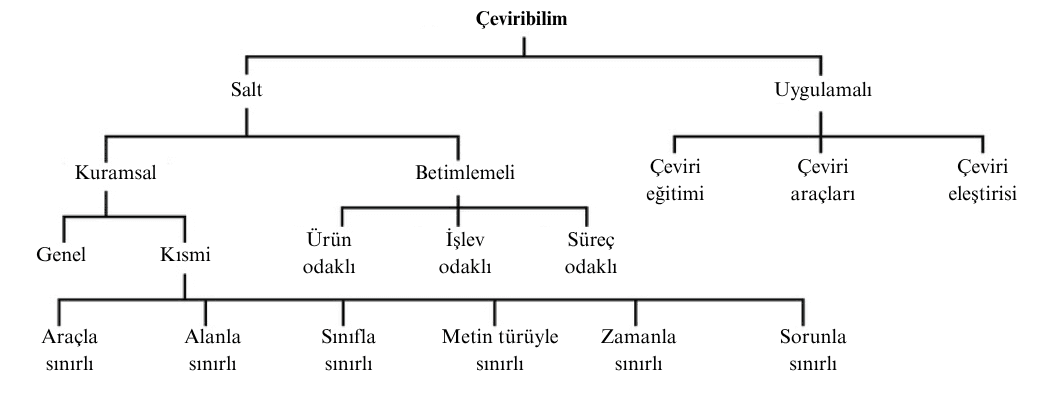
James Holmes’s Map of Translation Studies
García de Toro, Cristina. “Translation Studies: An Overview.” Universitat Jaume I, Spain, 2007. Accessed October 24, 2025. https://periodicos.ufsc.br/index.php/traducao/article/view/1001/1418.
Sharma, Shivnath Kumar. “The Role and Scope of Translation Studies in the 21st Century.” IOSR Journal of Humanities and Social Science. Accessed October 24, 2025. https://www.academia.edu/download/118577149/Translation_Studies_paper.pdf.
University of Exeter. “What Is Translation Studies? | University of Exeter.” University of Exeter. 2025. Accessed October 24, 2025. https://www.exeter.ac.uk/study/degrees/translation-studies/what-is-translation-studies/.
Vedran. 2015. “Translation Icon Vector Clip Art | Free SVG.” Freesvg.org. Accessed October 24, 2025. https://freesvg.org/translation-icon-vector-clip-art.
Yazıcı, Mine. Çeviribilimin Temel Kavram ve Kuramları. Istanbul, Multilingual Yabancı Dil Yayınları, 2010.

No Discussion Added Yet
Start discussion for "Translation Studies" article
Difference Between Translation and Translation Studies
Historical Development
Modern Period
Institutionalization of Translation Studies
James S. Holmes and the Scope of Translation Studies