

This article was automatically translated from the original Turkish version.
When the Agreement Was Signed
Signature Date | March 16, 1921 | ||||||||
|---|---|---|---|---|---|---|---|---|---|
Place of Signing | Moscow | ||||||||
Parties | TBMM Government – RSFSR (Soviet Union) | ||||||||
The Treaty of Moscow, signed on 16 March 1921 between the Government of the Grand National Assembly of Türkiye and the Russian Soviet Federative Socialist Republic (RSFSR) acting on behalf of the Union of Soviet Socialist Republics, is an international agreement that defined Türkiye’s northeastern borders and resolved boundary issues in the Caucasus region. This treaty is regarded as one of the first international successes of the TBMM during the War of Independence. It also marked a diplomatic turning point in Türkiye-Soviet relations.
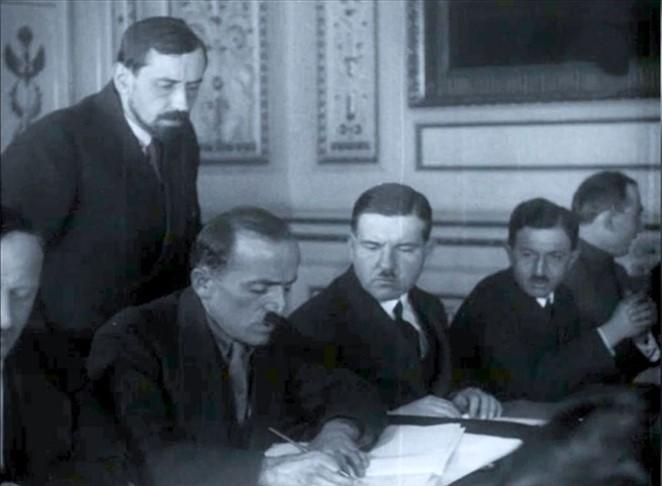
Images of the Treaty of Moscow (TRT News)
Following World War I, the political and military weakening of the Ottoman Empire created the conditions for the Allied Powers to begin occupations in Anatolia. The Armistice of Mudros, signed on 30 October 1918, led to the demobilization of the Ottoman army, the confiscation of its weapons, and the initiation of occupations in various regions. Under these circumstances, the Turkish people, under the leadership of Mustafa Kemal Paşa, launched the National Struggle beginning on 19 May 1919.
The opening of the Grand National Assembly of Türkiye on 23 April 1920 established the Ankara Government, which assumed the political and military leadership of the independence struggle, distinct from the Ottoman Government in Istanbul. At the same time, the Tsarist regime in Russia had been overthrown as a result of the October Revolution of 1917, and the foundations of the Union of Soviet Socialist Republics were laid by the Bolsheviks. The new regime, led by Lenin, prioritized cooperation with anti-imperialist movements as a key objective of its foreign policy.
In this context, the Soviet Union viewed the Ankara Government, which was fighting imperialism in Anatolia, as a potential ally. Türkiye, on the other hand, urgently needed military and economic support, particularly against the Greek occupation backed by the West. As the needs of both sides complemented each other, diplomatic contacts accelerated rapidly. On 26 April 1920, Mustafa Kemal Paşa initiated direct diplomatic relations by sending a letter to Soviet leader Lenin, requesting the establishment of formal ties and seeking military assistance.
Following Mustafa Kemal Paşa’s letter, an exchange of correspondence and inter-delegation meetings began. In this framework, the first Turkish delegation, headed by Bekir Sami Bey on behalf of the TBMM, traveled to Moscow. However, the parties failed to reach an agreement on border issues. The Soviet side demanded the cession of certain eastern provinces to Armenia, a demand rejected by the Turkish delegation. The negotiations ended without result.
With changing political conditions, a new Turkish delegation was sent to Moscow in February 1921. This delegation included prominent figures such as Yusuf Kemal Tengirşek, Ali Fuat Cebesoy, and Rıza Nur. The negotiations commenced on 17 February 1921 and were conducted with the Soviet delegation led by Georgiy V. Chicherin, the Soviet Commissar for Foreign Affairs.
The main agenda items of the negotiations were as follows:
Nakhchivan was regarded by the Turkish delegation as strategically and ethnically significant. Turkey proposed that the region’s status be regulated as an autonomous entity under Azerbaijani protection rather than under direct Turkish sovereignty. The Soviet side accepted this proposal, leading to an agreement that Nakhchivan would be an autonomous region affiliated with Azerbaijan and not transferable to any third state.
The issue of Batum was more complex. Türkiye insisted on guarantees for the rights of the Muslim population living in Batum. This demand was accepted by the Soviets, resulting in a provision ensuring cultural autonomy for Batum within Georgia.
The Treaty of Moscow was signed on 16 March 1921. Its main provisions are as follows:
The Treaty of Moscow secured Türkiye’s eastern borders under international law and strengthened the diplomatic legitimacy of the TBMM. The treaty also provided a balanced solution that respected Türkiye’s historical ties with the Turkic and Muslim populations of the Caucasus. Following the treaty, Türkiye gained greater capacity to focus on the Western Front. The Treaty of Kars, signed on 13 October 1921, was subsequently ratified by Armenia, Azerbaijan, and Georgia, all of which recognized the territorial arrangements established by the Treaty of Moscow, thereby finalizing the regional borders through mutual agreement. From the Soviet perspective, the Treaty of Moscow stabilized its southern borders and represented a significant step in its strategy to break the imperialist encirclement by establishing friendly relations with a major regional actor like Türkiye.
Askeroğlu Arslan, Ayna. “Moskova Anlaşması ve Türkiye’nin Kuzeydoğu Sınırı.” Trakya Üniversitesi Sosyal Bilimler Dergisi 17, no. 2 (2015): 1–20. https://dergipark.org.tr/tr/download/article-file/321296
Kurban, Vefa. “16 Mart 1921 Moskova Andlaşması’na Türk ve Rus Kaynaklarına Göre Karşılaştırmalı Bir Bakış.” *Celal Bayar Üniversitesi Sosyal Bilimler Dergisi* 12, no. 1 (2014): 143–149. Accessed May 15, 2025. https://dergipark.org.tr/tr/pub/cbayarsos/issue/4062/53495
Musa, İsmayıl. “Azerbaycan ve Rus Kaynaklarına Göre 1921 Moskova-Kars Antlaşmaları ve Kuzey Azerbaycan’ın Toprak Bütünlüğü Meseleleri.” *Belleten* 66, no. 247 (2002): 517–523. https://dergipark.org.tr/tr/download/article-file/1485851
When the Agreement Was Signed
Signature Date | March 16, 1921 | ||||||||
|---|---|---|---|---|---|---|---|---|---|
Place of Signing | Moscow | ||||||||
Parties | TBMM Government – RSFSR (Soviet Union) | ||||||||
No Discussion Added Yet
Start discussion for "Treaty of Moscow (1921)" article
Historical Background of the Treaty
Process Leading to Diplomatic Negotiations
Content of the Negotiations
Provisions of the Treaty
Consequences and Impacts