


This article was automatically translated from the original Turkish version.
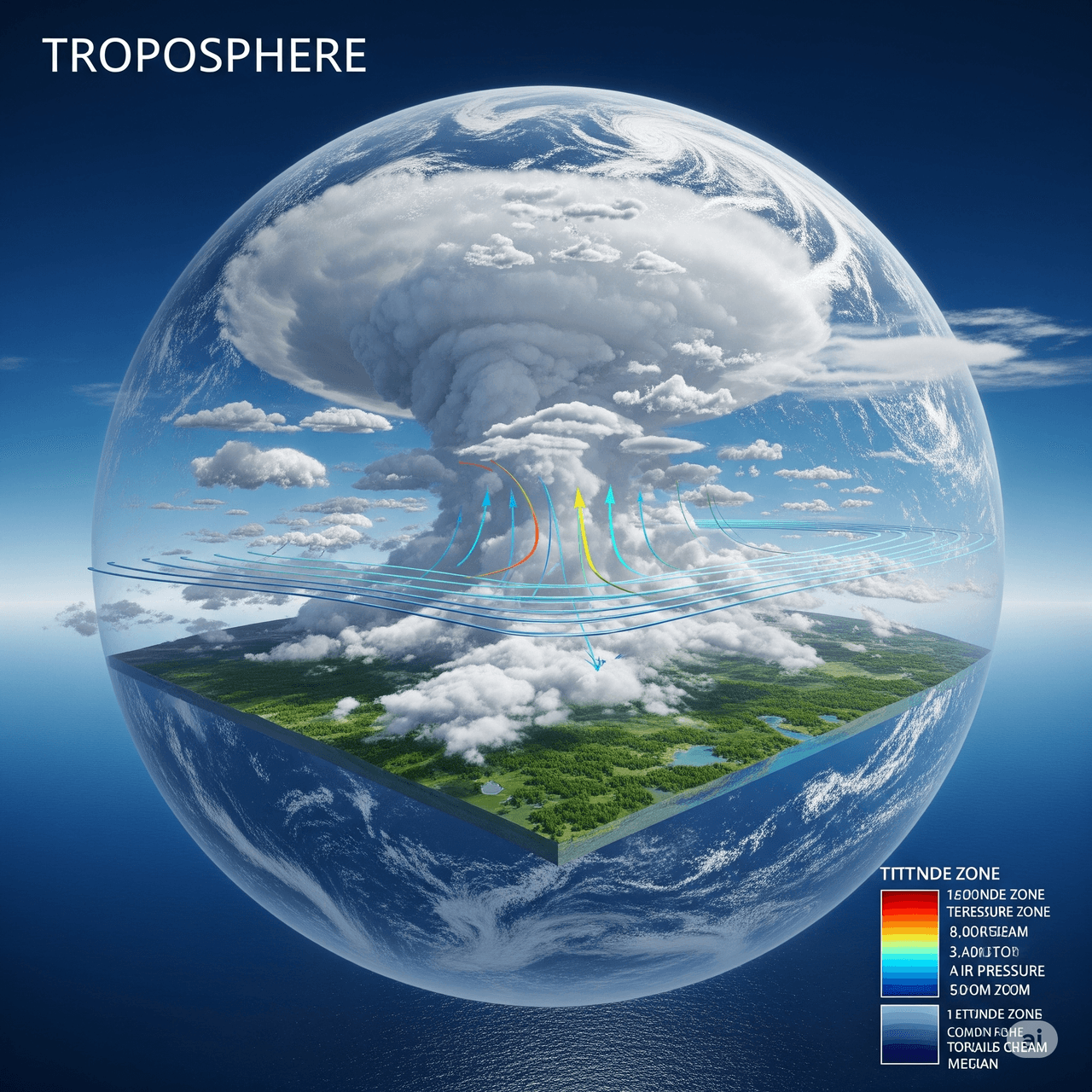
Troposphere
Altitude Range | 8 km (poles) - 15 km (equator) | ||||||||
|---|---|---|---|---|---|---|---|---|---|
Temperature Profile | Temperature decreases with altitude | ||||||||
Main Component(s) | etc.) water vapor CO₂ 1% other gases (argon 21% oxygen 78% nitrogen | ||||||||
Weather Events | wind storm precipitation Cloud formation | ||||||||
Impact of Climate Change | water vapor feedback increase in temperature Expansion of the troposphere | ||||||||
The troposphere is the layer of Earth’s atmosphere closest to the surface, and nearly all meteorological phenomena occur within this region. Approximately 75 to 80 percent of the atmosphere’s total mass is concentrated here. The surface, warmed by absorption of solar radiation, triggers vertical convection within the troposphere. These vertical motions form the basis of processes such as cloud formation, precipitation systems, and the transport of heat and moisture. The thermodynamic structure and physical processes of the troposphere constitute the foundation of weather forecasting.
In the troposphere, temperature decreases with altitude at an average rate of approximately 6.5 °C per kilometer. This temperature gradient is the primary driver of vertical air mixing within the layer. The upper boundary of the troposphere is the tropopause, a layer where the temperature decline ceases or reverses. The height of the tropopause varies from 16–18 km at the equator, to 10–12 km in temperate zones, and 7–9 km at the poles. Temperatures in the tropopause are typically around –60 °C, and pressures range between 100–200 hPa. These variations are directly related to local heating rates, seasonal circulation patterns, and the overall atmospheric structure.
The boundary layer (Planetary Boundary Layer – PBL), located in the lower portion of the troposphere, is shaped by surface friction and thermal exchanges. Turbulent flows developing in this layer due to daily surface heating facilitate the vertical mixing of moisture and aerosols.

Troposphere (MGM)
The thickness of the troposphere and the height of the tropopause vary significantly with latitude and season. This variability is linked to factors such as surface temperatures, general atmospheric circulation, and the distribution of solar radiation. In equatorial regions, persistent and intense surface heating causes the air column to expand, resulting in a higher tropopause located at approximately 16–18 km. Vertical convection is particularly active in these areas.
In temperate zones, the tropopause height exhibits marked seasonal fluctuations. During summer months, increased surface temperatures and expanding air masses raise the tropopause to 13–15 km, while in winter it descends to 8–10 km. This variation influences the stability characteristics of the atmosphere in relation to thermal gradients.
In polar regions, the troposphere remains thin throughout the year due to low solar angles. The tropopause reaches 8–9 km in summer and drops to 6–7 km in winter. This low tropopause height results in a more stable and thinner tropospheric layer. It also plays a decisive role in the formation of polar vortices and stratosphere-troposphere interactions.
Seasonal variability affects not only tropopause height but also secondary parameters such as water vapor distribution, cloud structure, and levels of tropospheric turbulence. This makes it a critical factor to consider in climate modeling and regional weather forecasting.
The general circulation of the troposphere is defined by large-scale cellular structures known as the Hadley, Ferrel, and Polar cells. Warm air rising in equatorial regions descends around 30° latitude within the Hadley cell, sustaining the subtropical zone. The Ferrel cell in temperate zones supports air flows moving toward the poles, while the Polar cell forms due to the sinking of cold air at the poles.
Strong horizontal wind systems known as jet streams develop along the boundaries of these cells. The tropical and polar jet streams can reach speeds of 300–400 km/h at pressure levels of 250–350 hPa. These jets play a crucial role in determining the direction and speed of weather systems and are also critically important for stratosphere-troposphere interactions.
Water vapor concentration is directly related to temperature. While water vapor content reaches 4–5 percent at the equator, it falls below 1 percent at the poles. This distribution of moisture plays a decisive role in the geographic patterns of cloud formation and precipitation systems.

Troposphere (MGM)
The structure and dynamic properties of the troposphere are monitored using various ground-based and space-based measurement techniques. One of the most widely used systems is radiosonde balloons, which ascend to altitudes of 30–35 km to collect data on temperature, pressure, and humidity. These measurements enable the determination of tropopause height and the tracking of climatic trends.
Lidar systems, deployed on aircraft or satellite platforms, generate three-dimensional profiles of humidity, aerosols, and clouds. Microwave and infrared sensors can resolve global distributions of water vapor and temperature with high precision. GPS Radio Occultation techniques calculate tropospheric humidity and temperature profiles with millimeter-level accuracy from measurements of atmospheric refraction index.
Ground-based meteorological radars reveal the vertical and horizontal components of precipitation and cloud structures with high resolution, using reflectivity and Doppler shift data.
Connolly, M., R. Connolly, W. Soon, V. M. V. Herrera, R. G. Cionco, and N. E. Quaranta. "Analyzing Atmospheric Circulation Patterns Using Mass Fluxes Calculated from Weather Balloon Measurements: North Atlantic Region as a Case Study." *Atmosphere* 12, no. 11 (2021): 1439. Accessed May 26, 2025. https://doi.org/10.3390/atmos12111439
MGM. "Sıkça Sorulan Sorular." *Meteoroloji Genel Müdürlüğü.* Accessed May 26, 2025. https://www.mgm.gov.tr/genel/sss.aspx?s=atmosfer
World Meteorological Organization (WMO), and M. Jarraud. *Guide to Meteorological Instruments and Methods of Observation*. 7th ed. Geneva: World Meteorological Organization, 2008. Accessed May 26, 2025. https://www.weather.gov/media/epz/mesonet/CWOP-WMO8.pdf
Xian, T., J. Xia, W. Wei, Z. Zhang, R. Wang, L. Wang, and Y. Ma. "Is Hadley Cell Expanding?" *Atmosphere* 12, no. 12 (2021): 1699. Accessed May 26, 2025. https://doi.org/10.3390/atmos12121699
Xian, T., and C. R. Homeyer. "Global Tropopause Altitudes in Radiosondes and Reanalyses." *Atmospheric Chemistry and Physics* 19, no. 8 (2019): 5661–5678. Accessed May 26, 2025. https://doi.org/10.5194/acp-19-5661-2019

Troposphere
Altitude Range | 8 km (poles) - 15 km (equator) | ||||||||
|---|---|---|---|---|---|---|---|---|---|
Temperature Profile | Temperature decreases with altitude | ||||||||
Main Component(s) | etc.) water vapor CO₂ 1% other gases (argon 21% oxygen 78% nitrogen | ||||||||
Weather Events | wind storm precipitation Cloud formation | ||||||||
Impact of Climate Change | water vapor feedback increase in temperature Expansion of the troposphere | ||||||||
Structural Characteristics and the Tropopause
Seasonal and Latitudinal Variations
Dynamic Structure and Weather Systems
Observation and Measurement Methods