This article was automatically translated from the original Turkish version.
+1 More
Type of Geographical İndication | Place of Origin | ||||||||
|---|---|---|---|---|---|---|---|---|---|
File Number | C2013/024 | ||||||||
Application Date | 18.03.2013 | ||||||||
Registration Number | 471 | ||||||||
Registration Date | 19.11.2019 | ||||||||
Product / Product Group(s) | Processed and unprocessed fruits vegetables and mushrooms | ||||||||
Applicant/Registrant(s) | Tunceli Provincial Directorate of Agriculture and Forestry | ||||||||
Tunceli Garlic is an endemic garlic variety belonging to the species Allium tuncelianum and is native to Tunceli Province in Türkiye. It was officially registered as a geographical indication under Law No. 6769 on Industrial Property on 19 November 2019.
Tunceli Garlic is a rare species that grows naturally in the wild and is classified as Vulnerable (VU). Its most distinctive feature is that it consists of a single clove. Unlike other garlic varieties it is capable of flowering and producing viable seeds. The ability to propagate through seeds is the primary characteristic that distinguishes this species from cultivated garlics, which typically do not flower or produce fertile seeds.
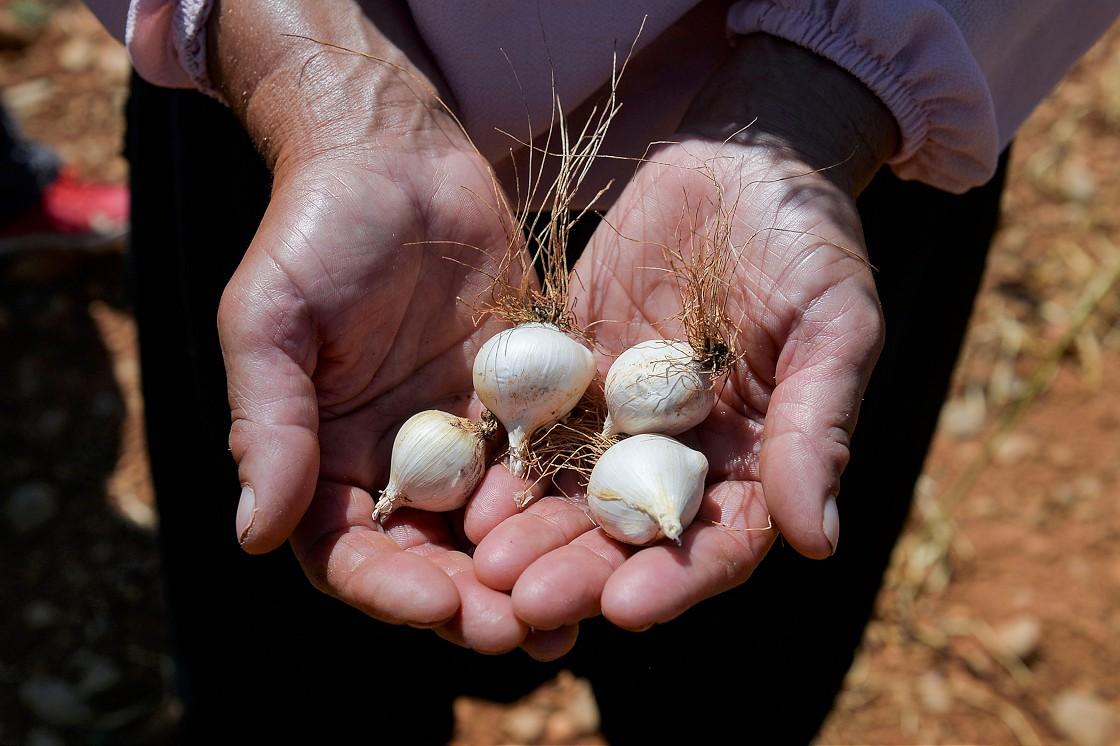
The bulbs have white outer skins and contain 1 to 4 cloves between them. The clove skin is white while the flesh is dirty white. It contains no or very little anthocyanin pigment. Flowering occurs in July–August. The flowers are pale pink, dirty blue or white and have a short bell shape. Each flower cluster consists of 300–500 individual flowers. The plant has a fibrous root system and thrives easily in rocky and stony terrains at elevations between 1000 and 2500 meters.
The average bulb diameter ranges from 2.8 to 3.4 cm and the height from 2.7 to 3.5 cm. The average bulb weight is 10–30 grams, reaching up to 80 grams under optimal conditions. Its Brix value is 37.94%, making Tunceli Garlic sweeter and less pungent than other garlic varieties. Its active compounds (allicin: 0.08 µg, alliin: 0.36 µg) are similar to those found in other garlic types.
The materials used in production are: seeds, scapes and cloves.
Seed-based production is more advantageous than cultivation of common garlic due to this species’ efficient flowering. The seeds are black, wrinkled and triangular, resembling onion seeds. The weight of 1000 seeds is 3–3.4 grams and their diameter is 1–2 mm. Seeds mature by the end of August.
Tunceli Garlic has a fibrous root system. Despite its natural habitat being rocky and stony, its root development is robust, allowing the plant to grow easily. The plant produces 4–8 long, green, flat strap-shaped leaves. The leaves are 1.5–3 cm wide and 30–45 cm long on average. Their cross-section is semi-concave. The leaves are hairless and arranged in a spiral pattern. Planting and transplanting are carried out between September and November. The field is plowed deeply once or twice in autumn and once shallowly. On average, 2 tons of composted animal manure are applied per hectare.
After soil preparation, planting is done manually. In clove planting, spacing is maintained at 10–12 cm between plants and 30 cm between rows. Approximately 200 kg of bulbs are planted per hectare. Yield from clove planting ranges from 650 to 950 kg per hectare. In seed-based production, yield is 50–100 kg per hectare. Harvesting is carried out in August, and the produce is dried for 8–12 days in a shaded, well-ventilated area before being marketed.

Tunceli Garlic Harvesting Operations (Anadolu Agency)
Monitoring activities are conducted by a monitoring body composed of the Tunceli Provincial Directorate of Agriculture and Forestry, the Tunceli Forest Management Directorate, Munzur University, the Tunceli Chamber of Agriculture, the Tunceli Provincial Directorate of Environment and Urbanization, and the Tunceli Provincial Directorate of Culture and Tourism, under the coordination of the Tunceli Provincial Directorate of Agriculture and Forestry. Monitoring is carried out monthly, four times per year, between August and November.
The monitoring scope includes:
In necessary cases, support may be obtained from public institutions, private organizations or experts. The registering authority is responsible for initiating legal procedures to protect the geographical indication rights.
Anadolu Ajansı. “Tunceli Sarımsağını Toplayan Yanacak.” Anadolu Ajansı, December 8, 2015. Accessed July 17, 2025. https://www.aa.com.tr/tr/yasam/tunceli-sarimsagini-toplayan-yanacak/37167.
Anadolu Ajansı. “Tunceli’de 2 Bin Rakamda Yetişen Dağ Sarımsağı Kadınların İş Kapısı Oldu.” Anadolu Ajansı, June 15, 2024. Accessed July 17, 2025. https://www.aa.com.tr/tr/gundem/tuncelide-2-bin-rakimda-yetisen-dag-sarimsagi-kadinlarin-is-kapisi-oldu/2295490.
Turk Patent and Trademark Office. Tunceli Dağ Sarımsağı (Allium tuncelianum) – Geographical Indication Registration File. Registration No: CI 38-090. Ankara: Turk Patent and Trademark Office, 2021. https://ci.turkpatent.gov.tr/Files/GeographicalSigns/007fdeda-fbe4-4c83-ba83-0f4db91c2334.pdf.
Türk Patent ve Marka Kurumu. "Coğrafi İşaret: Tunceli Dağ Sarımsağı (CI 38-090)." Türk Patent ve Marka Kurumu – Coğrafi İşaretler Platformu. Accessed July 17, 2025. https://ci.turkpatent.gov.tr/cografi-isaretler/detay/38090.

Type of Geographical İndication | Place of Origin | ||||||||
|---|---|---|---|---|---|---|---|---|---|
File Number | C2013/024 | ||||||||
Application Date | 18.03.2013 | ||||||||
Registration Number | 471 | ||||||||
Registration Date | 19.11.2019 | ||||||||
Product / Product Group(s) | Processed and unprocessed fruits vegetables and mushrooms | ||||||||
Applicant/Registrant(s) | Tunceli Provincial Directorate of Agriculture and Forestry | ||||||||
Biological Characteristics and Distinguishing Features
Production Method
Monitoring