

This article was automatically translated from the original Turkish version.
Construction Period | Approximately 1st millennium BCE to 19th century CE | ||||||||
|---|---|---|---|---|---|---|---|---|---|
Builders | The Uyghur people and earlier communities living in the region | ||||||||
Purpose(s) | Agricultural irrigation ensuring the continuity of settlements supply of drinking and utility water | ||||||||
Observation Point | Turpan Karez Museum | ||||||||
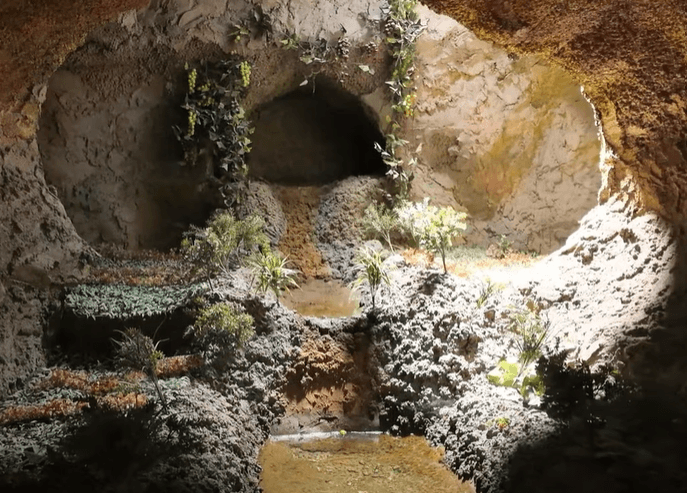
Turfan Karez System is a traditional water management system in the Turfan Basin in southern Eastern Turkistan, designed to bring groundwater to the surface for use in agriculture and settlements. The system is based on connecting vertical shafts, dug at regular intervals, with horizontal underground tunnels that channel water from the foothills of mountains to populated areas.
This system is regarded as a product of the Uyghur people’s creativity, collective labor, and harmonious relationship with nature, both as an engineering and cultural heritage. Karez systems have played a vital role in the Turfan region, particularly under its arid and desert climate, by enabling irrigation of farmland, securing drinking and domestic water, sustaining livestock activities, and ensuring the continuity of settlements.
Historical sources indicate that the origins of karez systems date back thousands of years, with the Uyghur Turks adapting and refining the technique to suit their local geographical conditions. Although their numbers have declined in the face of modern irrigation technologies, karez systems are still recognized as a heritage requiring protection due to their technical and cultural value.
Video of a Traveler Visiting the Turfan Karez Systems (Traveler Without a Route)
The karez system traces its origins to one of the oldest underground water conveyance techniques in Central Asia. Similar systems elsewhere in the world are known as qanat in Iran, falaj in Oman, and kahriz in Azerbaijan, while in Eastern Turkistan the system is called “karez.”
Archaeological and historical evidence shows that this water technology emerged in Central Asia during prehistoric times and became a crucial irrigation method along settlements of the Silk Road.
The Turfan Basin has an entirely arid climate, with summer temperatures reaching up to +50°C, annual rainfall of only 16–23 mm, and high rates of evaporation. These conditions necessitated the development of a sustainable system capable of bringing groundwater to the surface, making the karez technique the region’s lifeline.
The systematic construction of karez in Turfan matured during the Uyghur Turk period. The Uyghurs combined technical knowledge inherited from earlier civilizations with their own geographical experience to refine the system. Karez systems played a fundamental role in irrigating the region’s agricultural centers, particularly vineyards, melon fields, and orchards.
The construction process required specialized expertise passed down through generations via master-apprentice relationships. Karez diggers (karez craftsmen) became prominent for their engineering knowledge in determining water direction, flow rate, and pressure. This profession gained high social status among the people, imbued with both material and spiritual significance.
The primary purpose of karez systems was to transport groundwater accumulated at mountain foothills to settlements without losing it to evaporation. This enabled:
Karez construction is a process demanding high technical knowledge, physical strength, and long-term cooperation. First, experts determine the location of underground water sources, the slope of the terrain, and soil composition. Water is typically drawn from underground aquifers at mountain foothills. Then, vertical shafts are dug at regular intervals between the water source and the settlement. These shafts are connected underground by gently sloping horizontal tunnels to allow water to flow by gravity.
Karez construction is a craft learned through master-apprentice relationships and passed down from generation to generation. Known as “karez craftsmen,” these specialists became experts in regulating water flow, performing maintenance, and ensuring tunnel safety. This profession was held in high esteem among the people, and karez craftsmen were regarded as both engineers and artisans.
The Turfan Karez System formed the foundation of the region’s agricultural activities. In Turfan’s arid and desert climate, consistent year-round water access was possible only through the karez system. Karez systems provided the critical irrigation infrastructure for vineyards, melon cultivation, orchards, and vegetable farming. The productivity of Turfan’s famous “Grape Valley” has been preserved thanks to the steady irrigation provided by karez. Livestock watering points were also integrated into karez outlets.
Karez systems were the primary source of drinking and domestic water. By ensuring a continuous flow of clean water to settlements, they secured both household needs and the continuity of social life. From a public health perspective, especially during hot summer months, karez water served as a vital source of cool, clean drinking water. Areas around karez outlets became social hubs where communities gathered to share water and carry out daily tasks.
Thanks to regular irrigation, agricultural production increased, and the diversity and quality of products improved. This enhanced the economic power of Uyghur settlements both in local markets and along the Silk Road trade routes. Karez systems ensured the sustainability of agriculture and trade while securing a stable agricultural labor force in the region.
Karez systems have shaped not only the economic life but also the spiritual world of the Uyghur people. They appear in numerous aspects of culture, from oral traditions to written literature, rituals to everyday expressions. Sources show that karez is treated both as concrete cultural heritage and as abstract cultural value, intertwined with themes of water’s sanctity and the elevation of labor.
Theme: Extracting water from the earth, divine assistance, collective community effort.
Function: Explaining the origin of karez and granting it sacred legitimacy.
Example: In a Turfan legend, during a drought, the people’s prayers are answered, and sweet water emerges from a karez dug at the direction of a “water saint.” Such narratives contribute to the perception of karez as a miraculous phenomenon.
Heroic Karez Craftsmen Motifs
In legends, karez craftsmen are depicted as people who can “hear” the water. The master detects the water’s location by observing soil color, moisture, and sound. This knowledge is passed down through generations as ancestral craft.
Proverbs and sayings summarize the place of karez in Uyghur culture.
In folk poetry, karez appears both as a concrete entity and as a metaphor.
“We dug the earth together, brought water to the village,
Our sweat flowed into the soil, abundance filled the heavens.”
“Your eyes are clear like water flowing from a karez,
The more I drink, the more I thirst for your love from distant lands.”
“We dug the karez, gave water to the plain,
The rulers turned a blind eye, and the people fell into hardship.”
The Uyghurs believe that karez diggers have a spiritual guide or “pir.”
Before excavation begins, rituals of honoring the pir and offering prayers are performed.
Animal sacrifice is carried out to invoke the water’s blessings.
Foods such as fruit, bread, and sweets are offered as non-blood sacrifices.
It is believed that karez water brings fertility to fields.
Ceremonies are held at the water source before planting.
Karez water is believed to cure certain illnesses.
Bathing in the water is considered a ritual to ward off the evil eye.
Until the mid-20th century, hundreds of active karez systems existed in the Turfan Basin; today, this number has dramatically declined. Between 1949 and 2004, the number of karez systems with flowing water in Turfan dropped sharply, with many drying up or becoming unusable due to neglect. The main causes of this decline are:
In Turfan and surrounding villages, some local communities have begun restoring karez systems still in usable condition. The Tuxtaş Karez Ecology Conservation Community in Chaqchal Village, for example, has reopened agricultural lands around the karez to revive both production and the ecosystem. In some villages, annual campaigns to clean and maintain karez using traditional methods are organized.
Various official and international projects are underway to protect karez systems:
The Turfan Karez Museum serves as a tourist center showcasing the structure and working principle of an active karez system. Here, both local residents and tourists can closely observe karez tunnels and vertical shafts.
Local authorities aim to integrate karez systems into cultural tourism to generate economic income and increase public awareness of the system.
Despite conservation efforts, the future of karez systems remains at risk:
Video about the Turfan Karez Museum (ehabweb)
Abudula, Aibibaimu (Habibe Abdullah). *Geçmişten Günümüze Turfan Karızları*. Master's thesis, İstanbul Üniversitesi Sosyal Bilimler Enstitüsü, 2013. Accessed August 11, 2025. https://tez.yok.gov.tr/UlusalTezMerkezi/TezGoster?key=1zw6GvYMe-q3Hf6HR-3US0-yEImknqsngBor3uZ8GLT5z-PVLAknt89iL6IiLQLI
Kılıç, Ebru. *Turfan Uygurlarının Karız Folkloru ve Su Yönetimi*. PhD thesis, Hacettepe Üniversitesi Sosyal Bilimler Enstitüsü, 2023. Accessed August 11, 2025. https://tez.yok.gov.tr/UlusalTezMerkezi/TezGoster?key=j_Fjwp4JS4mk97Puqti8rifns6V_oayfjnecP03cXNU7vPf1nISzjuOckXXh9Cdj
Kılıç, Ebru. “Geleneksel Su Yönetim Sisteminin (Karız) Uygur Halk Koşaklarına Yansıması.” *Avrasya Uluslararası Araştırmalar Dergisi* 11, no. 35 (2023): 661–677. Accessed August 11, 2025. https://dergipark.org.tr/en/pub/avrasyad/issue/76889/1276033
Rotasız Seyyah YouTube Channel. "Çin'in Uygur Bölgesini Gezdim - 3. Bölüm KARIZ SU KANALLARI." Accessed August 11, 2025. https://www.youtube.com/watch?v=MMGsqycbwIo
ehabweb Youtube Kanalı. "Visiting Turpan Karez Museum - Xinjiang - China - 吐鲁番坎儿井博物馆." Accessed August 11, 2025. https://www.youtube.com/watch?v=yqXAHNIwM7c
Özçalık, Mahire, and Özkul Çobanoğlu. “Karız Su Sisteminin Uygur Kültüründeki Sosyokültürel Değerinin Araştırılması.” *Uluslararası Uygur Araştırmaları Dergisi*, no. 22 (2023): 74–82. Accessed August 11, 2025. https://dergipark.org.tr/tr/pub/uygur/issue/81672/1321782

Construction Period | Approximately 1st millennium BCE to 19th century CE | ||||||||
|---|---|---|---|---|---|---|---|---|---|
Builders | The Uyghur people and earlier communities living in the region | ||||||||
Purpose(s) | Agricultural irrigation ensuring the continuity of settlements supply of drinking and utility water | ||||||||
Observation Point | Turpan Karez Museum | ||||||||
No Discussion Added Yet
Start discussion for "Turfan Karez System" article
History
Original Purposes of Construction
Construction Technique and Stages
Construction Process
Construction Stages
Tools Used
Professionalization and Knowledge Transmission
Role in Uyghur Life
Agricultural Production
Settlement and Daily Life
Economic Contributions
Karez in Uyghur Folklore
Karez in Oral Culture
Legends and Traditions
Karez in Proverbs and Sayings
Karez in Folk Poetry (Koşaklar)
Beliefs and Rituals
Current Status and Conservation Efforts
Local-Level Conservation and Restoration Initiatives
National and International Support
Tourism and Cultural Promotion Efforts