This article was automatically translated from the original Turkish version.
+1 More
Type(s) | Music külliyesi | ||||||||
|---|---|---|---|---|---|---|---|---|---|
Creator/Compiler | Amannisahan, wife of Sultan Abdureşit Han | ||||||||
Creation/Compilation Time | Yarkent Khanate period (16th century) | ||||||||
Number of Maqams | 12 | ||||||||
Names of the Maqams | Rak, Çebbayat, Müşavirek, Çehargah, Pencigah, Özhal, Acem, Uşşak, Bayat, Neva, Segâh, Irak | ||||||||
Uyghur Twelve Muqams (On Ikki Muqam, Uyghur: On ikki muqam) is a musical corpus regarded as one of the most important examples of Uyghur musical culture, distinguished by its melodic, rhythmic, and literary richness developed in both folk and classical music traditions.
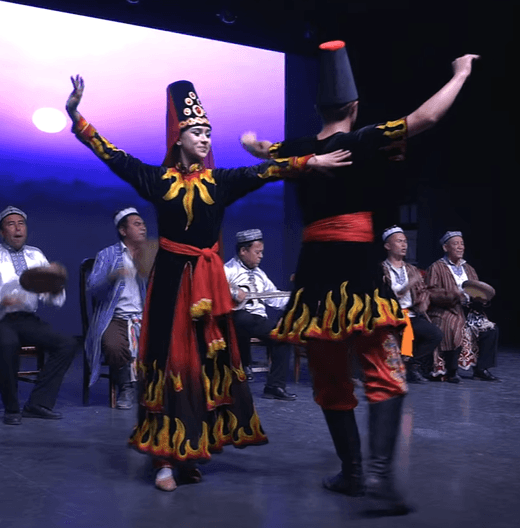
This collection of works integrates song, poetry, dance, theater, and instrumental performance, reflecting the historical memory, aesthetic sensibility, social life, and philosophical thought of the Uyghur people.
Traditionally, it consists of twelve distinct muqams, each composed of three main sections—chong neqme (great naqma), dastan (epic/narrative), and mäshräp (music-dance festival). Although the names of these twelve muqams are fixed, their content has been transmitted orally from generation to generation over centuries. The musical and literary texts include folk songs, epics, folk tales, and ghazals by classical poets such as Lütfi, Navai, and Qalandar.
The Uyghur Twelve Muqams serve as carriers of social norms, moral values, and collective memory. Performed at nearly all social gatherings except funerals and prayers, these muqams are an inseparable part of Uyghur sociocultural life, often described as the “fish and water” relationship.
Uyghur Twelve Muqams (Turkish Culture and Art Agency)
The Uyghur Twelve Muqams trace their roots to the ancient musical traditions of Central Asia and were shaped over centuries through interaction with Turkic, Arab, Indian, and Greek cultural spheres; from the 16th century onward, they attained a systematic unity. Each muqam in this corpus represents a broad formal structure composed of sections such as chong neqme (great naqma), dastan, and mäshräp.
Historically, the term “muqam” entered Eastern musical literature relatively late. In the 13th century, the primary concepts in Safi al-Din al-Urmawi’s music theory were “dair/devir”; the systematic use of “muqam” as a musical term is first recorded in sources by the Azerbaijani Turkic scholar Abd al-Qadir al-Maraghi in 1418. In Anatolia, the terminological use of “muqam” appears in the 15th century. Until then, terms such as “edvâr,” “dair/devir,” and “shudud” dominated textual references.
The number “twelve” in the name Uyghur Twelve Muqams has been interpreted in various ways throughout history. Among Uyghur scholars, there is disagreement over whether it derives from the zodiac system in astronomy/astrology or whether it was adopted as a formalized, conventional number over a long historical process. Some researchers link it to the zodiac, while others explain it as the result of a symbolic or schematic preference; indeed, although the number of Uyghur muqams has fluctuated over time, the community has consistently referred to them as “twelve.” The same “twelve” pattern is also used for regional systems such as Kumul, Ili, and Dolan. Furthermore, the origin of “twelve” is emphasized as potentially connected to astronomical, astrological, religious-mythological, and philosophical codes.
In the broader historical context of ancient Turkic music tradition, notes indicate that the number of musical pieces known as “küğ/küy” was equated with the days of the year—366—and that nine principal roots were counted among them; this suggests that the number “twelve” functions as a symbolic overarching number.
Uyghur scholars Abdukerim Rahman and Abduşükür Muhemmetimin propose that the origin of the twelve muqams can be traced to the twelve-tampere system discovered by Sucup, a 6th-century music master and theorist from Kusen. This narrative is supported by records in the Chinese historical source Sui Shu – Music Annals, which note that seven principal tones combined with five half-tones to form twelve. Within the same framework, it is also suggested that the term “muqam” may be etymologically linked to the Kusen Tochar word “maka-yame,” meaning “great naqma.” These views constitute an ancient theoretical bridge between Uyghur regional heritage and broader Eurasian musical thought.
The Uyghur Twelve Muqams are not only shaped by post-Islamic classicization but also by the musical heritage of the pre-Islamic period. Evidence that some muqams originated before the Uyghurs’ conversion to Islam highlights the corpus’s multilayered history. Therefore, the relationship between Uyghur muqams and the musical cultures of other peoples must be understood as a multidimensional interaction.
The compilation of melodies, folk songs, and poems, previously preserved through oral tradition, into a cohesive institutional corpus in the 16th century was initiated by Amannisahan, the wife of Sultan Abdurashid Khan of the Yarkent Khanate. It is recorded that Amannisahan gathered master performers at court, collected and organized the repertoire, and—according to legendary accounts—completed this service over approximately ten years; a new muqam attributed to her, titled “Ishret-engiz,” is also mentioned. This period marks the primary turning point in the Uyghur Twelve Muqams’ acquisition of their modern identity as a “corpus.”
The textual fabric of the corpus is composed of folk songs, epics, and folk tales transmitted orally across generations, alongside selected poems by classical poets such as Lütfi, Navai, and Qalandar. Thus, a hybrid repertoire that unites folk and court/classical traditions has been constructed.
Over time, the Uyghur Twelve Muqams have been enriched by regional variants and systems (Kumul, Dolan, Turfan, Hotan, etc.). The Kumul Twelve Muqams resemble the classical system in melody and instrumentation but differ in content; all names are in Uyghur, and local dialects are preserved. Kumul texts contain many words retained from Old Uyghur, giving this system the character of a “literary anthology” carrying a large portion of the local oral culture (koşak, dastan, etc.).
Variants also differ in performance duration and the number of “name” (pieces/melodies). For instance, one source mentions 258 names and approximately ten hours of performance in the Kumul system, while another notes performances lasting up to 24 hours; separate counts and durations are also provided for Dolan and Turfan. These variations reflect the historical variability of local compilation and performance practices.
Dolan Mäshräbi (Emre Yücelen Voice Lesson)
The Hotan tradition in Uyghur geography has also maintained its own classification of twelve muqams and local performance chain (e.g., Rak, Chariqah, Ushshaq, Penchigah, Chebbeyat, Bayat, Husayni, Segah, etc.). The repertoire has been transmitted from generation to generation through master musicians. Regional performance ensembles—such as the Dolan/Kumul/Turfan combinations of ghijak–rawap–def/davul–surnay—have historically reinforced local stylistic identities.
In the modern era, the professional systematization of scattered melodies existing in daily folk life—through collection, notation, and ordering of performance sequences—is regarded as the construction of a “musical canon”; this process has also been integrated into ideological frameworks in different contexts (e.g., Soviet/Chinese). The Uyghur Twelve Muqams were similarly affected by such reclassification and staging efforts in the 20th century, undergoing reinterpretation within their historically layered structure and contemporary performance and representation policies.
The Uyghur Twelve Muqams possess a layered and expansive structure both musically and thematically. Each muqam traditionally consists of three main sections:
Chong neqme (Great Naqma): The instrumental and vocal introductory section that presents the fundamental melodic structure of the muqam. This section is typically performed with long phrases and wide melodic arcs.
Dastan (Epic): The section where narrative and poetry predominate, strongly reflecting the oral tradition. Texts here are drawn from folk epics, tales, and ghazals by classical poets.
Mäshräp (Music-Dance Festival): The final section, more rhythmic, dynamic, and open to communal participation. Dance and collective entertainment elements are concentrated here. Each muqam possesses its own unique melodic patterns, rhythmic structures, and specific performance durations.
The Uyghur Twelve Muqams include both free-meter (non-metrical) introductory sections and sections adhering to regular rhythmic cycles. These cycles are connected to regional folk dances and ceremonial music.
Although based on the tampere system, the muqams exhibit similarities to the tetrachordal and pentachordal intervallic structures found in traditional Turkish music. Melodic lines feature both wide pitch ranges and distinctive ascending and descending motifs.
Texts consist of folk songs, epics, folk tales, and ghazals by classical poets such as Lütfi, Navai, and Qalandar. Classical poetry composed in the aruz meter is combined with folk songs in the finger-meter system.
Through this structure, the Uyghur Twelve Muqams continue to exist as a multifaceted stage art integrating oral literature, dance, and theater.
The Uyghur Twelve Muqams consist of twelve distinct muqams, each possessing a unique musical and literary structure. While their names and melodic characteristics are connected to the classical Eastern music tradition, they have been distinctly shaped by Uyghur culture.
The classical order of the Uyghur Twelve Muqams is as follows:
Rak (Raq): Features a powerful and energetic melodic structure and is often performed as the opening muqam.
Chebbeyat: Possesses softer and more lyrical melodies; its textual sections emphasize themes of love and nature.
Mushavirek: Known for its complex rhythmic patterns and lively mäshräp section.
Chehargah: Based on a four-note scale structure and exhibits melodic characteristics also found in classical Eastern music.
Penchigah: Based on a pentachordal structure, combining both serious and cheerful melodies.
Ozhall: Contains local melodic motifs and generally features medium-tempo pieces.
Acem: A slow, heavy, and deeply emotional muqam with a melodic structure similar to the “Acem” muqam in Eastern music.
Ushshaq: A lyrical and emotive muqam where themes of love predominate.
Bayat: Distinguished by its warm and sincere melodic structure, well known in both folk and classical music.
Neva: Recognized for its bright and wide pitch range; sometimes preferred for ceremonial and official events.
Segah: Characterized by a semitone interval, featuring melancholic and refined melodies.
Irak: The closing muqam of the corpus, distinguished by its deep and solemn melodic structure.
Each muqam is performed within the framework of the three main sections described above. Additionally, some sources indicate that transitions occur between muqams, and multiple muqams may be interwoven within a single performance.
Over time, the Uyghur Twelve Muqams have diversified across different regions through local performance traditions and repertoire variations. While these variants preserve the core melodic structure and primary names, they differ in content, performance duration, instrumentation, and language/dialect used.
The Kumul regional system of twelve muqams resembles the classical Uyghur Twelve Muqams in melody and instrumentation but differs in content. Local dialect is preserved, and the archaic vocabulary of Uyghur Turkish is heavily maintained. The Kumul Twelve Muqams also function as a literary anthology, combining koşak, dastan, and folk tales. Performance duration varies between ten and twenty-four hours, depending on the number of pieces and local performance practices.
The Dolan regional muqams generally fall into the “folk muqam” category and are closely linked to local dances, rituals, and communal festivities. Dolan muqams are distinguished by their unique rhythmic structures, local instrument combinations, and region-specific melodic motifs.
The Turfan regional muqams are classified among the “indigenous muqams” and consist of finger-meter folk songs and couplets. Their oral texts are shaped around themes of local history, nature, and love.
The Hotan region maintains its own sequence of twelve muqams. Among the muqam names are Rak, Chariqah, Ushshaq, Penchigah, Chebbeyat, Bayat, Husayni, and Segah—terms known both in classical Eastern music and in the Uyghur tradition. The performance tradition is transmitted from generation to generation through a lineage of masters.
Regional variants demonstrate the living and dynamic nature of the Uyghur Twelve Muqams tradition; these differences enrich the repertoire and help preserve local identities through music.
The instruments used in the performance of the Uyghur Twelve Muqams are an inseparable part of the muqam tradition, fulfilling both melodic and rhythmic functions. While instruments vary slightly by region and variant, the core instrumental groups can be classified as follows:
The combination of instruments varies according to regional style. For example, in Dolan, Kumul, or Turfan variants, the ghijak–rawap–def/davul–surnay ensemble is prominent. Melodic instruments reveal the melodic contours of the muqams, while rhythmic instruments support dance and communal participation, especially during the mäshräp sections.
Emre Yücelen Şan Dersi Youtube Kanalı. "Uygur Dolan Müziği Ve Dansı - DOLAN MEŞREP ÖZEL BÖLÜMÜ." Accessed August 11, 2025. https://www.youtube.com/watch?v=xVqbcywZ_o0&list=PL2ZRacUcYDbXfOBdbuW4wrrOw-khdWpPu&index=4
Gültekin, Burak. *Uygur 12 Makam Repertuvarındaki “Rak, Çebbeyat ve Müşavirek” Makamlarının Türk Müziği Ses Sistemine Aktarılması ve İncelenmesi*. Master's thesis, Bursa Uludağ Üniversitesi, 2019. Accessed August 11, 2025. https://acikerisim.uludag.edu.tr/entities/publication/12b7238a-826c-45bb-8bc3-88d258b5a102
Savut Udmuş, Tursuncan. “Uygur Makamlarının Uygur Kültüründeki Yeri.” Trans. Aygüzel Abdusalam. *Uluslararası Uygur Araştırmaları Dergisi* 6 (2015): 127–145. Accessed August 11, 2025. http://uygurarastirmalari.com/arsiv/tek/2015_6.pdf
Tuerde, Wusiman. *Kumul On İki Makamı Üzerine Bir İnceleme*. Master's thesis, Nevşehir Hacı Bektaş Veli Üniversitesi, 2016. Accessed August 11, 2025. https://akademiye.org/tr/wp-content/uploads/2020/08/KUMUL-ON-%C4%B0K%C4%B0-MAKAMI-%C3%9CZER%C4%B0NE-B%C4%B0R-%C4%B0NCELEME.pdf
Türk Kültürü ve Sanat Ajansı Youtube Kanalı. "Uygur Makamları / Mugamları 12." Accessed August 11, 2025. https://www.youtube.com/watch?v=pZRp9izVZD4&list=RDpZRp9izVZD4&start_radio=1
Özdemir, Erdem. “Geçmişten Günümüze Uygur Türklerinde Geleneksel Müzikler.” *Türük: Uluslararası Dil, Edebiyat ve Halkbilimi Araştırmaları Dergisi* 6, no. 14 (2018): 247-260. Accessed August 11, 2025. https://www.academia.edu/37493037/GE%C3%87M%C4%B0%C5%9ETEN_G%C3%9CN%C3%9CM%C3%9CZE_UYGUR_T%C3%9CRKLER%C4%B0NDE_GELENEKSEL_M%C3%9CZ%C4%B0KLER
İnayet, Alimcan. “Oniki Makam Adı Üzerine.” *Uluslararası Uygur Araştırmaları Dergisi* 4 (2014): 37-44. Accessed August 11, 2025. https://dergipark.org.tr/tr/pub/uygur/issue/30036/324327

Type(s) | Music külliyesi | ||||||||
|---|---|---|---|---|---|---|---|---|---|
Creator/Compiler | Amannisahan, wife of Sultan Abdureşit Han | ||||||||
Creation/Compilation Time | Yarkent Khanate period (16th century) | ||||||||
Number of Maqams | 12 | ||||||||
Names of the Maqams | Rak, Çebbayat, Müşavirek, Çehargah, Pencigah, Özhal, Acem, Uşşak, Bayat, Neva, Segâh, Irak | ||||||||
No Discussion Added Yet
Start discussion for "Uyghur Twelve Makams" article
History and Origins
Origin and Symbolism of the Number “Twelve”
Sucup and the Twelve-Tampere Narrative
Pre-Islamic Elements and Multilayered Influences
Systematization in the 16th Century: Yarkent and Amannisahan
Sources of Text and Repertoire
Compilation and Canon Formation in the 20th Century
Musical Structure and Sections
Rhythm and Meter
Melodic Structure
Text Usage
Names and Characteristics of the Muqams
Regional Variants
Kumul Twelve Muqams
Dolan Muqams
Turfan Muqams
Hotan Muqams
Instruments
Plucked String Instruments
Bowed String Instruments
Percussion Instruments
Wind Instruments