


This article was automatically translated from the original Turkish version.
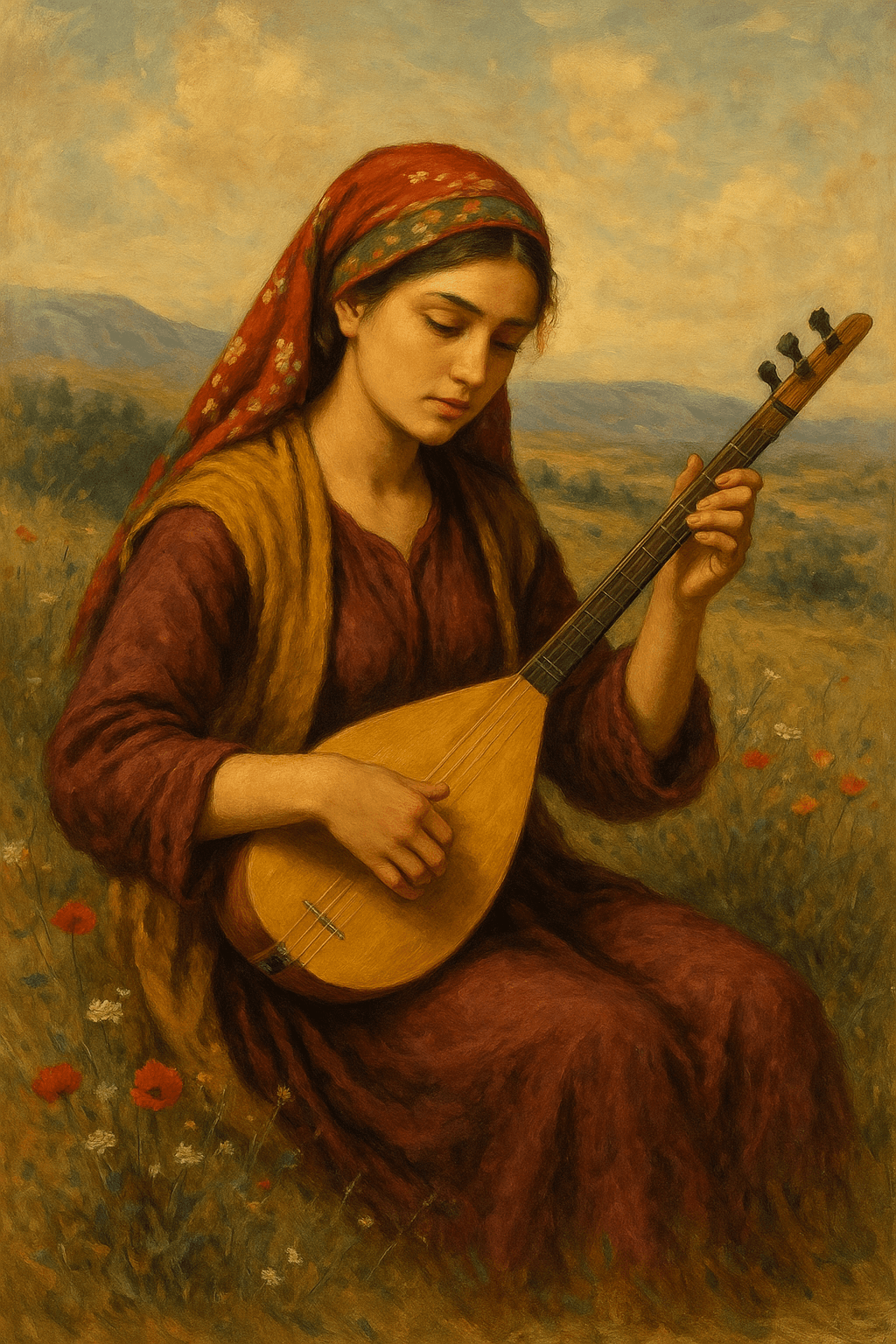
Acem Kızı (Song) (Generated by artificial intelligence)
Region(s) | Kırşehir and Çukurova | ||||||||
|---|---|---|---|---|---|---|---|---|---|
Repertoire Number | 1398 | ||||||||
Source Person | Çekiç Ali | ||||||||
Collector | Osman Özdenkçi | ||||||||
Mode/Sequence | Acemkürdi | ||||||||
Rhythm | 15/8 | ||||||||
Sound Field | On ses | ||||||||
“Acem Kızı” is a Turkish folk song transmitted orally across generations in Central Anatolia and Çukurova regions, characterized by its lyrics, melody, and narrative layers. From the second half of the 20th century onward, it reached wide audiences primarily through radio and vinyl records, becoming embedded in public memory, and was formally registered in the TRT repertoire as originating from the Kırşehir region. However, differing accounts have emerged regarding the song’s origin context, its source informant, and the original arrangement of its verses. When academic studies, repertoire catalogues, and performance records are examined together, it becomes evident that the song left traces in both Central Anatolia and Çukurova; variants centered on the “şano/şanova” phrasing directly influenced textual standardization; and the core text preserved in TRT recordings represents a selected excerpt from longer regional variants.
Neşet Ertaş - Acem Kızı (YouTube-Bayar Music)
When she steps onto the stage with a flourish
Enjoy yourself, stay on the stage, Acem girl
When she glances from beneath her brows
Her beauty breaks the heart, Acem girl
What can the boy who loves you do with his wealth
Each time he closes his eyes, pearls fall like tears
Nose like a hazelnut, mouth like a coffee cup
Is it sugar, syrup, or honey, Acem girl
The opening line of the song, “Çırpınıp da şano(ya)’ya çıkınca,” has taken on various spellings, particularly widespread as “şanova” or “şamova.” Scholarly literature indicates that “şano” originally referred to the stage, while the form “şanova” became established later through oral transmission and recording processes. This observation is supported by internal textual analysis and dictionary references.
In TRT’s Turkish Folk Music repertoire catalogues, the piece is recorded on the Acemkürdi melodic series and in 15/8 meter. It is noted that the final note is “la,” and the vocal range spans ten notes. These technical catalog entries provide essential data explaining the rhythmic flow and melodic progression of the song.
The work, registered under repertoire number 1398, is listed under the Kırşehir region, with “Çekiç Ali” named as the source informant and “Osman Özdenkçi” as the collector and transcriber. This documentation strengthens the association of the song’s popular performance tradition with Central Anatolia. Additionally, the repertoire note specifically highlights the explanation of “şano.”

Acem Kızı (Türküpedia)
The core text found in TRT recordings and common performances circulates as a short version consisting of two quatrains. In contrast, longer variants recorded in the field show an increased number of lines relating to geography, metaphors, and direct addresses to the “Acem Kızı,” including lines referencing “America, Europe, English, French, Belgium, German.” When digital transcriptions are compared with repertoire catalogues, it becomes clear that the short version was selected and fixed from among these longer regional forms. Dictionary annotations explaining “telef etmek” as “to destroy/kill” and “mercan” as “tears” draw attention to the semantic layers of the variants.
Field collections and regional memory in Çukurova and Kahramanmaraş emphasize the song’s connection to the folk poet Âşık Hüseyin of Tenecioğlu. According to this narrative, the song was spontaneously composed in a pleasure venue in Ceyhan, addressed to a performer named “Acem Kızı” on stage, and later expanded into a poetic-performance whole through additional quatrains. Research papers, regional oral testimonies, and local sources corroborate this account. Furthermore, in the song’s literature, certain quatrains are explicitly linked to Âşık Hüseyin through the “tapşırma” tradition. According to this reading, the song’s subsequent dissemination through other performers and collectors led to the original singer’s name being detached from the work.
In Central Anatolia, the song is tied to a story of “observation and inspiration,” in which the musician Yusuf Cöke from the Kırşehir-Kırıkkale basin witnessed a Persian performance troupe. In this narrative, the name “Acem Kızı” was used as a general address to a young woman on stage whose identity was unknown. This tradition, transmitted through performers and regional musicians, aligns with the Kırşehir connection noted in the repertoire catalogues. Field notes further record that the meter and melodic structure of the song conform to the Central Anatolian performance tradition.
From the mid-20th century onward, the song was carried to wider audiences through local artist recordings and Ankara Radio programs, and later became widely circulated via 45 rpm records and subsequent compilations. After the 1990s, its digital and platform-based visibility increased, with the TRT core text establishing the performance standard. On digital music services, the song appears in Neşet Ertaş’s discography within album releases from the late 1990s.
Two main interpretive trends have emerged regarding the song’s authorship: Çukurova-centered readings attribute it to Âşık Hüseyin, while Central Anatolia-centered readings point to Yusuf Cöke. The repertoire catalogue’s linkage to Kırşehir, along with the placement of the source informant and collector in that region, produced an archival record favoring the Central Anatolia connection. Conversely, Çukurova’s oral traditions and field knowledge, which associate the song with Âşık Hüseyin within its narrative folk song tradition, argue for the song’s origin in that region. A combined reading of oral history and written records has led to a reasoned evaluation supporting Âşık Hüseyin as the original author.
In the short version of the song, the opening line has taken on various spellings due to the “şano/şanova” distinction. It is noted that “şano” was used to denote the stage, while “şanova” and “şamova” were interpreted as place names during transmission and recording processes, thereby entering the text as such. Repertoire notes have recorded this distinction with linguistic clarification. The same differentiation is also observed in digital transcriptions of the song’s lyrics.
In the Âşık tradition, new lyrics are composed and folk songs are disseminated over established melodic patterns (hava), which helps explain the circulation of “Acem Kızı.” In Kırşehir, the term “havalandırmak” refers to performing a song on stage or in conversation, while field reports indicate that the same text was performed in a different melody in Çukurova. These differences have resulted in regional variations of the song’s melody and verse structure.
Certain words in the text are explained according to regional and traditional meanings: “telef etmek” is rendered as “to destroy/kill,” and “mercan” as “tears,” thereby clarifying the emotional intensity embedded in the lines. Such explanations facilitate contemporary audiences’ understanding of the song’s lyrics.
Online repertoire libraries present the core lyrics alongside selected longer variants, catalog entries, and conceptual explanations together. Annotations accompanying the visual content of these pages enable the entry “Acem Kızı” to be read as a cohesive, encyclopedic entry.
In some contemporary texts, the song has been retold as a hagiographic tale centered on the characters “Ali” and “Acem Kızı,” with the opening line rendered in spellings such as “şan ovaya” or “hanova.” These narratives are documented as modern or literary adaptations reflecting the richness of field variants.
The song’s lyrics and contemporary performances are accessible on digital dictionaries, lyric websites, and music streaming platforms. These records confirm that the short version has been fixed as the repertoire core and that the song’s title appears in album compilations dated to the late 1990s.
“Acem Kızı” derives its meaning from two primary narrative axes: Çukurova/Âşık Hüseyin and Central Anatolia/Yusuf Cöke. While the repertoire catalogue anchors the song in Central Anatolia, local oral memory points to Çukurova. The distinction between “şano” and “şanova” constitutes a decisive node both in linguistic history and in oral-written transmission practices. Musical catalogues and meter-verse data demonstrate that the song’s form follows the performance conventions of Central Anatolia.
An Dergi. "Acem Kızı Türküsünün Hikayesi." *An Dergi - Aylık Edebiyat Fikir Dergisi.* Accessed October 2, 2025. https://an-dergi.com.tr/Acem-Kizi-Turkusunun-Hikayesi.html
Atmaca, Seher. “Âşık Hüseyin ve Acem Kızı Türküsü.” Turuk Uluslararası Dil Edebiyat ve Halkbilimi Araştırmaları Dergisi 20 (2015): 136–149. http://www.turukdergisi.com/Makaleler/1083523575_20.%20Dr.%c3%96%c4%9fr.%c3%9c.S%20Atmaca%20136-149.pdf
Bayar Müzik. "Acem Kızı-Neşet Ertaş." YouTube. Accessed October 2, 2025. https://www.youtube.com/watch?v=yv_ygVuZ3A8&list=RDyv_ygVuZ3A8&start_radio=1
Genius. “Neşet Ertaş – Acem Kızı Lyrics.” *Genius Lyrics.* Accessed October 2, 2025. https://genius.com/Neset-ertas-acem-kz-lyrics
Spotify. "Acem Kızı - müzik ve şarkı sözleri: Neşet Ertaş." Spotify. Accessed October 2, 2025. https://open.spotify.com/intl-tr/track/3JL7Spc6ECJKDLyRwc9Nkz
Türküpedia. "Çırpınıp da Şanova'ya Çıkınca Acem Kızı." Repertükül - Türküpedia Repertuar Türküleri Külliyatı - Türkü Ansiklopedisi. Accessed October 2, 2025. https://www.repertukul.com/CIRPINIP-DA-SANOVA-YA-CIKINCA-Acem-Kizi-1398

Acem Kızı (Song) (Generated by artificial intelligence)
Region(s) | Kırşehir and Çukurova | ||||||||
|---|---|---|---|---|---|---|---|---|---|
Repertoire Number | 1398 | ||||||||
Source Person | Çekiç Ali | ||||||||
Collector | Osman Özdenkçi | ||||||||
Mode/Sequence | Acemkürdi | ||||||||
Rhythm | 15/8 | ||||||||
Sound Field | On ses | ||||||||
Lyrics of the Song
On the Title, Phrasing, and Core Line
Structural and Musical Features
Repertoire Catalogue and Collection Information
Variants and Core Text
Narratives: The Çukurova Line and Âşık Hüseyin
Narratives: The Central Anatolia Line and Yusuf Cöke (Selli Yusuf)
Dissemination, Recording, and Common Performance
Authorship and Attribution Debates
Textual Standardization, Circulation, and the “Şano/Şanova” Knot
Performance Practice and the “Havalandırma” Tradition
Cultural Elements and Terminology in the Lyrics
Visual Materials and Documents
Alternative Popular Narrative Accounts
Digital and Platform-Based Visibility