
This article was automatically translated from the original Turkish version.
+2 More
Year of Establishment | 1994 (predecessor: the Ministry of Posts established in 1840) | ||||||||
|---|---|---|---|---|---|---|---|---|---|
Previous Corporate Structure | PTT (Postal Telegraph Telephone) | ||||||||
Privatization Year | 2005 (55% of shares transferred to Ojer Telekom) | ||||||||
Number of Subscribers (2025) | TV: 2.9 million Broadband: 15.4 million Mobile: 27.9 million Total: 53.6 million | ||||||||
Areas of Activity | Fintech Call center Education Software Television Broadband internet Mobile communication Fixed telephone | ||||||||
Partnership Structure | 15% Publicly traded 25% Ministry of Treasury and Finance 60% Türkiye Varlık Fonu | ||||||||
Headquarters | Ankara / Türkiye | ||||||||
Website(s) | www.turktelekom.com.tr/ | ||||||||
Türk Telekom was established as a separate company in 1994 under the name Türk Telekomünikasyon A.Ş. as the continuation of an institution originally founded in 1840 to manage postal services. The company provides integrated fixed telephone mobile communication internet and television services across Türkiye and continues its operations through various subsidiaries.
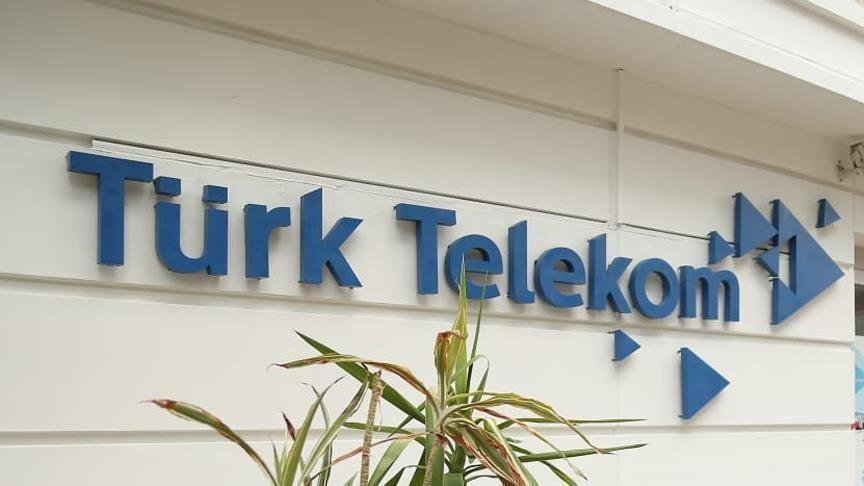
Türk Telekom (Anadolu Agency)
Türk Telekom has an institutional history dating back to the 19th century as Türkiyes first integrated telecommunications operator. In 1840 the Posta Nezareti was established to manage postal services and later adopted the name PTT Nezareti as telephone and telecommunications services were incorporated. The telecommunications division of this structure was separated in 1994 as a distinct corporate entity under the name Türk Telekomünikasyon A.Ş. In the same year all telecommunications services and related assets previously under PTT were transferred under the Türk Telekom umbrella.
As part of the privatization process in 2005 55 percent of the company’s shares were transferred to Ojer Telekomünikasyon A.Ş. In 2008 an additional 15 percent of shares were offered to the public and Türk Telekom began trading on Borsa İstanbul. These developments laid the groundwork for the company’s restructuring according to private sector dynamics. To respond to evolving communication needs Türk Telekom adopted an integrated structure in 2015. Under this framework Türk Telekomünikasyon A.Ş. TTNET A.Ş. and TT Mobil İletişim Hizmetleri A.Ş. retained their legal identities but began delivering services under a single corporate umbrella. By 2016 mobile internet fixed telephone and television services were unified under the Türk Telekom brand.
As of 2025 Türk Telekom serves a total of 53.6 million subscribers. This subscriber base includes 27.9 million mobile users 15.4 million fixed broadband customers and 2.9 million television and Tivibu Go subscribers. The number of users benefiting from the company’s high-speed internet services Fibernet and Hipernet has reached 13.9 million while the number of fixed access lines stands at 17.4 million. The length of the fiber infrastructure has expanded to 482 thousand kilometers and the number of fiber-enabled households has reached 33.2 million. Through its international subsidiary Türk Telekom International the company also operates a fiber network spanning approximately 49 500 kilometers from Central and Eastern Europe to the Middle East.
Within its corporate structure mobile communication services are provided by TT Mobil İletişim Hizmetleri A.Ş. internet and television services by TTNET A.Ş. and convergence technology activities by Argela Yazılım ve Bilişim Teknolojileri A.Ş. Innova Bilişim Çözümleri A.Ş. offers information technology solutions while SEBİT Eğitim ve Bilgi Teknolojileri A.Ş. operates in the field of online education software. AssisTT provides call center and customer service operations while TT Ventures invests in early-stage technology companies. The company also owns affiliated entities active in energy supply support services electronic money and payment systems.
In terms of capital structure 60 percent of Türk Telekom shares are owned by the Türkiye Varlık Fonu and 25 percent by the Republic of Türkiye Ministry of Treasury and Finance. The public float accounts for 15 percent of shares. The Türkiye Varlık Fonu also holds 1.68 percent of the publicly traded shares. No other individual or legal entity holds more than 5 percent of the capital.
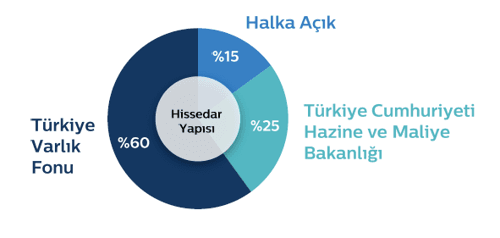
A Graph Showing the Company’s Shareholder Distribution (Türk Telekom)
Its corporate development has been marked by several milestones. TTNET established in 2006 obtained an internet service provider license and began operations. In 2009 Türk Telekom’s subsidiary Avea transitioned to 3G services. The bond issuance in 2014 became the largest in Turkish corporate history up to that date. In 2015 full ownership of Avea shares was transferred to Türk Telekom 4G infrastructure was developed and full membership in the SEA-ME-WE-5 submarine cable system was secured. In 2016 Türk Telekom became the first operator to integrate ULAK Türkiyes first domestically developed LTE base station into its network.
Since 2017 the company has invested in new areas including 5G technologies cybersecurity infrastructure digital keyboard platforms (TAMBU) digital music applications (MUUD) and payment systems and has signed various partnerships domestically and internationally. It has also achieved international recognition in 5G speed trials and gained membership status in the world’s leading network technology platforms.
The Cybersecurity Center opened in Ankara has become one of the highest-capacity infrastructures in the field of digital security. TT Ventures has increased sectoral diversity by investing in digital health and education initiatives. Türk Telekom has also participated in public-private partnership projects providing technology infrastructure to city hospitals and developing the e-Görüş system for correctional institutions.
Today Türk Telekom operates with 36 054 employees across all 81 provinces of Türkiye and is positioned as the country’s first integrated telecommunications provider of fixed telephone mobile communication broadband internet and television services. The services offered by the institution cover not only individual consumers but also public institutions private sector organizations and various social service projects reaching diverse segments of society.
Anadolu Ajansı. "Türk Telekom'dan organizasyonel değişiklikler." Accessed July 1, 2025. https://www.aa.com.tr/tr/isdunyasi/bilisim/turk-telekomdan-organizasyonel-degisiklikler/653355
Electrical Engineers Chamber. "Türkiye’de Telekomünikasyon Tarihçesi." emo.org.tr. Accessed July 1, 2025. https://www.emo.org.tr/ekler/e52547a0e7bca35_ek.pdf.
Kamuyu Aydınlatma Platformu. "Türk Telekomünikasyon A.Ş." KAP. Accessed July 1, 2025. https://www.kap.org.tr/tr/sirket-bilgileri/genel/1473-turk-telekomunikasyon-a-s.
Mobil Telekomünikasyon Operatörleri Derneği. "Türk Telekom." *m-TOD.* Accessed July 1, 2025. https://www.m-tod.org/turk-telekom/.
Türk Telekom. "Ortaklık Yapısı." Türk Telekom Yatırımcı İlişkileri. Accessed July 1, 2025. https://www.ttyatirimciiliskileri.com.tr/tr-tr/turk-telekom-grubu/turk-telekoma-yatirim/sayfalar/ortaklik-yapisi
Türk Telekom. "Rakamlarla Türk Telekom." Türk Telekom Resmi Web Sitesi. Accessed July 1, 2025. https://www.turktelekom.com.tr/hakkimizda/rakamlarla-turk-telekom
Türk Telekom. "Türk Telekom Logo." Türk Telekom Resmi Web Sitesi. Accessed July 8, 2025. https://www.turktelekom.com.tr/Assets/img/turk-telekom-og.png
Türk Telekom. "Vizyon & Değerlerimiz." Türk Telekom Resmi Web Sitesi. Accessed July 1, 2025. https://www.turktelekom.com.tr/hakkimizda/vizyon-ve-degerlerimiz
Türk Telekom. "İlk Bakışta Türk Telekom." Türk Telekom Resmi Web Sitesi. Accessed July 1, 2025. https://www.turktelekom.com.tr/hakkimizda/i%CC%87lk-bakista-turk-telekom

Year of Establishment | 1994 (predecessor: the Ministry of Posts established in 1840) | ||||||||
|---|---|---|---|---|---|---|---|---|---|
Previous Corporate Structure | PTT (Postal Telegraph Telephone) | ||||||||
Privatization Year | 2005 (55% of shares transferred to Ojer Telekom) | ||||||||
Number of Subscribers (2025) | TV: 2.9 million Broadband: 15.4 million Mobile: 27.9 million Total: 53.6 million | ||||||||
Areas of Activity | Fintech Call center Education Software Television Broadband internet Mobile communication Fixed telephone | ||||||||
Partnership Structure | 15% Publicly traded 25% Ministry of Treasury and Finance 60% Türkiye Varlık Fonu | ||||||||
Headquarters | Ankara / Türkiye | ||||||||
Website(s) | www.turktelekom.com.tr/ | ||||||||
Foundation and Historical Development
Services and Subscriber Base
Subsidiaries and Areas of Activity
Ownership Structure
Technological Development and Investments
Current Position and Scope of Operations