

This article was automatically translated from the original Turkish version.
+1 More
Türk Hava Kurumu Müzesi is located in the Ulus neighborhood of the Altındağ district in Ankara and is one of Turkey’s civil aviation institutions. The museum began operations on 19 May 2002. Its complex also includes the historic Parachute Tower.

Türk Hava Kurumu Müzesi (Culture Portal)
The museum complex comprises 287 square metres of indoor space and 5,294 square metres of outdoor exhibition area. The main collection includes documents and photographs related to civil aviation, pilot uniforms, parachute samples, aviation engineering equipment, medals, badges, commemorative stamps and various models.
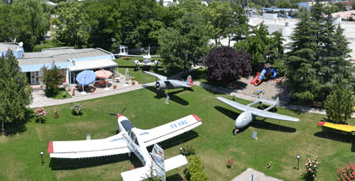
In the museum’s garden, various aircraft and helicopter models used or produced by Türk Hava Kurumu are displayed. The museum also features model representations of Ottoman aviation pioneers such as Lagâri Hasan Çelebi and Hezarfen Ahmet Çelebi.
Documents relating to the aircraft manufacturing activities of Kayseri TOMTAŞ, one of the significant historical records of Turkish aviation, are also archived here. The museum, which presents the historical development of aviation to visitors, is further supported by play areas and educational materials designed for children.

Türk Hava Kurumu Müzesi (Turkish Aeronautical Association)
Opening hours vary by season: 09:00–18:00 during winter months and 10:00–19:00 during summer months. The museum is closed on Mondays. It welcomes an average of 15,000 visitors annually.
“Ankara Paraşüt Kulesi ve THK Müzesi.” Türk Hava Kurumu. Accessed July 7, 2025. https://www.thk.org.tr/ankara_parasut_kulesivemuze
“Türk Hava Kurumu Müzesi.” Kültür ve Turizm Bakanlığı, Kültür Portalı. Accessed July 7, 2025. https://www.kulturportali.gov.tr/turkiye/ankara/gezilecekyer/turk-hava-kurumu-muzes
“Türk Hava Kurumu Müzesi.” Muzeler.org. Accessed July 7, 2025. https://muzeler.org/turk-hava-kurumu-muzesi--800445

No Discussion Added Yet
Start discussion for "Turkish Aeronautical Association Museum" article
Complex