


This article was automatically translated from the original Turkish version.
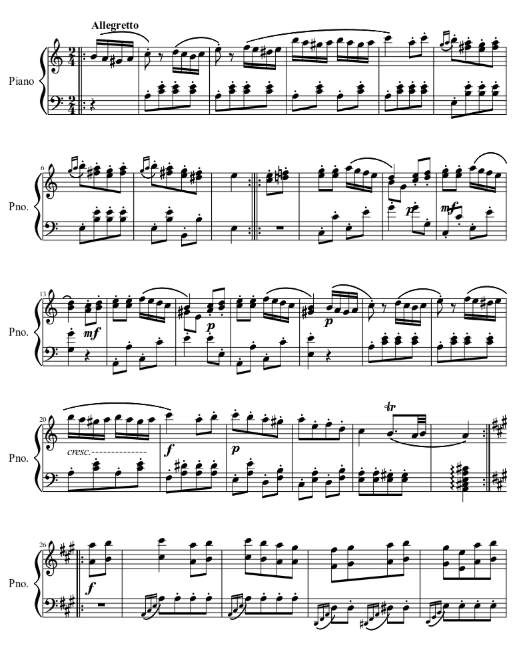
Title of the Work | Turkish March (Rondo alla Turca) | ||||||||
|---|---|---|---|---|---|---|---|---|---|
Composer | Wolfgang Amadeus Mozart | ||||||||
Year of Composition | 1783 | ||||||||
Related Work | Piano Sonata No. 11 in A Major, K. 331 | ||||||||
Section | Third movement | ||||||||
Musical Influences | Turkish style (Alla Turca) inspired by Ottoman mehter music | ||||||||
Prominent Features | percussive effect sharp dynamic transitions Driving rhythms | ||||||||
"Turkish March" (Rondo alla Turca) is the third movement of the Piano Sonata No. 11 in A major, K. 331, composed by the Austrian composer Wolfgang Amadeus Mozart in 1783. The work is regarded as one of the important examples of classical period musical style. This movement is composed in rondo form and has established a prominent place in the piano repertoire.
In 18th century Europe, interest in the Ottoman Empire created the conditions for the development of a musical approach known as the "Turkish style" (Alla Turca). This style involves the adaptation of rhythmic and tonal characteristics of Ottoman mehter music into European classical music. In the "Turkish March", striking rhythms, sharp dynamic transitions, and percussive techniques are clear examples of this influence.
Turkish MarchRousseau
The piece follows the classical rondo form. The main theme is clearly presented and recurs after different intervening sections (episodes). The main theme stands out through rhythmic accents and melodic embellishments. The intervening sections have a lighter character and provide contrast to the overall dynamic structure of the work.
The "Turkish March" is widely recognized among Wolfgang Amadeus Mozart's piano works. It has been performed and arranged by various interpreters. The piece is used as a teaching resource in academic studies and holds historical significance in the classical music literature.
Artlist. "Turkish March (Rondo Alla Turca) - Royalty-Free Music." Accessed April 27, 2025. https://artlist.io/royalty-free-music/song/turkish-march-rondo-alla-turca/116644.
Classicman. "Türk Marşı (Rondo alla Turca) - Musescore." Accessed April 27, 2025. https://musescore.com/classicman/scores/49143?srsltid=AfmBOoqsCcKHoAThneVsO1TFvuphWKnaUF_0hMJJwtbn0kXeAFvGqkBo.
Mutopia Project. "KV 331 3. Bölüm - Rondo Alla Turca (PDF Partisyonu)." Accessed April 27, 2025. https://www.mutopiaproject.org/ftp/MozartWA/KV331/KV331_3_RondoAllaTurca/KV331_3_RondoAllaTurca-a4.pdf.

Title of the Work | Turkish March (Rondo alla Turca) | ||||||||
|---|---|---|---|---|---|---|---|---|---|
Composer | Wolfgang Amadeus Mozart | ||||||||
Year of Composition | 1783 | ||||||||
Related Work | Piano Sonata No. 11 in A Major, K. 331 | ||||||||
Section | Third movement | ||||||||
Musical Influences | Turkish style (Alla Turca) inspired by Ottoman mehter music | ||||||||
Prominent Features | percussive effect sharp dynamic transitions Driving rhythms | ||||||||
No Discussion Added Yet
Start discussion for "Turkish March (Rondo alla Turca)" article
Turkish Style Influence
Form and Structure
Interpretation and Influence