
This article was automatically translated from the original Turkish version.
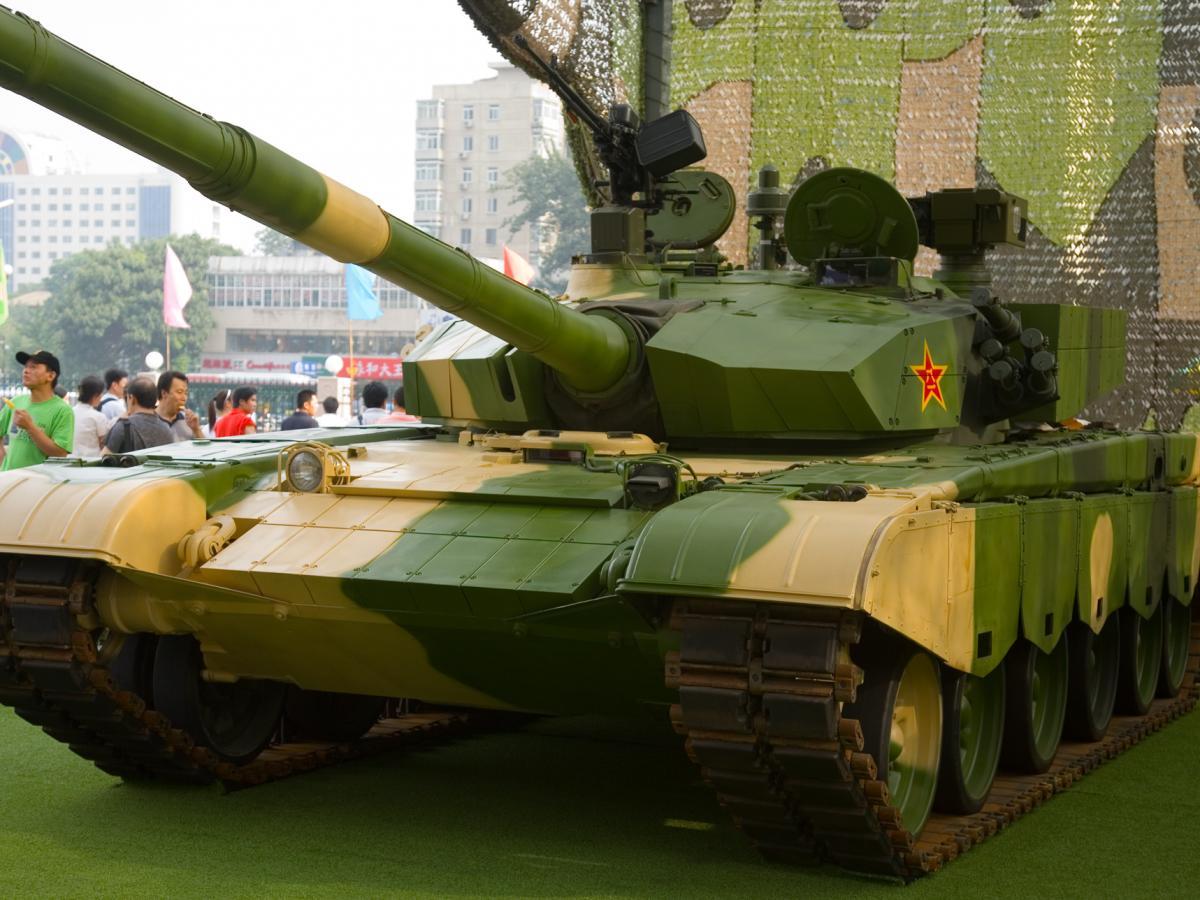
Type 99 (industrial designation ZTZ-99) is a third-generation main battle tank family developed by the People’s Republic of China. Designed by Norinco, it entered serial production for the People’s Liberation Army from the late 1990s onward. Key features include a 125 mm autoloader-equipped main gun, composite hull and turret armor reinforced with explosive reactive armor, modern fire control systems, and a high-power diesel engine.
The design of the Type 99 was pursued during the 1980s and 1990s in response to the need for a domestic successor and lessons learned from foreign systems. Early prototypes (Type 90/98) evolved into production models, and the vehicle was publicly unveiled in 2001. Over time, upgrades in armor, electronics, and hardware have been introduced through variants such as the Type 99A and subsequent sub-variants. The tank’s protection system comprises a welded steel/composite hull, modular appliqué panels, explosive reactive armor blocks on the front and turret surfaces, and signature management measures. Later variants feature modifications to the extent of explosive reactive armor coverage and turret geometry. Limited information is available in open sources regarding integrated active protection systems (APS).
The main armament is a 125 mm autoloader-equipped smoothbore gun capable of firing APFSDS, HE-FRAG, and gun-launched anti-tank guided missiles. Modern variants are equipped with advanced fire control systems incorporating stabilized barrels, thermal sights, laser rangefinders, and digital ballistic computers. Ammunition is typically stored in an autoloader carousel with safety measures in place. The Type 99 series aims for a high power-to-weight ratio using diesel engines rated between approximately 1,200 and 1,500 horsepower depending on the variant. The suspension system is based on a conventional tracked undercarriage; newer variants have improved performance and cross-country mobility.

Type 99 Technical Sketch (The Blueprints)
Type 99 (early production): The initial service models, produced in limited numbers from the early 2000s.
Type 99A / 99A1: Features enhanced armor, electronics, and sights; the most commonly reported model in PLA units.
Type 99A2 / 99A3 (reported): Expected improvements include increased frontal protection, a new turret shape, upgraded sensors, network connectivity, and integration of more capable fire control and defensive systems. Open-source details vary, and naming conventions differ among analysts.
The Type 99, designed as a high-end MBT for command and mobile operations, is deployed in elite PLA armored units. Unlike export-oriented platforms, China has maintained limited disclosure of detailed operational data. Open-source analyses indicate that the Type 99 serves as the technological and capability foundation for China’s heavier armored brigades, while the PLA continues to modernize the bulk of its forces with upgraded Type-96 and T-72 derivatives in greater numbers.
The Type 99 family has not been widely exported compared to earlier Chinese designs; China’s defense export focus for MBTs has generally centered on derivatives such as the Al Khalid, developed from the Type 90 design for Pakistan. In capability terms, the Type 99 stands alongside contemporary third-generation MBTs—modernized variants from the late Cold War era equipped with digital fire control systems and explosive reactive armor—and reflects China’s intent to close the capability gap with Western and Russian MBT developments.
Crew: 3 (commander, gunner, driver)
Combat weight: ~50–55 tonnes (varies by variant and attachments)
Main armament: 125 mm autoloader-equipped smoothbore gun (some variants capable of firing gun-launched ATGMs)
Secondary armament: 12.7 mm HMG (roof-mounted), 7.62 mm coaxial MG
Engine: Diesel family (reported outputs of 1,200–1,500 hp depending on upgrade level)
Maximum road speed / range: 76 km/h.
Army Recognition. 2025. “Type 99A (99-A2) ZTZ-99A Main Battle Tank — China.” Army Recognition, August 22, 2025. https://www.armyrecognition.com/military-products/army/main-battle-tanks/main-battle-tanks/type-99a-99-a2-ztz-99a-main-battle-tank-china-11408171.
Army Technology. "ZTZ99 Main Battle Tank (Type 99)." Army-Technology. Accessed October 20, 2025. https://www.army-technology.com/projects/type99chinese-main/.
Ermilin, Petr. 2025. “Китайские танки: обзор, перспективы” [Chinese Tanks: Overview and Prospects]. Военное обозрение «Правда.ру» [Pravda.ru Military Review], August 21, 2025. https://military.pravda.ru/2264440-kitai/.
GlobalSecurity.org. n.d. “Type 99 Main Battle Tank (ZTZ-99).” GlobalSecurity. Accessed October 20, 2025. https://www.globalsecurity.org/military/world/china/type-99.htm.
ODIN. 2024. “ZTZ-99A (Type-99A2) Chinese Main Battle Tank (MBT).” ODIN / TRADOC, December 18, 2024. https://odin.tradoc.army.mil/WEG/Asset/Type_99A2_%28ZTZ-99A2%29_Chinese_Main_Battle_Tank_%28MBT%29.
Seitz, Isaac. 2025. “China’s Type 99 Tank: A Paper Tiger or Battlefield Threat?” 19FortyFive, February 17, 2025. https://www.19fortyfive.com/2025/02/chinas-type-99-tank-a-paper-tiger-or-battlefield-threat/.
The-Blueprints. n.d. “PLA Type 99 — Three-View Blueprint.” The-Blueprints.com. Accessed October 20, 2025. https://www.the-blueprints.com/blueprints/tanks/tanks-n-p/87930/view/pla_type_99/.

No Discussion Added Yet
Start discussion for "Type 99 Main Battle Tank" article
Development and Design
Variants
Operational History
Technical Specifications