

This article was automatically translated from the original Turkish version.
The T-90 is a third-generation Russian main battle tank (MBT) developed by UralVagonZavod (Nizhny Tagil) based on the T-72 design during the final years of the Soviet Union.
Introduced in the early 1990s, this tank remains in service as the primary MBT of the Russian armed forces and continues to be exported, notably to India as the T-90S/T-90SI. Modernized variants such as the T-90A and T-90MS/T-90M feature upgraded engines, armor, fire control systems, and electronic equipment.
The T-90 represents the mature outcome of continuous Soviet, and later Russian, efforts to combine the compact, low-profile survivability of the T-72 series with advanced fire control, protection concepts, and automotive components developed for subsequent Soviet designs, particularly the T-80U. In the late 1980s, the Kartsev-Venediktov design team at UralVagonZavod began developing an MBT that could be produced in large quantities, was easier to maintain than higher-end but more expensive designs, and incorporated the best available subsystems of the time: an upgraded diesel powerpack, enhanced gun and sighting systems, and explosive reactive armor. The initial Object-188 prototypes retained the basic T-72 autoloader and low silhouette but integrated the 1A45T/Irtysh fire control concept from the T-80U and higher-performance components where beneficial. In the early 1990s, Russia initiated production of the T-90 as a pragmatic, exportable MBT capable of rapidly replacing aging T-72 inventories while allowing for incremental upgrades—such as new turret castings, upgraded engines, ERA, active protection, and digital electronics—within budgetary constraints.
The T-90’s protection is layered: a steel/composite base armor, appliqué ERA (Kontakt-5 on early models; Relikt or equivalent blocks on recent upgrades), and soft-kill systems such as Shtora (electro-optical/IR jammers and laser warning receivers). The turret and glacis are shaped to reduce shot traps and maintain a low profile; additional side skirts and cage elements serve as temporary countermeasures against top-attack and drone/IED threats. Later T-90M variants place greater engineering emphasis on expanding the frontal ERA coverage and addressing historically vulnerable areas such as the mantlet and turret ring. Russia has also tested limited numbers of modular hard-kill and active protection packages. Combat experience in the 2020s has demonstrated that the T-90’s layered protection remains effective against many older munitions but leaves it vulnerable to modern tandem ATGMs, top-attack warheads, and persistent drone/loitering munition threats unless integrated into a robust combined-arms defense posture.
The T-90’s main armament is a 125 mm 2A46 series smoothbore gun with an autoloader (three-man crew: commander, gunner, driver). The gun can fire APFSDS, HE-FRAG, and HEAT rounds, as well as gun-launched anti-tank guided missiles such as the 9M119 ‘Svir’/‘Refleks’ family. Modern fire control systems include stabilized sights, thermal imaging for day/night engagements, laser rangefinders, and ballistic computers. Later variants feature enhanced multi-band sensors and digital fire control systems that significantly improve first-round hit probability against moving targets. Ammunition storage capacity is typically ~40–43 rounds (mixed loading); the autoloader reduces crew size and vehicle height but makes ammunition survivability and magazine design critical design factors.
Mobility varies by model. Early T-90s used the V-84 diesel engine (~840 hp), while modernized T-90M/T-90MS platforms employ the more powerful V-92 family engines (~1,000–1,130 hp) to maintain mobility despite increased weight from added armor and systems. The torsion bar suspension, featuring six road wheels per side, a rear drive sprocket, and track return rollers, provides cross-country performance comparable to previous-generation Western MBTs. Maximum road speed is typically ~60 km/h with an operational range of ~500–600 km (extendable with external fuel drums). While engine and transmission reliability is sufficient for regional operations, sustained high-tempo production and spare parts supply have become increasingly difficult due to wartime attrition and sanctions-driven logistics constraints.

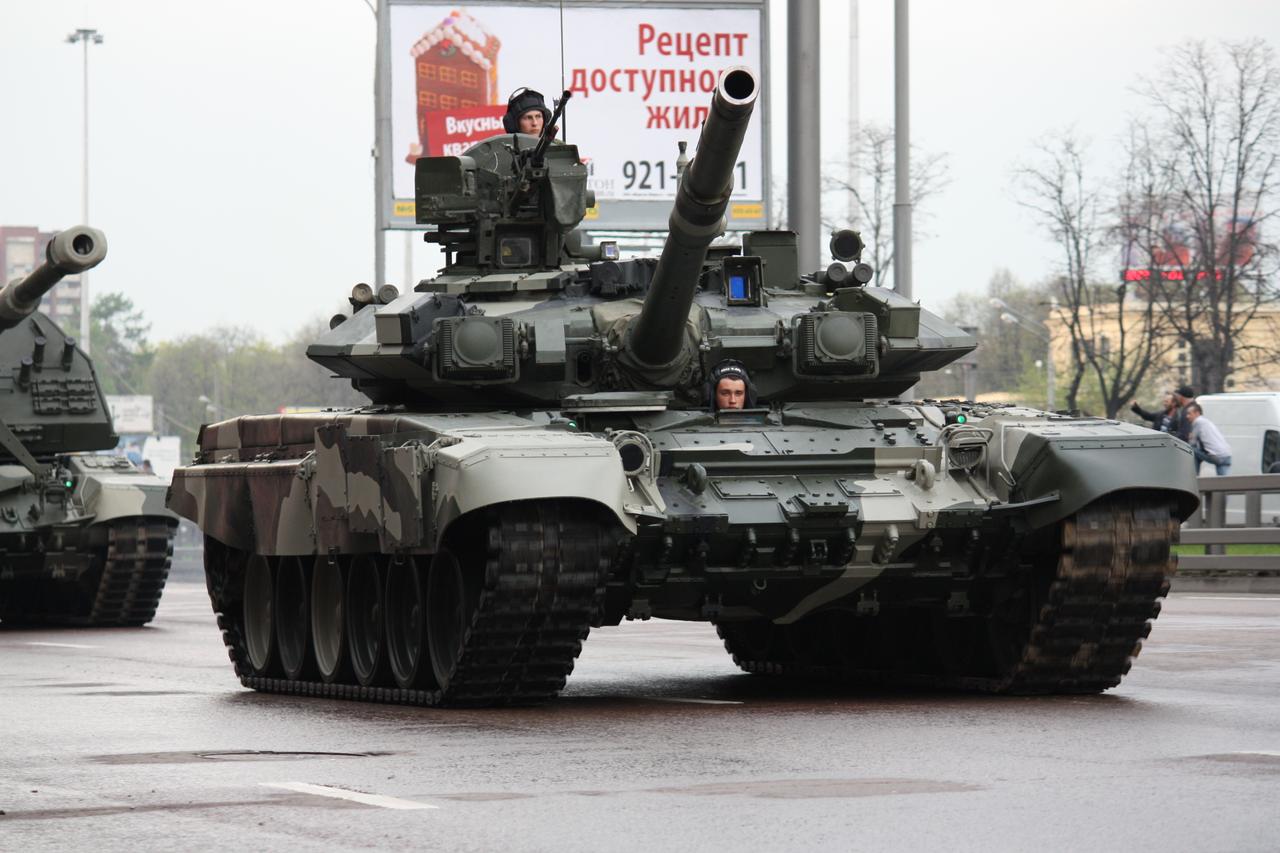
T-90 (GoodFon)
The T-90 has been exported and deployed in various conflicts with mixed results. Limited Russian and export deployments in Syria provided operational data on desert operations and logistics. Reports from the 2020s, particularly regarding the Russo-Ukrainian War, document both tactical successes and significant losses. Open-source intelligence and investigative journalism reports indicate that a substantial number of T-90s, including T-90M variants, have been destroyed, captured, or damaged in Ukraine. Visual evidence shows that the platform is consistently vulnerable to modern ATGMs, top-attack munitions, and unmanned systems when not adequately protected or coordinated within a combined-arms framework. High-profile losses have compelled operational adaptations—such as added cage-type attachments, modified tactical usage, active protection initiatives, and improved crew training—and analysts emphasize that survivability on today’s battlefield depends as much on integrated combined arms (infantry, engineers, air defense, electronic warfare, and unmanned systems) and logistics as on the tank’s own armor. The continued frontline use of the T-90 reflects Russia’s production priorities and the platform’s upgrade trajectory, yet battlefield attrition has exposed its limitations against modern asymmetric threats.
Crew: 3 (commander, gunner, driver)
Combat weight: ~46–48 tonnes (varies by model)
Main armament: 125 mm 2A46 series autoloader-equipped smoothbore gun (with gun-launched ATGM capability). Ammunition capacity ~40–43 rounds.
Secondary armament: 7.62 mm coaxial MG; some models feature a 12.7 mm roof-mounted MG.
Engine: V-84 (~840 hp) to V-92 family (~1,000–1,130 hp), depending on model.
Maximum road speed: ~60 km/h; range: ~500–600 km (internal fuel).

T-90 Technical Drawing (DrawingDatabase)
The T-90 family exemplifies Russia’s pragmatic approach to extending platform life and exportability through iterative modernization. Its strengths include a proven industrial heritage, compact profile, and an effective 125 mm gun with missile-launching capability. Current weaknesses identified in ongoing conflicts include vulnerability to modern top-attack weapons and unmanned systems, concerns over ammunition and autoloader survivability, and logistical challenges under sustained attrition. Future upgrades expected or experimentally fielded include expanded ERA coverage, integration of hard-kill APS, enhanced multispectral sensors, and improved C-UAS defenses. Whether these measures can restore parity with the latest Western MBTs depends not only on armor thickness but also on sensor quality, active protection integration, and logistical robustness.
Army-Technology. "T-90S Main Battle Tank (MBT), Russia." Army Technology, March 30, 2022. Accessed October 20, 2025. https://www.army-technology.com/projects/t90/.
ArmyRecognition. "T-90M Model 2017 Proryv-3 (technical data)." Army Recognition, September 17, 2025. Accessed October 20, 2025. https://armyrecognition.com/military-products/army/main-battle-tanks/main-battle-tanks/t-90m-model-2017-mbt-main-battle-tank-technical-data-sheet.
Cole, Brendan. “Putin’s ‘Best in the World’ T-90 Tank Losses Reach Grim Milestone.” *Newsweek*, July 16, 2024. Accessed October 20, 2025. https://www.newsweek.com/russia-ukraine-tank-t-90-losses-1925763.
DrawingDatabase. n.d. “T-90 Blueprint.” DrawingDatabase. Accessed October 20, 2025. https://drawingdatabase.com/t-90/.
Oryx. “Attack On Europe: Documenting Russian Equipment Losses.” February 24, 2022. Accessed October 20, 2025. https://oryxspioenkop.com/2022/02/attack-on-europe-documenting-equipment.html.
[1]
Değerler kaynağa ve belirli alt varyantlara göre değişir.

No Discussion Added Yet
Start discussion for "T-90 Main Battle Tank" article
Development and Design Basis
Technical Structure
Major Variants
Operational History and Combat Performance
General Technical Specifications【1】
Assessment and Modernization