

This article was automatically translated from the original Turkish version.
+1 More
Registration Number | 1100 | ||||||||
|---|---|---|---|---|---|---|---|---|---|
Registration Date | 09.05.2022 | ||||||||
Applicant/Registrant(s) | Uluborlu Municipality | ||||||||
Province(s) | Isparta | ||||||||
Type of Geographical İndication | Mahreç Sign | ||||||||
Application Date | 25.02.2021 | ||||||||
Product / Product Group(s) | Handicraft products other than carpets kilims and textiles | ||||||||
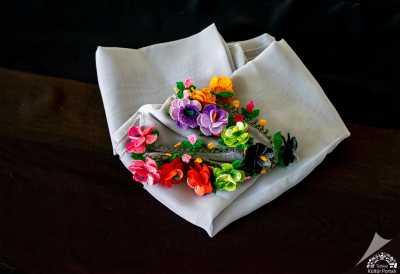
Uluborlu Çeki Oyası is a traditional embroidery craft unique to the Uluborlu district of Isparta Province in Türkiye and is a protected traditional craft under geographical indication. Registered under Law No. 6769 on Industrial Property, this craft was applied for on 25 February 2021 and officially registered as a geographical indication on 9 May 2022. Registered by the Uluborlu Municipality, this embroidery is an integral part of the district’s cultural heritage, with all stages of its production taking place within the boundaries of Uluborlu.

Uluborlu Çeki Oyası (Turkish Patent)
Uluborlu Çeki Oyası is a three-dimensional embroidery technique typically executed with a crochet hook using 70-count colored mercerized lace thread. It is applied along the edges of square cotton coverlets, known as çeki, measuring approximately 90 x 90 cm. The threads used consist of 5-gram balls, from which 10 to 12 çeki motifs are produced. The foundational structure of the embroidery is built upon a green-colored chain-like strip, referred to as the root or water, which is crocheted using a 18-22 count hook to a length of approximately 4 meters. A second layer, called kirpik, is added on top of this strip, and floral or other motifs are embroidered at intervals of about 10 cm along the kirpik. A completed çeki embroidery typically contains 40 motifs.
One of the most distinctive features of this embroidery is the use of a milk powder derived from the roots of the geven plant (Astragalus). During spring, the roots are extracted from the soil, their sap is dried and ground into powder, then mixed with water in a 1:1 ratio to prepare the sizing solution. The embroidery is immersed in this mixture, removed, shaped by hand, and left to dry for a day. Alternatively, gelatin may be used for sizing: in this case, half a gelatin leaf is dissolved in a cup of hot water. The sizing process gives the embroidery a smooth and firm appearance.
Uluborlu Çeki Oyası stands out for its rich variety of motifs inspired by nature and daily life. The most commonly used motif is the three-dimensional, multi-petaled rose. The rose motif consists of 12 petals arranged in three stages: five petals in the first stage, four in the second, and three in the third. A bud is added at the center, and the motif is completed by attaching it to the base with two green leaves. Other floral motifs include almond blossom, plum blossom, hyacinth, hawthorn, violet, cup-shaped flower, squash blossom, carnation, and Uluborlu cherry. Additionally, motifs inspired by animals such as sparrow’s eye, goose foot, and rabbit’s lip are used, as well as motifs named after objects such as package stone, broom, ring needle, basket, patience stone, and gold plate.
In addition to crochet embroidery, techniques such as needlework, bobbin lace, fringe, and beadwork are also employed. For example, needlework motifs include flowered tatar, starry tin tin, and sugar basket; bobbin lace motifs include watermelon seed, eyebrow and eyelash, and water border; fringe embroidery motifs include mushroom and pearl; and beadwork motifs include lady’s handbag, ladder of love, Türkan Şoray hedgehog, and officer’s braid.
The production of Uluborlu Çeki Oyası follows traditional methods unique to the Uluborlu district. In the first stage, a green chain strip is crocheted using 70-count mercerized lace thread, forming the base of the embroidery. Next, thread is wound onto the hook and passed through chain loops to create the kirpik layer. Floral or other motifs are then added on top of the kirpik. Each motif is carefully crafted, typically drawing inspiration from natural forms. The production process concludes with sizing, after which the embroidery is sewn onto the çeki coverlet to prepare it for sale. When the coverlet becomes worn, the embroidery can be removed and transferred to another coverlet, ensuring long-term use.
Uluborlu Çeki Oyası is monitored annually by a three-member oversight body coordinated by the Uluborlu Municipality, comprising representatives from the Isparta Provincial Directorate of Culture and Tourism, the Uluborlu Chamber of Trades and Crafts, and an expert delegate. Additional inspections are conducted as needed or upon complaint. During inspections, the appropriateness of materials used, adherence to production methods, and correct application of the Uluborlu Çeki Oyası designation and geographical indication emblem are verified. The registering Uluborlu Municipality pursues legal procedures to safeguard these rights.
Uluborlu Çeki Oyası is a deeply rooted tradition extending from the past to the present, closely tied to the geographic and cultural identity of the Uluborlu district. Its production techniques and motif diversity are inspired by the district’s natural environment and social life. In this way, Uluborlu Çeki Oyası is not merely a handicraft but a cultural heritage that reflects the region’s history and aesthetic sensibility.
Ministry of Culture and Tourism. "Uluborlu Çeki Oyası." Kültür Portalı. Accessed August 16, 2025. https://www.kulturportali.gov.tr/portal/uluborlu-ceki-oyasi.
Turk Patent and Trademark Office. "Uluborlu Çeki Oyası." Accessed August 16, 2025. https://ci.turkpatent.gov.tr/Files/GeographicalSigns/17d11686-14a5-41b9-a23d-fca9f2e36133.pdf.
Turkish Patent and Trademark Office. "Uluborlu Çeki Oyası Tescil Belgesi." Geographical Indications Portal. Accessed August 16, 2025. https://ci.turkpatent.gov.tr/cografi-isaretler/detay/3494

Registration Number | 1100 | ||||||||
|---|---|---|---|---|---|---|---|---|---|
Registration Date | 09.05.2022 | ||||||||
Applicant/Registrant(s) | Uluborlu Municipality | ||||||||
Province(s) | Isparta | ||||||||
Type of Geographical İndication | Mahreç Sign | ||||||||
Application Date | 25.02.2021 | ||||||||
Product / Product Group(s) | Handicraft products other than carpets kilims and textiles | ||||||||
No Discussion Added Yet
Start discussion for "Uluborlu Çeki Oyası" article
Definition and Characteristics
Motifs
Production Process
Monitoring and Protection
Cultural and Geographic Connection