


This article was automatically translated from the original Turkish version.
+1 More
United Fruit Company
Industry | Agriculture | ||||||||
|---|---|---|---|---|---|---|---|---|---|
First Come | Tropical Trading and Transport Company Boston Fruit Company | ||||||||
Inheritance | Chiquita United Brands Company | ||||||||
Employee | 20000 | ||||||||
United Fruit Company (later United Brand Company and currently Chiquita) is a U.S.-based multinational agricultural corporation. It was established in 1899 through the merger of Minor Cooper Keith’s Tropical Trading and Transport Company and Andrew Preston’s Boston Fruit Company. The company expanded by producing and exporting tropical fruits, particularly bananas, from Central America and the Caribbean.
The foundations of United Fruit Company were laid in 1899 with the merger of commercial ventures initiated in the 1870s by Minor Cooper Keith, Andrew Preston, and Lorenzo Dow Baker. In the 1870s, Minor Cooper Keith began constructing a railway in Costa Rica under his company, Tropical Trading and Transport Company. Struggling to finance the railway, Keith planted banana trees along the route and exported the fruit to the United States. This trade proved highly successful, allowing Keith to rapidly expand his enterprise【1】. Captain Lorenzo Dow Baker, who began transporting bananas from Jamaica to the United States on his fishing vessel, partnered with Andrew Preston in 1885 to found the Boston Fruit Company. In 1899, Tropical Trading and Transport Company and Boston Fruit Company merged to form United Fruit Company on March 30, 1899【2】.
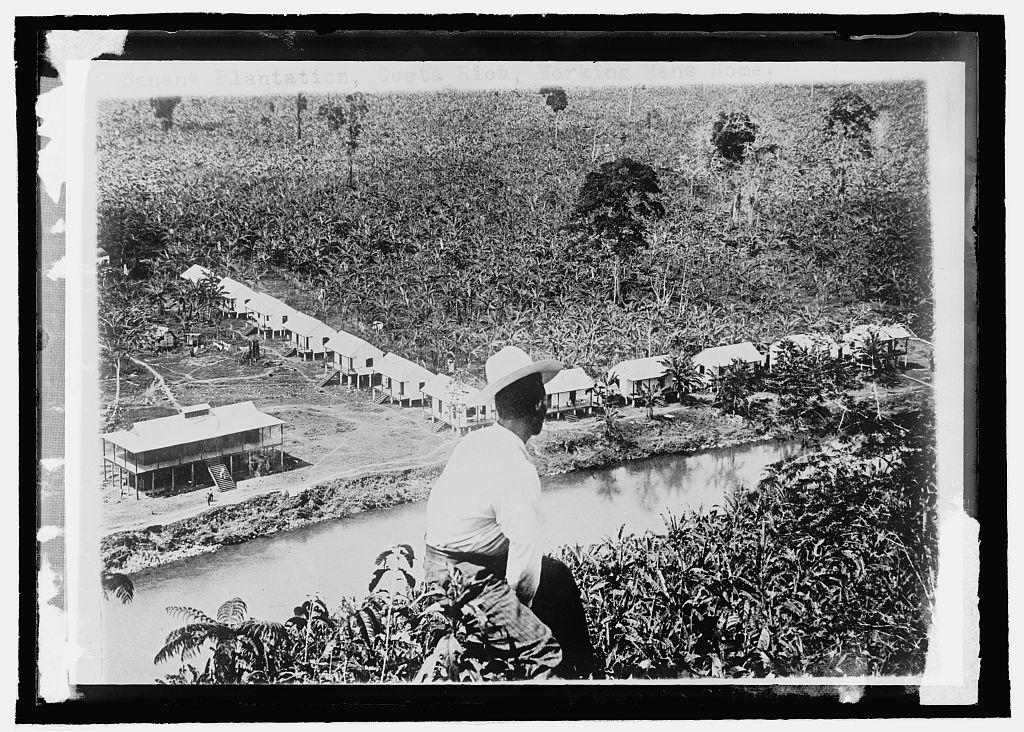
During the period before World War II, the company expanded rapidly, establishing large plantations across Latin America to increase production capacity. It also controlled infrastructure such as railways, telegraph lines, housing, hospitals, and ports within its production areas【3】. With its own railway network and maritime fleet, the company built an extensive integrated supply chain across the United States. By the 1920s, more than 80 percent of bananas imported into the United States were supplied by UFC【4】.

A Banana Plantation in Costa Rica (loc.gov)
Through its infrastructure investments in countries such as Costa Rica, Honduras, Guatemala, and Panama, the company developed close ties with authoritarian regimes in these nations. It was accused of collaborating with local governments to suppress labor movements. Leaders such as Tiburcio Carías in Honduras (1932–1949) and Jorge Ubico in Guatemala (1931–1944) granted the company extensive land concessions while suppressing workers’ rights【5】. In 1954, the company organized a U.S.-backed coup to prevent Guatemalan President Jacobo Arbenz from implementing land reform. Arbenz’s expropriation of unused land owned by United Fruit Company led the company to portray the reform as a “communist threat” to the U.S. government, prompting CIA intervention【6】. After the oil crisis of the 1970s, rising economic nationalism in Latin America brought about nationalization and land reform. In several Latin American countries, the company’s operations were restricted or nationalized【7】. Having lost its concessions in Latin America, the company restructured by selling off some subsidiaries or forming partnerships with local governments. During this period, the company changed its name to United Brand Company.
In 1984, United Brand Company changed its name again to Chiquita, the name it retains today. In 2014, it merged with Fyffes to control approximately 29 percent of the global banana market【8】. The company has been frequently criticized in Latin American literature (by authors such as Gabriel García Márquez, Pablo Neruda, and Eduardo Galeano) and in the social sciences for its monopolistic practices, political interventions, and involvement in coups.
Bucheli, Marcelo. "Multinational Corporations, Totalitarian Regimes and Economic Nationalism: United Fruit Company in Central America, 1899–1975." Business History 50, no. 4 (2008): 433–454.
Chiquita. *The Chiquita Story*. Accessed October 18, 2025. https://web.archive.org/web/20250418185243/https://www.chiquita.com/the-chiquita-story/.
Detroit Publishing Co. United Fruit Company banana conveyors, New Orleans, La. Louisiana. 1910. https://www.loc.gov/item/2016811156/
Galeano, Eduardo. Open Veins of Latin America: Five Centuries of the Pillage of a Continent. New York: Monthly Review Press, 1997.
Irons, Oliver Eller. The History of the American Fruit Industry in the Caribbean. 1929.
Morey, Kevin. Blood for Bananas: United Fruit’s Central American Empire. Roots of Contemporary Issues Project. Washington State University, 2014.
National Photo Company Collection (Library of Congress). Banana plantation, Costa Rica. 1908–1919. https://www.loc.gov/item/2016821465/
United Fruit Historical Society. *Minor Cooper Keith*. Archived October 30, 2008. https://web.archive.org/web/20081030011947/http://www.unitedfruit.org/keith.htm.
Washington State University. *Blood for Bananas: United Fruit’s Central American Empire*. Accessed May 12, 2025. https://history.wsu.edu/rci/sample-research-project/.
[1]
https://web.archive.org/web/20081030011947/http://www.unitedfruit.org/keith.htm
[2]
https://web.archive.org/web/20250418185243/https://www.chiquita.com/the-chiquita-story/
[3]
(Bucheli, 2008, s. 434).
[4]
Irons, Oliver Eller. The History of the American Fruit Industry in the Caribbean. 1929.
[5]
(Bucheli, 2008, s. 440-442).
[6]
(https://history.wsu.edu/rci/sample-research-project/ ; Bucheli, 2008, s. 445)
[7]
Bucheli, 2008, s. 448-449
[8]
https://history.wsu.edu/rci/sample-research-project/

United Fruit Company
Industry | Agriculture | ||||||||
|---|---|---|---|---|---|---|---|---|---|
First Come | Tropical Trading and Transport Company Boston Fruit Company | ||||||||
Inheritance | Chiquita United Brands Company | ||||||||
Employee | 20000 | ||||||||
No Discussion Added Yet
Start discussion for "United Fruit Company" article
Founding and Early Expansion
Growth Period and Political Influence
Legacy and Criticisms