


This article was automatically translated from the original Turkish version.
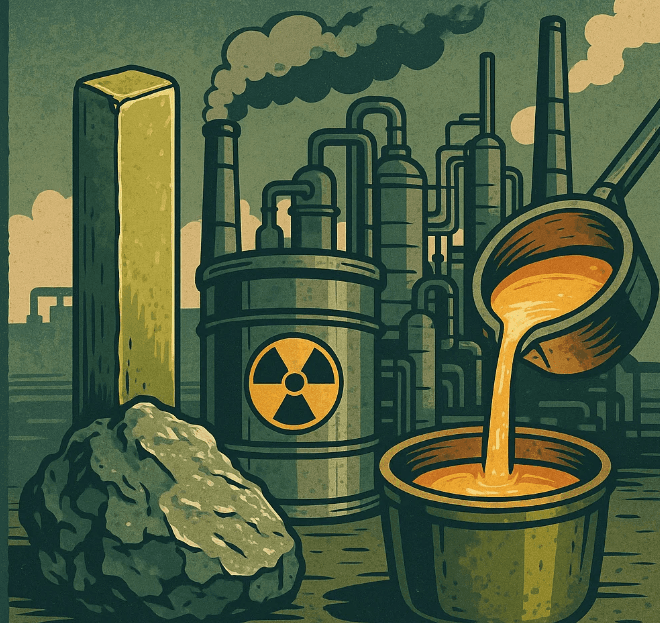
Uranium metallurgy
Processing Methods | Pelletizing Sintering Powder metallurgy | ||||||||
|---|---|---|---|---|---|---|---|---|---|
Alloys | Microstructure analysis Uranium-Molybdenum (U-Mo) Uranium-Zirconium (U-Zr) | ||||||||
Thermomechanical Properties | Mechanical strength Thermal conductivity | ||||||||
Application Area(s) | Nuclear reactor fuels Nuclear waste recovery Ballistic applications Radiation shielding | ||||||||
Uranium metallurgy is a materials science discipline concerned with the processing and characterization of uranium, which is used in various industrial fields, primarily nuclear technologies. This discipline encompasses comprehensive processes ranging from the extraction of uranium from the Earth’s crust as an ore, through its conversion into pure metal, alloying, microstructural engineering, and control of its thermomechanical properties. By the nature of its applications, uranium metallurgy constitutes a set of procedures requiring both advanced engineering knowledge and high precision.
Uranium is a heavy metal with atomic number 92, naturally occurring primarily as the isotopes uranium-238 and uranium-235. Physically, it has a very high density and exhibits an orthorhombic crystal structure at low temperatures. As temperature increases, this structure transforms sequentially into tetragonal and then cubic phases, demonstrating distinct thermal behavior. These phase transitions are particularly significant during shaping and sintering operations. Another critical property to consider in metallurgical processing is uranium’s susceptibility to oxidation in air; therefore, atmosphere control during processing is of major importance.
One of the most commonly employed methods for processing uranium is powder metallurgy. In this approach, uranium dioxide (UO₂) or metallic uranium is first reduced to very fine particles. These powders are then compacted into pellet form and sintered under controlled atmospheres to enhance mechanical strength. Sintering temperatures are carefully selected to achieve optimal density and low porosity without compromising phase stability. Particularly, uranium dioxide pellets used in nuclear reactors can be manufactured with the required dimensional precision and microstructural characteristics using this method.
Pure uranium may be mechanically inadequate for certain applications; therefore, alloying is used to improve its properties. Alloys such as uranium-zirconium and uranium-molybdenum offer advantages in terms of high-temperature resistance, dimensional stability, and thermal conductivity. Key parameters monitored during alloying include the distribution of soluble elements, grain size, porosity level, and the tendency to form intermetallic phases. The control of these microstructures is evaluated in detail using microscopic analysis techniques.
The thermal conductivity of uranium and its alloys is a critical parameter, especially in fast neutron reactors. Studies have shown that uranium-zirconium alloys produced via powder metallurgy exhibit a more homogeneous structure than those made by conventional casting methods, resulting in superior thermal conductivity. Additionally, the maintenance of mechanical strength at elevated temperatures, resistance to crack propagation, and corrosion behavior are also considered during characterization. The determination of these properties directly affects the safe use of uranium alloys in both nuclear and conventional applications.
Uranium metallurgy is most widely used in the production of nuclear reactor fuel. However, due to its high density and radiation shielding properties, it is also considered for specialized armor materials and ballistic applications. Furthermore, with advances in nuclear waste management and reprocessing technologies, the recovery of secondary materials containing uranium has become part of the scope of metallurgical processes.
Current research in this field not only aims to enhance material properties but also focuses on making production processes more economical, sustainable, and environmentally safe. Advanced sintering techniques, microstructure modeling, and thermomechanical testing systems are enabling uranium metallurgy to become increasingly precise and controllable.
Uranium metallurgy is a strategic field that integrates complex physical and chemical processes and demands advanced engineering expertise. Accurate analysis of uranium’s properties and the proper application of production techniques are vital for both nuclear energy generation and other defense and industrial applications. This interdisciplinary domain lies at the intersection of materials science, nuclear engineering, and process control technologies.
Fairman, Henry E., and Ann Kelly. "Metallography and Microstructures of Uranium and Its Alloys." In *Metallography and Microstructures*, Vol. 9, ASM Handbook, edited by George F. Vander Voort, 918–932. Materials Park, OH: ASM International, 2004. Accessed July 26, 2025. https://dl.asminternational.org/handbooks/edited-volume/38/chapter-abstract/481533/Metallography-and-Microstructures-of-Uranium-and?redirectedFrom=fulltext
Garnetti, David Joseph. *Uranium Powder Production via Hydride Formation and Alpha Phase Sintering of Uranium and Uranium-Zirconium Alloys for Advanced Nuclear Fuel Applications*. Master’s thesis, Texas A&M University, 2009. Accessed July 26, 2025. https://core.ac.uk/download/pdf/147134958.pdf
Ortega, Luis H., Brandon Blamer, Karyn M. Stern, James Vollmer, and Sean M. McDeavitt. "Thermal Conductivity of Uranium Metal and Uranium-Zirconium Alloys Fabricated via Powder Metallurgy." *Journal of Nuclear Materials* 531 (2020): 151982. Accessed July 26, 2025. https://www.sciencedirect.com/science/article/abs/pii/S002231151931253X?via%3Dihub
Warner, J. C., ed. *Metallurgy of Uranium and Its Alloys*. National Nuclear Energy Series, Volume 12A. Oak Ridge, TN: United States Atomic Energy Commission, 1953. Accessed July 26, 2025. https://www.osti.gov/servlets/purl/4637891

Uranium metallurgy
Processing Methods | Pelletizing Sintering Powder metallurgy | ||||||||
|---|---|---|---|---|---|---|---|---|---|
Alloys | Microstructure analysis Uranium-Molybdenum (U-Mo) Uranium-Zirconium (U-Zr) | ||||||||
Thermomechanical Properties | Mechanical strength Thermal conductivity | ||||||||
Application Area(s) | Nuclear reactor fuels Nuclear waste recovery Ballistic applications Radiation shielding | ||||||||
Basic Properties of Uranium
Powder Metallurgy and Pelletization Processes
Alloys and Microstructure Control
Thermal and Mechanical Properties
Applications and Technological Advancements