


This article was automatically translated from the original Turkish version.
Coffee holds a distinguished reputation and profound significance worldwide. With its diverse material and spiritual meanings across many cultures, coffee is one of the most important and valued elements of Turkish culture. The saying, “A cup of coffee is worth forty years,” illustrates the deep value assigned to coffee. This significance has given rise to social institutions such as the coffeehouse in the Ottoman era. As one of the key dynamics of society, coffeehouses served as tools for socialization that facilitated societal progress. Considered among the first public spaces in the Ottoman Empire, these establishments possessed historical and social integrity, contributing to their continued existence today. On the other hand, the consumption of coffee was not confined to coffeehouses. Women, who were excluded from these public venues, developed their own coffee rituals in private domestic settings. It is essential to recognize the importance of spatial distinctions in Ottoman society when examining coffee use. The unifying power of coffee is reflected in multiple spheres, and understanding the differences between its use in private and public spaces is crucial to grasping coffee’s role in Ottoman society. Although coffee is commonly associated with women in popular belief, its consumption in the Ottoman Empire spanned two distinct domains.
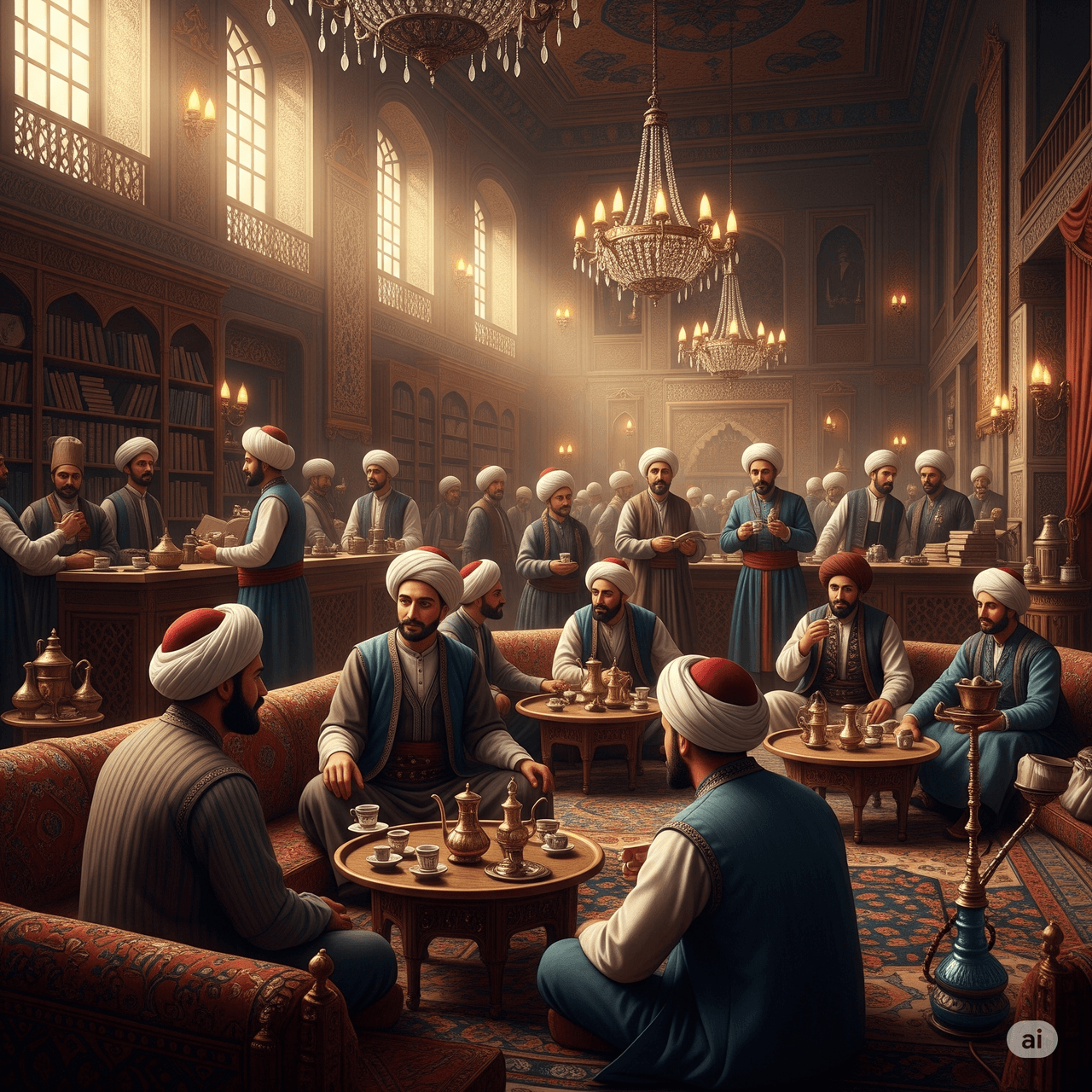
Ottoman Coffeehouse Depiction (Generated by Artificial Intelligence)
There are various theories regarding the origin of the name of coffee, a beverage distinguished by its unique aroma and non-thirst-quenching properties compared to other drinks. The term “coffee” is believed to derive from the region of Kaffa in Ethiopia, where the plant grows. This word, rooted in Arabic, was pronounced as “kahva” in early periods. Another theory suggests that “kahva,” originally referring to wine—a substance familiar in Arabic culture—evolved into “kahve.” The homeland of coffee, with its dynamic history, is Africa, but its earliest consumption occurred in southern Arabia. Its global dissemination was facilitated by Venetian merchants in the 17th century, which greatly increased its popularity. The importance accorded to coffee, which comprises over a hundred varieties, is extraordinary, particularly within Turkish culture. In the Ottoman Empire, Turks developed their own version, “Turkish coffee,” through distinct preparation methods and serving customs. Initially consumed only by palace elites, coffee gradually permeated broader society and became an indispensable part of daily life. As coffee became embedded in cultural traditions, its use extended beyond homes into public streets, giving rise to coffeehouses, institutions born of coffee’s unifying power. The earliest documented coffeehouses appeared in Mecca and Cairo in 1511, and by 1553, they had become prominent social and cultural fixtures in Istanbul. Over time, their numbers grew substantially, establishing coffeehouses as a defining and enduring feature of Ottoman socialization and culture.
The human need for socialization manifests in diverse ways across different geographies. For example, beer halls in Germany, pubs in Britain, and cafés in France are socialization spaces shaped by distinct cultural contexts in different societies.【1】Coffeehouses in the Ottoman Empire represent suitable and significant examples of such social practices. The original purpose of coffeehouses—to serve coffee—evolved over time. One major shift was their use as venues for political discourse. For instance, Sultan Murad IV regarded coffeehouses as a threat to his authority, perceiving them as gathering places for dissenters and agitators because'aThe forum where the public shared their news, opinions, and complaints about the state had the potential to become a political club.’【2】 Consequently, he ordered their destruction. Another function of coffeehouses was to provide social entertainment through performances. However, the intent behind organizing such events was not solely to meet social needs; proprietors also sought to attract patrons and gain competitive advantage over rival establishments.
Karagöz shadow puppetry and Meddah storytelling are cited as examples of entertainment offered in coffeehouses. Moreover, conversations held in coffeehouses were neither trivial nor insignificant. According to Peçevi, Customers often engage in heated literary discussions.【3】 In this way, poets and writers gained access to a critical and engaged audience. Coffeehouses thus became public spaces with distinct cultural characteristics, developing their own norms and traditions. It is a fact that coffeehouses held substantial and considerable importance and influence. Therefore, they can be regarded as the first true public spaces in the Ottoman Empire.
A notable feature of the widespread popularity of coffeehouses in Ottoman society is the absence of women in these spaces, indicating that coffee occupied a distinct and significant role in the private sphere. Although records concerning private domestic life are limited, coffee held considerable meaning within the home. In the private realm, coffee also functioned as a medium of socialization, much as it did in coffeehouses. It was regarded as an integral component of meals, during which family members discussed news, events, and personal matters. Furthermore, when analyzing Ottoman society, it becomes evident that women lacked common public spaces for social interaction. It is plausible that such private gathering spaces were created precisely through the ritual of coffee consumption. Gathering under the pretext of drinking coffee formed an essential part of women’s social life. Coffee fortune-telling emerged during these meetings as a means of passing time and subtly expressing opinions about one another. Additionally, the presentation of coffee held great significance in terms of the value placed on guests. The method of preparation, the style of the cup, the water served alongside, and the accompanying desserts all conveyed implicit messages. As a result, coffee carried distinct and meaningful roles within private domestic settings.
In conclusion, coffee holds an undeniable importance and multifaceted role in Turkish culture. Its rapid adoption and widespread use underscore its uniqueness, with no true equivalent in other traditions. Especially within the Ottoman Empire, the value and significance attributed to coffee are evident in numerous examples. The distinction in its use across public and private spaces can be clearly examined. Coffee fulfilled vastly different functions and carried divergent meanings in public coffeehouses and private domestic settings. By analyzing coffee use in both spheres, one can deduce key dynamics of Ottoman society.
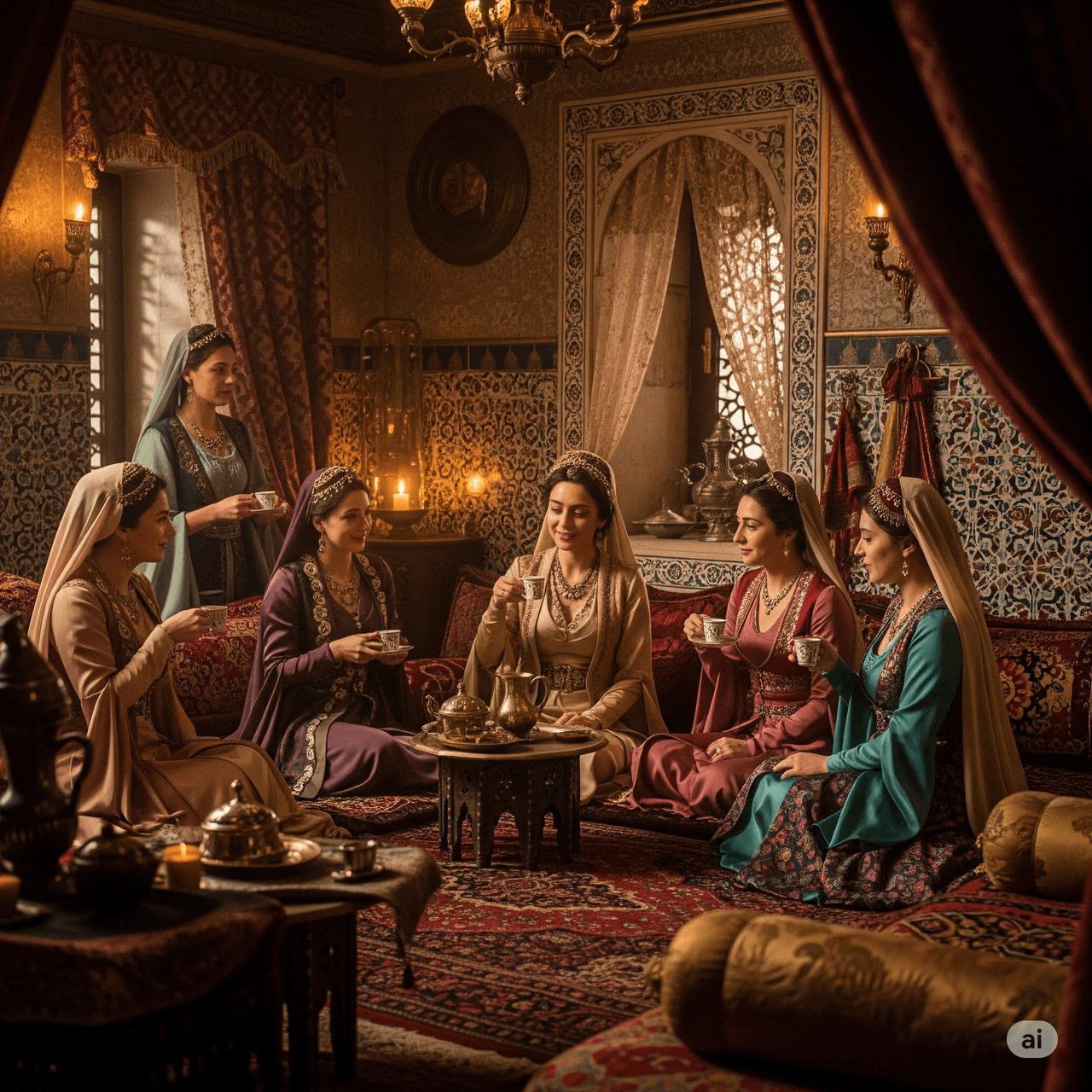
Ottoman Coffeehouse Depiction (Generated by Artificial Intelligence)
Boyar, Ebru. Osmanlı İstanbul’unun Toplumsal Tarihi. Translated by Serpil Çağlayan. 2017.
Dündar, Alper. “Kamusal Bir İletişim Mekanı: Kahvehane.” Kültür ve Mekan Araştırmaları, Bölüm No: 4. 2022.
Ervin, Martin. “Coffee and The Ottoman Social Sphere.” University of Puget Sound. 2014.
Gür, Nagihan. “Osmanlı Fal Geleneği Bağlamında Yıldızname, Falname ve Taliname Metinleri.” Milli Folklor. 2012.
Hattox, Ralph S. Coffee and Coffee Houses, The Origins of a Social Beverage in the Medieval Near East. Translated by Nurettin Elhüseyni. University of Washington: University of Washington Press. 1988.
Inalcık, Halil. Turkey and Europe in History. Istanbul: Eren Press. 2006.
Kaplan, Melike. “Bir Fincan Keyif: Kahvenin Öyküsü”. Yurt ve Dünya Dergisi. 2011. Kömeçoğlu, Uğur. “The Publicness and Sociabilities of The Ottoman Coffeehouse.” The Public. 2014. Accessed June 5, 2025.
Sadji, Dana. Ottoman Tulips, Ottoman Coffee: Leisure and Lifestyle in The Eighteenth Century. London: Tauris Academic Studies. 2007.
Çağlayan, Savaş. “Anadolu’nun İlk Kamusal Alanı: Kahvehane.” Muğla Sıtkı Koçman Üniversitesi Sosyal Bilimler Enstitüsü Dergisi. 2012.
[1]
(1) Çağlayan, Savaş. “Anadolu’nun İlk Kamusal Alanı: Kahvehane.” Muğla Sıtkı Koçman Üniversitesi Sosyal Bilimler Enstitüsü Dergisi. 2012, 96.
[2]
(1) Hattox, Ralph S. Coffee and Coffee Houses, The Origins of a Social Beverage in the Medieval Near East. Translated by Nurettin Elhüseyni. University of Washington: University of Washington Press. 1988, 90.
[3]
Hattox, Ralph S. Coffee and Coffee Houses, The Origins of a Social Beverage in the Medieval Near East. Translated by Nurettin Elhüseyni. University of Washington: University of Washington Press. 1988, 89.
Coffeehouses as Public Spaces in the Ottoman Empire
Coffee in the Private Sphere: Women and Domestic Culture
The Lasting Role of Coffee in Ottoman Society
