


This article was automatically translated from the original Turkish version.
Valentine's Day (Generated by Artificial Intelligence.)
Core Rituals | Gift-giving, card-sending, romantic dinners | ||||||||
|---|---|---|---|---|---|---|---|---|---|
Celebrating Groups | Lovers, spouses, family members, pet owners | ||||||||
Official Name(s) | Saint Valentine's Day | ||||||||
Date(s) | Every year on February 14 | ||||||||
Commercial Turning Point | The shift of Hallmark Cards to mass production | ||||||||
Sociological Status | A product of the 'Culture Industry', a global consumption day | ||||||||
Classic Symbols | Heart shape, Cupid (Eros), Red rose, Lace cards | ||||||||
First Literary Reference | Geoffrey Chaucer - The Parliament of Fowls (1382) | ||||||||
Core Myth | A priest who secretly performed marriages despite Emperor Claudius II's marriage ban | ||||||||
Person After Whom It Is Named | Saint Valentine (Valentinus) | ||||||||
Religious Origins | A Christian feast day proclaimed by Pope Gelasius in 496 | ||||||||
Ancient Origins | Roman Lupercalia Festival (February 13–15) | ||||||||
Saint Valentine’s Day, commonly known as Valentine’s Day, is a special day observed annually on February 14 in many countries around the world, particularly in Western societies. Its origins are rooted in both religious and secular traditions. Today, the date has become a phenomenon centered on the celebration of romantic love. In some communities, it is still regarded as a Christian commemorative holiday, while in the modern world it is more commonly defined as an event focused on “celebrating love” and as a commercial activity.
The historical roots of Valentine’s Day extend to the Lupercalia festival, held in pre-Christian Rome between February 13 and 15. This festival, dedicated to Faunus, the Roman god of agriculture, and to Romulus and Remus, the founders of Rome, was essentially a rite of fertility and purification. As part of the ritual, priests known as Luperci sacrificed a goat, symbolizing fertility, and a dog, symbolizing strength. They then cut strips from the goat’s hide and went into the streets, lightly striking women and crops with these strips. It was believed that this act would make women more fertile for the coming year and purify them from evil spirits【1】. At the end of the festival, a lottery system was practiced in which the names of young women were placed in a container and men drew names to be paired with a woman for the duration of the festival; historical records indicate that many of these pairings resulted in marriage【2】. By the late 5th century (AD 496), Pope Gelasius officially declared February 14 as "Saint Valentine’s Day" to replace the pagan Lupercalia festival【3】.

A Visual Depicting the Lupercalia Festival, Based on the Historical Origins of Valentine’s Day (Generated by Artificial Intelligence).
The Catholic Church’s records contain multiple accounts of Saint Valentine. At least three distinct figures named Valentine (Valentinus), who lived during the Roman Empire and were associated with February 14, are officially recognized by the Church. Each was a clergyman martyred for his faith, and over time their stories merged into a single symbolic hero. The most detailed account, based on historical documents and Christian legends, concerns a priest named Valentine who lived in Rome during the reign of Emperor Claudius II in the 3rd century AD. Emperor Claudius, arguing that married men were less courageous on the battlefield due to their family ties and that unmarried men made more disciplined soldiers, enacted a strict law banning young men from marrying. Valentine, who viewed this law as contrary to his faith and to love, secretly continued to perform marriages for young couples. When Roman authorities discovered his clandestine activities, he was imprisoned and executed around AD 270【4】.
Another significant legend states that Valentine was targeted not only for performing marriages but also for helping Christian prisoners, who were subjected to severe torture and held in Roman jails, to escape. A third, more romantic version focuses on Valentine’s transformation during imprisonment. While incarcerated, he formed a bond with the daughter of his jailer. According to the legend, Valentine miraculously restored her sight and, shortly before his execution, left her a farewell note【5】. The signature he added to the note, “From your Valentine,” became the earliest known written example of the Valentine’s Day card tradition and has endured as a symbol of the holiday.

A Visual Depicting the Legends of Valentine’s Day (Generated by Artificial Intelligence).
The association of Valentine’s Day with “romantic love” in its modern sense gained momentum during the Middle Ages. According to a popular belief in 14th-century England and France, February 14 marked the beginning of the birds’ mating season. The English poet Geoffrey Chaucer linked this natural phenomenon to human romance in his poem “The Parliament of Fowls,” helping to establish the day’s romantic dimension【6】. From the 15th century onward, poems and written messages called “Valentines” exchanged between lovers became widespread. The oldest surviving “Valentine” message was written in 1415 by Charles, Duke of Orléans, while he was a prisoner after the Battle of Agincourt, addressed to his wife from the Tower of London【7】.
From the mid-19th century onward, the Industrial Revolution transformed handmade cards into mass-produced postcards. The launch of Hallmark Cards in 1916 marked a turning point in the transformation of the day into a commercial industry【8】. Sociological analyses suggest that Valentine’s Day represents, within the Frankfurt School’s concept of the “Culture Industry,” a process in which emotions and love are commodified. Modernism, having excluded “emotion” from its rational systems, has reconfigured it within capitalist structures as a consumer object to ensure the system’s continuity【9】.
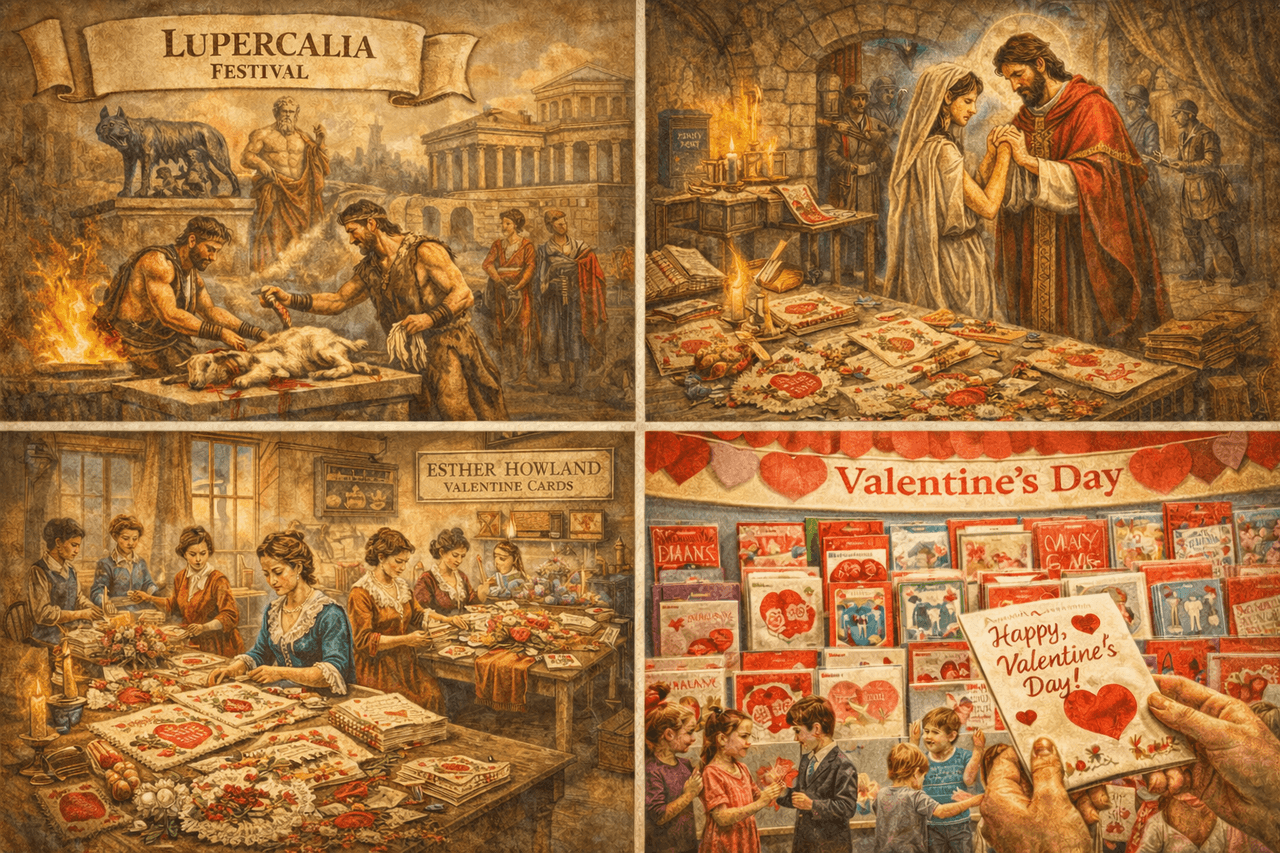
The practice of sending cards on Valentine’s Day has evolved historically from a personal literary act into a mass industrial activity. In the mid-18th century, handmade “Valentine” cards popular in the United Kingdom were adorned with lace, ribbons, and handwritten poems, featuring personalized designs. However, the Industrial Revolution of the 19th century transformed this tradition through advances in printing technology and declining paper production costs. The reduction in postal rates in Britain during the 1840s (the “Penny Post” system) made it easier for people to send written greetings, increasing demand for February 14 cards. In 1847–1848, Esther Howland’s workshop in the United States introduced the first mass-produced “Valentine” cards, using imported lace and embellishments from Europe, demonstrating the commercial potential of this market【10】.
At the beginning of the 20th century, particularly after the founding of Hallmark Cards in 1916 and the widespread adoption of offset printing technology, the industrial production of Valentine’s Day cards advanced significantly. This industrial shift standardized the expression of emotion, replacing personal letters written in one’s own words with “ready-made” products bearing pre-printed messages of affection. Factory-produced cards increased accessibility to the celebration, extending it to the middle and lower classes, while simultaneously embedding February 14 into a planned annual cycle of sales involving billions of units. Today, this tradition has expanded beyond romantic partners to include children giving cards to classmates and individuals sending them to family members, forming a broad consumer spectrum.

A Visual Depicting the Historical Evolution of the Card-Sending Practice on Valentine’s Day (Generated by Artificial Intelligence).
Although the origins of Valentine’s Day reach back to antiquity, its modern association with “romantic love” and gift-giving practices is primarily the result of a literary heritage that developed in Europe from the late Middle Ages onward. Until the 14th century, February 14 was viewed merely as a religious commemoration or a remnant of a fertility rite. It acquired new meaning through the influence of Geoffrey Chaucer, regarded as the father of English literature. In his epic poem “The Parliament of Fowls,” believed to have been written in 1382 to honor the engagement of King Richard II to Anne of Bohemia, Chaucer depicted birds gathering on February 14 to choose their mates. This work is historically recognized as the earliest written source in Western literature directly linking February 14 with romantic partner selection and love. Chaucer’s imagery established the cultural perception of the day as “the day when nature awakens to love,” laying the groundwork for the holiday’s transition from a religious context to a secular celebration of human affection.
This literary tradition evolved into a popular “romantic style” through the works of figures such as William Shakespeare in the 16th and 17th centuries. Shakespeare, especially through his play “Romeo and Juliet,” left a lasting legacy for the holiday. Blended with the influence of medieval chivalric culture, this literary current turned the practice of exchanging handwritten poems, love letters, and ornate papers called “Valentines” into a social norm. The letter written in 1415 by Charles, Duke of Orléans, while imprisoned after the Battle of Agincourt, and addressed to his wife from the Tower of London, is the oldest surviving written example of a “Valentine” and serves as historical evidence of this literary interaction.
From the 18th century onward, advances in printing technology and falling paper costs transformed the romantic language constructed by literature into printed booklets and “Valentine’s Day Guides” accessible to the general public. Young men began using pre-written poems and literary expressions from these guides to send messages to their beloveds, integrating high literature into everyday life and gift-giving culture. In the 19th century, this legacy spread beyond the borders of the United Kingdom to the rest of Europe and across the oceans to America, the “New World.” When Esther Howland, known as the “Mother of Valentine’s Day,” introduced her literary-themed cards adorned with ribbons and lace, the literary heritage became a commercial success, and February 14 became a global part of popular culture【11】.
Indeed, since the 1980s, as globalization accelerated, Valentine’s Day has moved beyond being a Western tradition to become a global phenomenon of “consumption frenzy” experienced simultaneously worldwide. During this period, capitalism, not merely as an economic model but as an ideological force shaping lifestyles, turned emotions into market commodities.
Today, February 14 represents a multi-billion-dollar economic sector that sustains industries such as fashion, cosmetics, jewelry, floristry, and technology. In this process, love is constructed as a performance indexed to consumption; the sale of millions of cards, flowers, and gifts annually reproduces the “homogeneous consumer type” desired by the system.
Arık, Bilal. “BİR KÜLTÜR ENDÜSTRİSİ ÜRÜNÜ OLARAK 14 ŞUBAT SEVGİLİLER GÜNÜ”. *İstanbul Üniversitesi İletişim Fakültesi Dergisi* | Istanbul University Faculty of Communication Journal, pp. 79–87. Accessed February 8, 2026. https://dergipark.org.tr/tr/pub/iuifd/article/244272
BBC. "Nereden çıktı bu 14 Şubat, Sevgililer Günü?" Accessed February 8, 2026. https://www.bbc.com/turkce/haberler/2015/02/150214_gch_sevgililer_gunu
BBC. "Sevgililer Günü (Valentines Day): Neden 14 Şubat günü kutlanıyor?" Accessed February 8, 2026. https://www.bbc.com/turkce/haberler-dunya-47235049
Canöz, Nilüfer. "KÜLTÜR ENDÜSTRİSİ ÜRÜNÜ OLARAK 14 ŞUBAT SEVGİLİLER GÜNÜ." *Selçuk Üniversitesi Sosyal Bilimler Enstitüsü Dergisi*, 34, 135–143. Accessed February 8, 2026. https://dergipark.org.tr/tr/pub/susbed/article/924783
Cheryl O'Malley. "The Origins of Valentine’s Day." medfieldhistoricalsociety.org. Accessed February 8, 2026. https://medfieldhistoricalsociety.org/the-origins-of-valentines-day/
Keyonna Summers. "The Hidden History of Valentine's Day." Accessed February 8, 2026. https://www.unlv.edu/news/release/hidden-history-valentines-day
Khan, Syed Muhammad. "Sevgililer Günü." *World History*. Accessed February 8, 2026. https://www.worldhistory.org/trans/tr/1-19420/sevgililer-gunu/
Çolak, Onur. "Aziz Valentine." *KÜRE Ansiklopedi*. Accessed February 8, 2026. https://kureansiklopedi.com/tr/detay/aziz-valentine-2
[1]
Syed Muhammad Khan, "Sevgililer Günü." World History, Erişim 8 Şubat 2026, https://www.worldhistory.org/trans/tr/1-19420/sevgililer-gunu/.
[2]
BBC, "Nereden çıktı bu 14 Şubat, Sevgililer Günü?" BBC, Erişim 8 Şubat 2026, https://www.bbc.com/turkce/haberler/2015/02/150214_gch_sevgililer_gunu.
[3]
BBC, "Nereden çıktı bu 14 Şubat, Sevgililer Günü?" BBC, Erişim 8 Şubat 2026, https://www.bbc.com/turkce/haberler/2015/02/150214_gch_sevgililer_gunu.
[4]
Syed Muhammad Khan, "Sevgililer Günü." World History, Erişim 8 Şubat 2026, https://www.worldhistory.org/trans/tr/1-19420/sevgililer-gunu/.
[5]
Syed Muhammad Khan, "Sevgililer Günü." World History, Erişim 8 Şubat 2026, https://www.worldhistory.org/trans/tr/1-19420/sevgililer-gunu/.
[6]
Syed Muhammad Khan, "Sevgililer Günü." World History, Erişim 8 Şubat 2026, https://www.worldhistory.org/trans/tr/1-19420/sevgililer-gunu/.
[7]
Cheryl O'Malley, "The Origins of Valentine’s Day." medfieldhistoricalsociety.org, Erişim 8 Şubat 2026, https://medfieldhistoricalsociety.org/the-origins-of-valentines-day/.
[8]
BBC, "Nereden çıktı bu 14 Şubat, Sevgililer Günü?" BBC, Erişim 8 Şubat 2026, https://www.bbc.com/turkce/haberler/2015/02/150214_gch_sevgililer_gunu.
[9]
Bilal Arık, “BİR KÜLTÜR ENDÜSTRİSİ ÜRÜNÜ OLARAK 14 ŞUBAT SEVGİLİLER GÜNÜ”. İstanbul Üniversitesi İletişim Fakültesi Dergisi | Istanbul University Faculty of Communication Journal, sy 80-81, Erişim 8 Şubat 2026, https://dergipark.org.tr/tr/pub/iuifd/article/244272.
[10]
Cheryl O'Malley, "The Origins of Valentine’s Day." medfieldhistoricalsociety.org, Erişim 8 Şubat 2026, https://medfieldhistoricalsociety.org/the-origins-of-valentines-day/.
[11]
Cheryl O'Malley, "The Origins of Valentine’s Day." medfieldhistoricalsociety.org, Erişim 8 Şubat 2026, https://medfieldhistoricalsociety.org/the-origins-of-valentines-day/.


Valentine's Day (Generated by Artificial Intelligence.)
Core Rituals | Gift-giving, card-sending, romantic dinners | ||||||||
|---|---|---|---|---|---|---|---|---|---|
Celebrating Groups | Lovers, spouses, family members, pet owners | ||||||||
Official Name(s) | Saint Valentine's Day | ||||||||
Date(s) | Every year on February 14 | ||||||||
Commercial Turning Point | The shift of Hallmark Cards to mass production | ||||||||
Sociological Status | A product of the 'Culture Industry', a global consumption day | ||||||||
Classic Symbols | Heart shape, Cupid (Eros), Red rose, Lace cards | ||||||||
First Literary Reference | Geoffrey Chaucer - The Parliament of Fowls (1382) | ||||||||
Core Myth | A priest who secretly performed marriages despite Emperor Claudius II's marriage ban | ||||||||
Person After Whom It Is Named | Saint Valentine (Valentinus) | ||||||||
Religious Origins | A Christian feast day proclaimed by Pope Gelasius in 496 | ||||||||
Ancient Origins | Roman Lupercalia Festival (February 13–15) | ||||||||
Historical Origins and the Stories of Saint Valentine
The Tradition of Sending Cards and the Industrial Revolution
Popularization and Literary Influence