


This article was automatically translated from the original Turkish version.
+1 More
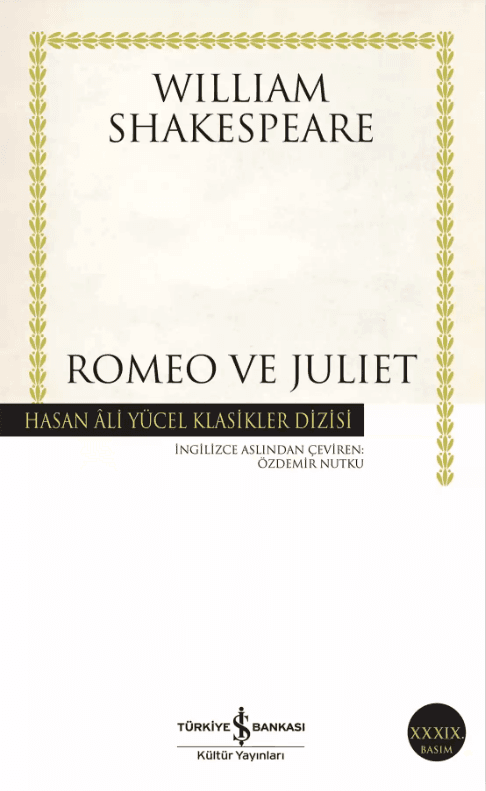
Author(s) | William Shakespeare | ||||||||
|---|---|---|---|---|---|---|---|---|---|
Translator(s) | Özdemir Nutku | ||||||||
Publisher(s) | Türkiye İş Bankası Kültür Yayınları | ||||||||
Publication Date | 10.06.2019 | ||||||||
Page | 133 | ||||||||
Language(s) | Turkish | ||||||||
Genre | Tragedy | ||||||||
Romeo and Juliet centers on the love between Romeo and Juliet, the children of two noble families linked by enemy. The long-standing hostility between the Capulet and Montague families in Verona determines the fate of the young lovers. Meeting at a masked ball, Romeo and Juliet fall in love without knowing each other’s identities. Even after learning they are from feuding families, they refuse to abandon their love and secretly marry. However, Romeo’s killing of Juliet’s cousin Tybalt alters the course of events and leads to his banishment from the city. Desperate to end their separation, Juliet plans to deceive her family by taking a potion that makes her appear dead. Her goal is to escape with Romeo. But Romeo, unaware of the plan, believes Juliet is truly dead and commits suicide. Upon awakening and finding Romeo’s lifeless body, Juliet also takes her own life. Game reveals the tragic dimensions of love and the destructive impact of family conflict on individuals.
Romeo and Juliet’s love for each other is shaped by love, pure and intense passion. Shakespeare emphasizes in this work that love is a force beyond reason and society norms. Yet this passionate love, unsupported by sufficient time and maturity, ends tragically.
The enmity between the Montague and Capulet families prevents individuals from making free choices. Romeo and Juliet, who wish to live their love, are constantly obstructed by their families. Shakespeare uses this theme to highlight the conflict between personal desires and traditional structures.
The progression of events is largely shaped by accidents and wrong misunderstandings. This situation suggests a fatalistic interpretation, implying that human control over life is limited. Romeo’s mistaken belief in Juliet’s fake death and the subsequent events reinforce a fate motif supported by dramatic irony.
The prolonged husumet between the families creates a constant atmosphere of violence in society. This condition is one of the key factors leading to the young characters’ tragic ends. Through this theme, Shakespeare demonstrates how social disputes transform into individual tragedies.
Romeo and Juliet attempt to choose their own paths in defiance of their families’ rules and demands. This represents youth’s idealism and desire for independence. However, their inexperience and impulsiveness become primary causes of the tragedy.
A young member of the Montague family. He is emotional and idealistic. After falling in love with Juliet, he is willing to risk everything for her. He defies his family and social norms for the sake of love. Yet his hasty decisions and intense emotions lead the events toward a tragic outcome.
A young daughter of the Capulet family. Initially appearing obedient and loyal to her family, she begins making independent decisions after meeting Romeo. She is intelligent, determined and courageous. However, the risky choices she makes for love end in death.
Romeo’s friend. He has a witty and sarcastic personality. He dies in a duel with Tybalt. This event provokes Romeo’s rage and leads him to kill Tybalt. Mercutio is a figure who embodies the play’s comic elements while laying the groundwork for the tragedy.
Juliet’s cousin. He is proud and combative. Driven by his hatred for the Montague family, he confronts Mercutio and kills him. His death at Romeo’s hands opens the door to the escalation of events.
The clergyman who performs the secret marriage of Romeo and Juliet. He seeks to reconcile the lovers and end the feud between their families. Yet his plans fail. Though motivated by peaceful intentions, the outcomes are tragic.
A noble young man who seeks to to get married Juliet. He is considered by Juliet’s family to be a suitable match. But Juliet does not love him. Paris represents societal expectations.
Romeo and Juliet is regarded as one of the most famous and influential examples of tragic love in West literature. Shakespeare’s work has been reinterpreted over the centuries in theater, literature, music and cinema.
Universal themes such as family pressure, individual freedom, social norms and the nature of love make the work timeless. The characters of Romeo and Juliet have become cultural archetypes representing the passion and helplessness of youth.
Work is evaluated as a source for understanding the relationship between the individual and society in educational curricula and art fields. As a dramatic text that questions the impact of social intransigence and authoritarian structures on individual, it is frequently referenced in numerous sociological and literary studies.
Folger Shakespeare Library. *Romeo and Juliet - Entire Play*. Accessed April 8, 2025. https://www.folger.edu/explore/shakespeares-works/romeo-and-juliet/read/.
Shakespeare, William. Romeo ve Juliet. Çev. Özdemir Nutku. İstanbul: Türkiye İş Bankası Kültür Yayınları, 2019.

Author(s) | William Shakespeare | ||||||||
|---|---|---|---|---|---|---|---|---|---|
Translator(s) | Özdemir Nutku | ||||||||
Publisher(s) | Türkiye İş Bankası Kültür Yayınları | ||||||||
Publication Date | 10.06.2019 | ||||||||
Page | 133 | ||||||||
Language(s) | Turkish | ||||||||
Genre | Tragedy | ||||||||
No Discussion Added Yet
Start discussion for "Romeo and Juliet (Book)" article
Themes
Love and Passion
Family and Social Pressures
Fate and Chance
Violence and Intransigence
Youth and Rebellion
Characters and Traits
Romeo
Juliet
Mercurio
Tybalt
Fr. Laurence
Paris
The Work’s Impact on Society